
























Author: Caroline Olsen-Van Stone
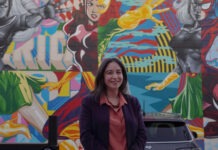
Pulitzer Prize winner, former documentary filmmaker and New York Times writer are just a few of the hats that Occidental alumna Andrea Elliott ’96 wears. Her Pulitzer story “An Imam in America” was part of the subject for her talk last Tuesday, Feb. 19. She shared her experiences covering the lives of Muslims in America following 9/11. The Alumni Association funded her two-day visit to Occidental and awarded her with the 2007 Distinguished Alumni award.
Elliott spoke on her experiences writing for the Miami Herald and the New York Times. Her story of getting to know the imam of the Brooklyn Bay Ridge Islamic Center, Sheik Reda Shata, was filled with hard lessons, challenges and a new understanding of Islam both in and outside America.
“The day I arrived to interview Sheik Reda, I was met at the door by a man in a suit who didn’t smile,” Elliott said. “When we began the interview, he turned on a tape recorder, saying ‘we record all interviews.'” Later, she found out that Shata had never been interviewed before and had been counseled not to allow a reporter to interview him.
“The press had a steep learning curve, they scrambled for experts [on Islam after 9/11],” she said. This resulted in a very dichotomous representation of Muslims, Elliott said-one of militant, extreme Islam and the other of progressive, extremely liberal Islam.
Elliott said earning Shata’s trust took a long time. To convince Shata to work with her, she and Times photographer James Estrin took him out to dinner several times to establish a rapport. She eventually told Shata that she wanted him to help her understand his community. “Imagine you’re making a film of your life,” she said to him. After this, he was willing, but she still needed to develop a trusting relationship with him.As an outsider to Islamic and Arabic culture and religion, Elliott had to do a lot of learning on the job. She read 10 expert-recommended books on the subject before she began writing about Islam in America.
Her knowledge of Islam has become much more nuanced than when she began coverage of Islam in America in 2003, when she started going to mosques in Midwood and to Little Pakistan to do a short article about the Special Registration policy. “I didn’t know what to expect,” she said. She found boarded-up shops, abandoned mosques and schools that reported decreased enrollment of Southwestern Asian students.
Interviewing a community so fearful of reporters taught Elliott to be flexible and open to new power structures. Ordinarily, she explained, she would have contacted the head of the board of directors of the mosque. In this case, however, her best informants turned out to be a pet shop owner and an engineer, two other board members. “It’s important to understand who are the true gate keepers,” she said.
Shata was educated at the prestigious Al-Azhar University, analogous to Harvard and other American Ivy Leagues. Elliott said he was very well-read, and came to America highly recommended. In Germany, where he was the imam before coming to Brooklyn, he was largely separate from secular forces. When at Bay Ridge in post-9/11 America, he had to take on a lot more than purely religious questions. “Can I eat a Big Mac? Can I serve alcohol?” Elliott recalls from her interviews with him. At first, he called experts in Egypt to get their advice, but now relies on his ability to “reconcile Islam’s traditions with a life in America,” Elliott said.
Today, Shata lives in a New Jersey suburb, where he makes a higher salary as an imam and he and his family have more space. “He’s a diehard fan of Costco,” Elliott said.
Shata explained to Elliott that he had turned from a “person of rigidity to a person of flexibility” through his experience as an imam in Brooklyn.
Student reactions to Elliott’s presentation were largely positive. Many who attended found the talk enlightening. Armanda Dingledy-Rodie (senior) said, “I loved her talk. The way she presented the story was really insightful and she made it accessible to those who do not have a background with [the subject of] Islam.”
In addition to the educational value of the talk, students found Elliott’s presentation interesting “I like that she used personalized and factual information at the same time,” Colleen Ward (senior) said.
This article has been archived, for more requests please contact us via the support system.