



























Author: Anahid Yahjian
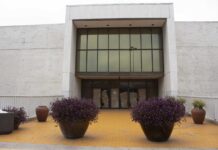
Campus Safety reported that a leak from the Mary Norton Clapp Library air conditioning system flooded several tiers and damaged tens of thousands of books on Saturday, March 1.
Systems Librarian John de La Fontaine arrived at the library Saturday morning to do his usual backup of the OASYS database system. Instead he was faced with two inches of water blurring the ground floor of the building. He immediately called Campus Safety.
Officers followed a steady stream of water pouring from the ceiling of the first floor all the way up to the flooded mechanical room above the third floor. Water had been rushing from the middle HVAC air-conditioning unit throughout the previous night, making its way through the concrete of the first, second, third and fourth tiers until it puddled on the carpeting of the “stacks” on the ground floor.
An estimated 21,000 books were damaged, according to head of Library Access Services Laura Serafini. Faced with a deadline of 48 hours to get the books into a refrigerator in the Johnson Student Center before the potential onset of mold growth, a team of library staff and student volunteers came together in the library’s snack lounge to perform the massive task of moving all the damaged books out of the tiers, scanning them into the computer system, boxing them and moving them to the Johnson Student Center. The boxes were shipped to a plant in Texas Tuesday, as part of a 30-day freeze-drying process that does not necessarily guarantee that all the books will be returned in good condition, Serafini said.
“We’re so frantic to get them out of here,” Interim College Librarian Emily Bergman said Saturday as she worked feverishly with Accounting Clerk Miwa Hamasaki to finish up packing the load of wet books in the cart at their scanning station.
A total of eight stations had been set up by the end of the day, with Catalog Librarian Mark Braden, ITS Network Security Specialist Wesley Tomatsu ’01, Circulation Manager Michael Kerwin and Acquisition Librarian Lindsey Reno working with Bergman, Hamasaki and de La Fontaine since the leakage was first reported. A crew of movers were brought in Saturday night to help move the boxes into the refrigerator.
“It’s an example of how the entire campus comes together,” Serafini said. Calling the group effort a testament to the “Oxy Family,” she added that one library staff member missed out on his wife’s birthday in order to help save the books. The moving company, Expedite, which was brought in to deliver the new furniture into Rangeview Hall, completed the circle. “I can’t tell you how great they were,” Serafini said.
Environment Health and Safety Manager Bruce Steele said that the middle HVAC unit had “sprung a leak” in its 1/2 inch cooling deck at some point in the night, leaking water out of the corroded pans underneath the unit. Because there is no secondary containment unit in the structure, the water dripped through the cracks in the concrete of the respective floors. The same unit previously leaked in January, but was repaired, while the first unit of the trio sprung a leak Monday morning into one of the library’s hallways, according to Steele.
Serafini said that students and staff members are continuing to find wet books, with plans to dry them on campus through a process called interleaving in which “blotter-type” paper is placed between each page of a book until all the moisture has been absorbed. Once the books return from the freeze-drying plant, they will have to be opened one by one to determine whether they are salvageable.
“We’ll probably lose maybe 25 percent of the collection,” Serafini said.
Steele said the “best speculation” is that the HVAC units were “upgraded in 1970 during the New Wing addition.” He anticipates new coils will cost around $8,000 per unit and is pushing for the installation of a secondary containment unit as well as a water alarm.
“We don’t want this to happen again,” he said.
This article has been archived, for more requests please contact us via the support system.