




















Author: Caroline Olsen-Van Stone
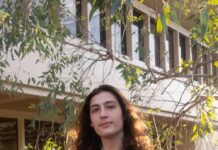
Though Derek Ross (senior) spends most of his time in his Norris Chemistry lab, lately his attention has been divided. Chemistry major Ross has re-discovered art.
“I was totally an art kid,” Ross said, chuckling a little. Attending the USC Performing and Visual Arts magnet elementary school in Los Angeles, he had no inkling of his future passion for science.
He took a hiatus from art until high school, when he enrolled in a ceramics class. Making fun of his poor attempts at drawing, he explained that his talent lies in “thinking in three dimensions.”
Though he loved ceramics and throwing pots on the wheel, he discovered his love of science in his second year of high school. His artistic endeavors became a low priority. When he is not working on his research, which involves synthesizing Prozac, he is grading for the infamous Organic Chemistry class.
Last semester, however, he decided to enroll in the ceramics class. He said this class was very structured, but he did find ways to create some off-the-wall pieces. When assigned to make a set of cups, he made them with handles that were crucified Christ figures.
“Taking art classes allows me to be creative in a different way than I have to be for science,” he said.
This semester, he is taking sculpture with Studio Art Professor Mary Beth Heffernan. Initially, he decided to take it because it sounded easy, even though he has a background in art. He convinced a fellow chemistry major to take the class with him, but that student dropped the class after the first day.
“I think [Heffernan] might have scared him. We could tell this class was going to be a lot of work,” he said.
Wanting to impress Heffernan, he made a large trenchcoat using wire for the first assignment, which was to re-create an article of clothing with wire. “I knew I had to pull off something big,” he said.
The next assignment was to make an enlarged version of a small everyday object using plywood, a very cheap material. Ross made a giant Prozac pill. This is appropriate given his research, which involves synthesizing Prozac.
Part of the assignment was to challenge ideas about high versus low art. Ross explained the use of Prozac, a “blockbuster drug” consumed by much of the public, to make people happy using high science. To make it out of plywood is to play with high and low art and science.
His application of science to art did not stop there, however. He also researched how to make the ends of the Prozac sculpture into geodesic domes. This involved calculating the correct angles of a second frequency geodesic dome, which he did online.
This piece impressed Heffernan. “This work was not only technically very difficult, but also resonates on multiple levels. It is a dark and funny commentary on how people try to improve themselves,” she said. He achieved this concept by combining the geodesic dome-an icon of idealism and utopian ideas designed by Buckminster Fuller, the antidepressant Prozac-and plywood as emblematic of the do-it-yourself movement, Heffernan said.
When he’d finished with the plywood sculpture, “I told my research advisor that I had succeeded in making Prozac,” Ross said.
“My research advisor got a little angry with me for spending so much time out of the lab, but truthfully, I am totally obsessed with my [chemistry] work,” he said.
His last project was perhaps the most innovative in using science to create art. The class was instructed to re-appropriate an object, or to transform an object.
With encouragement from his research advisor, he decided to transform an object on a molecular level. “I didn’t just want to melt plastic,” he said.
The object he chose to transform: pennies. He knew that one could use copper sulfate to grow crystals, but didn’t know if he would be successful.
The process from penny to crystal is a complicated one. First, he used hydrochloric acid to dissolve the zinc center out of the pennies. Then he cleaned the copper penny shells and used nitric acid to attack the copper. After this process, he was left with copper nitrate, which he mixed with sulfuric acid to make copper sulfate. He added water to the copper sulfate and let it evaporate. After a week, he found bright blue crystals had formed.
“You can do this after the first semester of General Chemistry,” he said. Though beware, he warned, that the materials used in this process are very dangerous if not handled properly.
Delighted, he began to think of how he would integrate the copper sulfate crystals and pennies into a sculpture.
He wanted to make a sculpture that would present one of the largest blue crystals that grew. He began melting pennies again, and came up with the idea to make them into petals. He described his method for creating the petals as “melt, splatter and piece together.”
Adding chlorine to some of them produced a varied patina of copper, blue and black.
Ross cites depression as one of the themes of his work, because he works in synthesizing the antidepressant Prozac. He said his sculptures are likely to evoke isolation and desolation, especially this one.
“I’ve tried to convey a sense of uneasy isolation, gloom and pain. It is alone, not in a bouquet or bush. It is dark and dirty. But sitting in the center is a brilliant blue crystal,” he said in his artist statement.
The petals’ rough texture and blotchy colors contrast sharply with the pure, bright blue crystal in the center. “This piece seems lonely. It’s like a post-apocalyptic flower,” he said. “But it can be interpreted any way you want.”
He struggled with coming up with a title, but when he noticed that fellow classmate Gabi Gutierrez (senior) called it “A Cents of Depression” on her Facebook profile, he knew he had found an ideal title.
Heffernan described Ross as the kind of student teachers appreciate most. “He inspires others students because he is intellectually curious,” she said, “and he has taught me a lot. He has certainly upped the ante for next year’s students.”
Ross has agreed to create a display of the intermediate steps between penny and crystal that Heffernan plans to show her class when she presents the appropriation and transformation project next year.
“Science and art are both very creative processes. Science translates pretty well into thinking critically about any other subject, including art,” he said.
“Derek not only has this intense interest in chemistry, but is also a talented artist. It is delightful,” Heffernan said.
Next year, he will begin UCLA’s graduate program in organic chemistry doing work similar to his research while at Occidental.
His pieces, and his sculpture classmates’, are on display in the Weingart Art Gallery.
This article has been archived, for more requests please contact us via the support system.