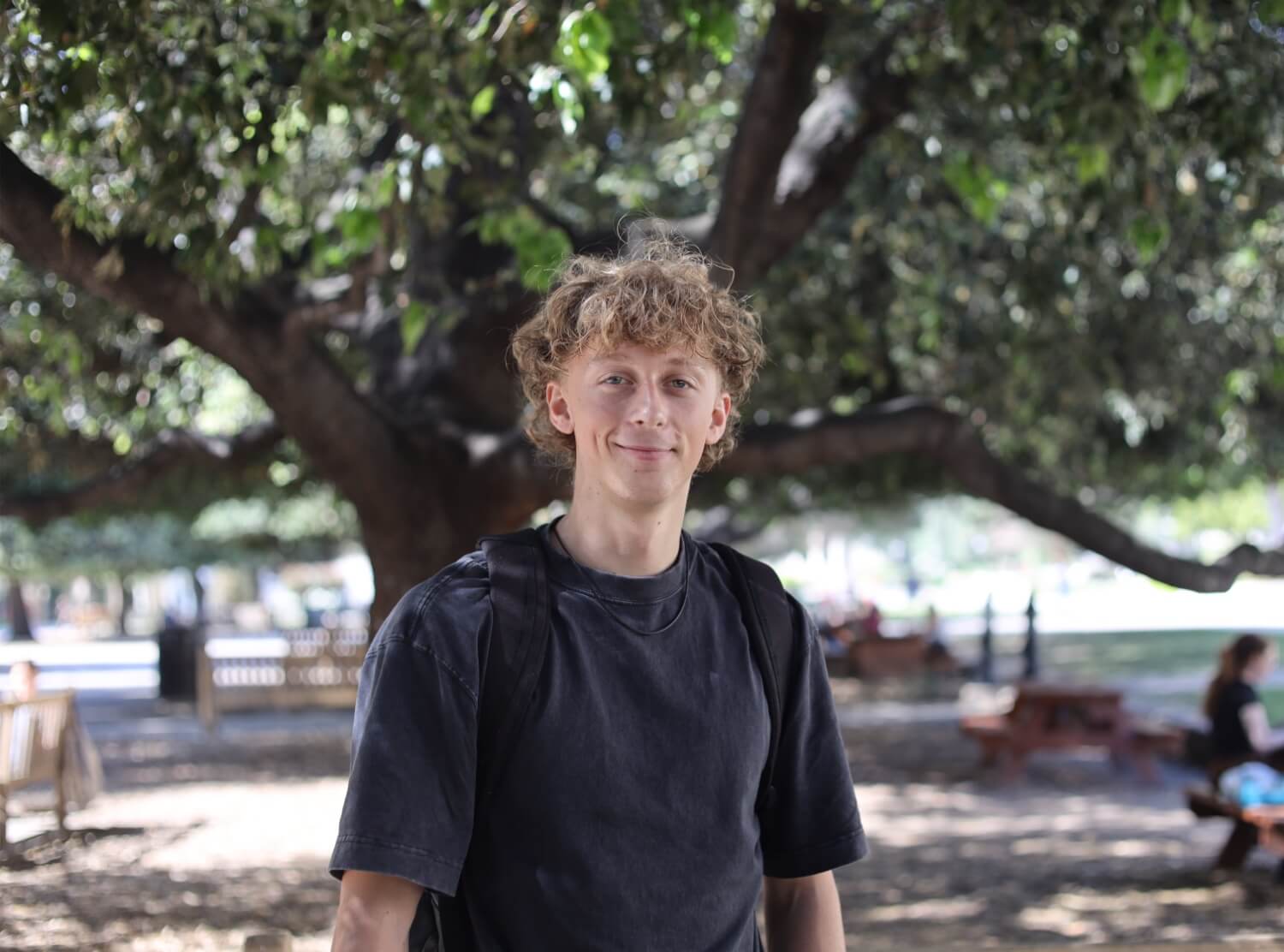
Rachel Aujero (senior) and Daniel Rowe (sophomore) led the Occidental golf teams to a strong finish at the recent Cal Lutheran Invitational, with the women’s team finishing second out of seven teams and the men’s team finishing third out of nine teams. With the golf season ending in April, the Cal Lutheran showing is one of the last golf events before bothteams attend the SCIAC conference finals April 23–25.
Head coach of both the men’s and women’s golf teams William Morris said Aujero and Rowe are both deserving of Athlete of the Week recognition.
“Rachel and Daniel are both excellent players and outstanding people,” Morris said via email.
Rachel Aujero
Rachel Aujero (senior) at Occidental College in Los Angeles, CA. March. 25, 2026. Isabel Marin/The Occidental
Aujero placed third overall and first on the women’s team, bolstering her record as one of the Tigers’ strongestgolfers.
According to Aujero, not only was the Cal Lutheran course windy, but the event itself was long.
“We even [used] golf carts because [it was] so long,” Aujero said. “Maintaining my head for the whole six hours was the toughest battle of playing that event.”
Aujero said the mental aspect of the game is important, and that every event is different.
“A huge part of my preparation is taking care of myself and being centered when I work in practice,” Aujero said.
Aujero said the team’s encouragement has also been important to her success.
“I think the success I’ve had this season has had a lot to do with our younger players being really supportive, and taking it as seriously as I take it,” Aujero said. “They have been great cheerleaders — but they’ve also played really well.”
Aujero said she feels good about the rest of the golf season.
“I’m really proud of the girls — they’ve handled the pressure really well this year,” Aujero said. “Our schedule is not easy. So, I feel pretty good about it. I’m excited for championships at Santa Anita — I think we’ll do really well.”
Rachel Aujero (senior) swings and follows through competing in the SCIAC #1 Golf Tournament hosted by Cal Lutheran at Olivas Links in Ventura, CA. Feb. 22, 2026. Courtesy of Freelance Photographer Sam Leigh
Aujero has played golf for the women’s team since the 2022–2023 season, when she had the best score on the team at the SCIAC finals. Aujero said she has been playing golf since she was eight, and that choosing to play golf at Occidental has worked out well.
“I really liked [Occidental] for the academic aspect,” Aujero said. “I still wanted to be a student as much as an athlete, which is the classic DIII response.”
Morris said via email that Aujero has been a leader and one of the best players in the SCIAC conference.
“Rachel is our two-year women’s captain, a senior and a four-year veteran,” Morris said. “She has been an all-SCIAC performer for the past two years.”
Looking forward, Aujero said she will continue to play golf after her time at Occidental.
“I think playing golf for Oxy is the highlight of my Oxy career,” Aujero said. “I’ve gotten to do some really amazing things outside of golf, but I think that I wouldn’t have had as robust of an experience if I hadn’t been able to play college golf. Golf will be a lifelong thing for me. I’m not done with it yet.”
Daniel Rowe
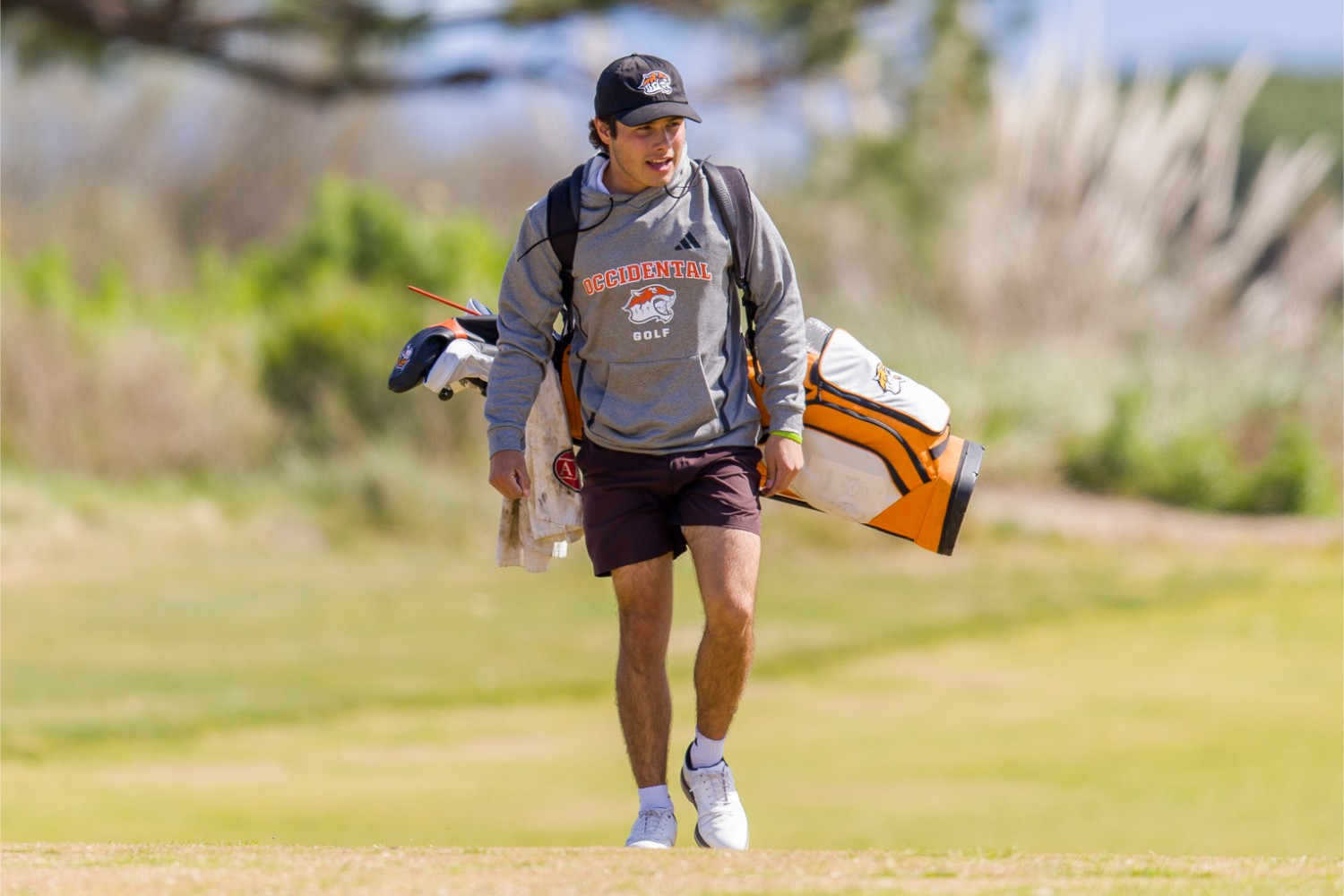
Daniel Rowe (sophomore) competing in the SCIAC #1 Golf Tournament hosted by Cal Lutheran at Olivas Links in Ventura, CA. Feb. 22, 2026. Courtesy of Freelance Photographer Sam Leigh
Daniel Rowe tied for seventh overall at the Cal Lutheran Invitational. Rowe’s showing at the invitational continued a series of strong performances in his first season with the Tigers after transferring from Northwestern Nazarene University last year.
Rowe said the Cal Lutheran Invitational was a windy event, but that he has experience playing in windy conditions.
“It was blowing pretty heavy,” Rowe said. “Wind was definitely a factor […] the confidence of knowing how to play in wind helped me play past a lot of the field, which was nice.”
Rowe said he thinks the team has a good chance of winning the SCIAC conference finals this year, and that the team’s performance at the Cal Lutheran Invitational will add momentum.
“The only other team that I’d expect to do well is Claremont,” Rowe said. “I’ve seen the work that we’ve put in this season, and I think we have a really good chance [of] beating them and coming out ahead during the conference finals.”
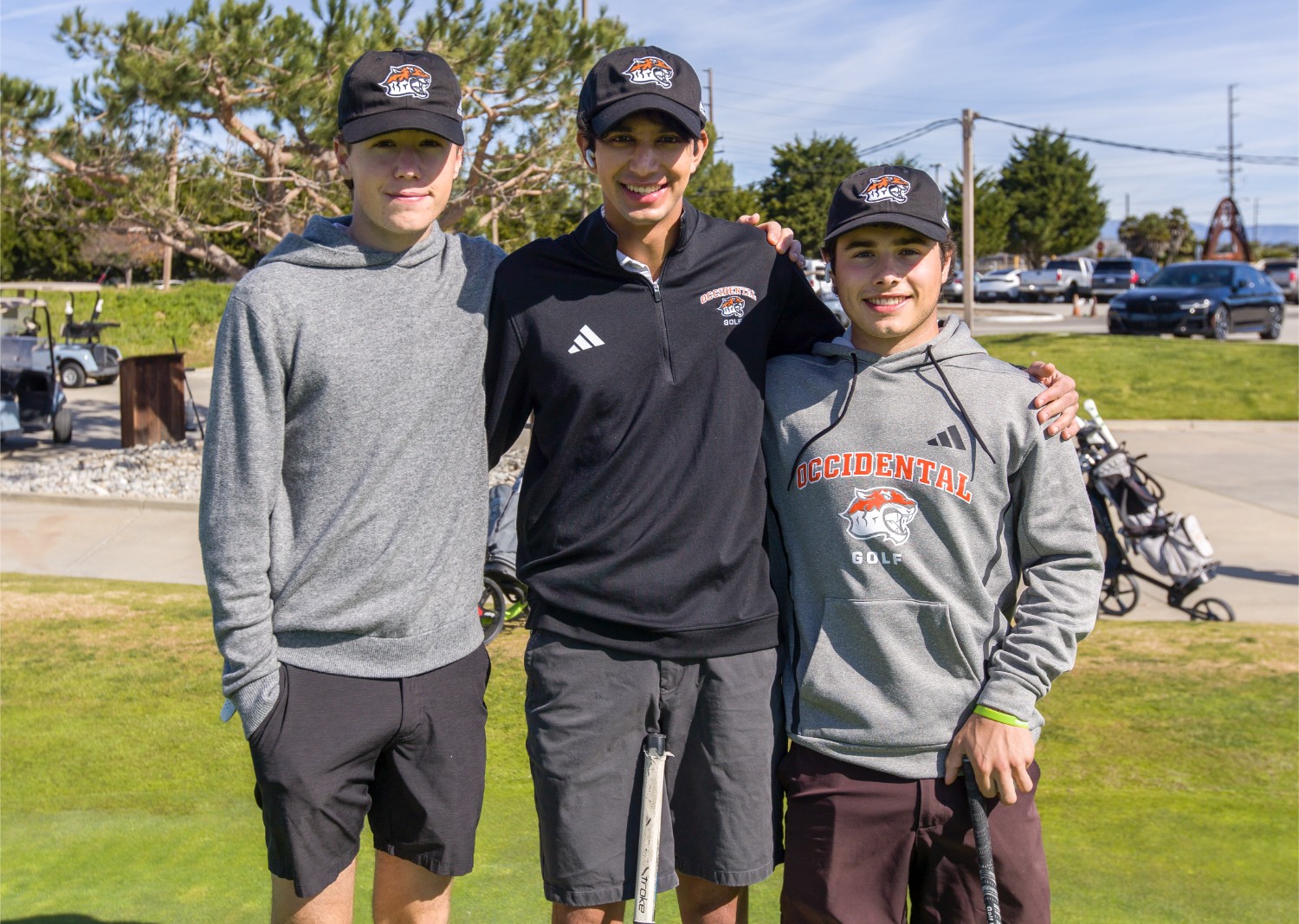
Daniel Rowe (sophomore) and teammates at the SCIAC #1 Golf Tournament hosted by Cal Lutheran at Olivas Links in Ventura, CA. Feb. 22, 2026. Courtesy of Freelance Photographer Sam Leigh
Rowe’s first season with the Tigers began with an excellent performance at the California State Intercollegiate this past September, where he placed fourth overall and first among the Tigers.
Rowe said the Occidental team does a good job of keeping morale high and spending time together outside of golf.
“We all hang out together, whether that’s on the course, on the weekends […] we all just have a really good time together,” Rowe said. “It’s really good for the team spirit aspect of it — because we all know each other really well, it’s easy to boost any one of us up if we need it.”
Daniel Rowe (sophomore) competing in the SCIAC #1 Golf Tournament hosted by Cal Lutheran at Olivas Links in Ventura, CA. Feb. 22, 2026. Courtesy of Freelance Photographer Sam Leigh
Morris said Rowe has been exceptional all year.
“He is very passionate and works extremely hard on his game,” Morris said via email. “He transferred into Oxy this year from a Division II institution and we are so fortunate to have him. We expect great things from him during his Oxy career.”
Rowe said he wanted to come play golf at Occidental after deciding to transfer last year.
“I talked to the coach here, and I talked about coming here when I was in high school,” Rowe said. “When I entered the transfer portal, I knew that I wanted to come here.”
Occidental faculty are bringing their research off-campus through a new lecture series, OxyTalks “On Tap.“ These events — intended for Occidental students and staff as well as local community members — have been held at Kiez Küche & Beer Garden, a German restaurant and ale house on York Boulevard. Occidental’s Center for Research and Scholarship (CRS) organizes these events.
Director of the CRS and Associate Professor of Cognitive Science Sasha Sherman said the CRS is focused on professional development for faculty members.
“It’s about amplifying faculty research on and off campus and thinking about the ways that we can tell Oxy’s faculty stories,” Sherman said.
Inspired by a nationwide event series Lectures on Tap that many of the college’s faculty participate in, Sherman said the CRS wanted to create a centralized program to facilitate community outreach and showcase work.
“The idea [is] that we could talk about our work in this more casual, intimate setting of a restaurant and also contribute to a local business,” Sherman said.
Sherman said Lectures on Tap uses a model that connects academics with bars and allows professors to present their work in a more accessible space. This model has been used across colleges and institutions to allow faculty to share their work, Sherman said, and Lectures on Tap centralizes the process by making it more available to bars and professors.
While OxyTalks “On Tap” bears resemblance to Lectures on Tap, Sherman said the college’s program is not in connection with the larger event series.
“It’s more so modeled off of Lectures on Tap, which is based on an old model,” Sherman said. “What Lectures on Tap does is they go around to many different bars, [but] we’ve decided we want to stay in our community.”
Sherman said by hosting events off-campus, the CRS is able to welcome more people than they might otherwise see at a talk on campus.
“We’re hoping to get a bigger and broader audience,” Sherman said. “In our ideal world it would be a mix of Oxy community and our local community.”
Assistant Professor of Cognitive Science Stephanie Nelli gave the most recent lecture March 25 at Kiez, titled “AI & Society.” Nelli said that as a researcher on AI, she enjoys getting direct information on what people are interested in when it comes to her area of expertise.
“For me, selfishly, it’s interesting always to see what and how people are thinking about AI, what the kind of ‘common knowledge’ is about AI and what people are concerned about,” Nelli said.
Violet Schultz* (senior), who attended the most recent OxyTalks “On Tap” event, said that even after graduation, she would consider coming back to off-campus Occidental events like these.
“If I’m in the area, and the talks are open to the community, then [I] definitely [see myself coming back],” Schultz said. “It was a great venue, especially being in Southern California.”
Schultz said she learned a lot from Nelli’s talk and from hearing community members’ questions afterward.
“[The talk was] a good supplement to what we’re learning in the classroom, and it was good meeting some community members who have similar interests,” Schultz said.
According to Nelli, around 25 people attended the event, with an even split of Occidental-affiliated attendees and community members.
Nelli said that one attendee, a science fiction writer, came to the event from Torrance. She said there is both a lot of interest and a lot of fear around the topic of AI. Nelli said she sees it as her responsibility as a professor and academic to help educate the public about AI.
“I think there’s a vague sense of fear about AI. But also, most people, fair enough, aren’t going to go get a math degree or computer science degree or cognitive science degree,” Nelli said. “So I think being able to communicate with [the general public]; it might not make them less fearful but at least their fears are grounded in some understanding.”
Nelli said giving this lecture is an opportunity for her research to have a greater impact outside of the academic and professional circles she works in. According to Nelli, now is a critical time for sharing knowledge with those who are not in higher education settings.
“I think that right now in this country, across the world […] I think there’s some distrust of intellectuals and academics and universities,” Nelli said. “While I don’t think it’s totally deserved, I don’t think it’s totally undeserved.”
Nelli said she thinks it is the responsibility of professors and academics to meet people where they are and to open up learning to everybody, especially those outside of academic institutions. Nelli said she sees this kind of program as an opportunity to do this.
“It’s also on professors and educators and scientists to make their work digestible, and to disseminate it, and not to look down their noses at people who don’t understand […] and not to just complain about the fact that nobody trusts us anymore,” Nelli said.
According to Nelli, as AI becomes more integrated into society, people will interact less with each other and more with AI models. Nelli said that OxyTalks “On Tap” gives the community the opportunity to reconnect with one another and have conversations.
“I think one amazing thing [about the event] […] is that we’re just a bunch of people,” Nelli said. “We’re talking about AI, but we’re talking to each other about it and exchanging ideas. We’re putting some of that humanity back.”
*Violet Schultz is a former copy editor for The Occidental.
Contact Amelia Darling at adarling@oxy.edu and Claire Wilson-Black at wilsonblack@oxy.edu.
The Sustainability Committee of the Eagle Rock Neighborhood Council (ERNC) is a body of eight elected volunteer members. According to Denys Hemen, chair of the committee, the group acts as an advisory body to the ERNC board to address local sustainability issues. Hemen said he has served in the committee’s leadership position for seven months and has sought to expand accessibility and interest in sustainability as a community issue.
According to Evan Lieber (senior), who serves on the ERNC’s Outreach Committee, Hemen brings knowledgeable leadership and a commitment to public service to the sustainability committee.
“I think that Denys [Hemen] is a great person to be leading it,” Lieber said. “He takes his role very seriously and wants to encourage Eagle Rock to be a sustainable community.”
According to Hemen, the sustainability committee drafts community impact statements on local issues with input from both the committee and community members. Then, Hemen said the ERNC board approves these statements and forwards them to Council District 14 (CD14) to ensure that community perspectives are represented in the district. Hemen said the volunteer nature of the committee emphasizes public service and a genuine commitment to sustainability.
“We’re all there because we care about our neighborhood,” Hemen said. “It’s an endorsement of the community,” Hemen said.
Hemen said the committee passed a community impact statement to support LA Climate Week and involve Eagle Rock in city-wide programming April 8–15. LA Climate Week is an opportunity for grassroots organizations and local governance across LA to convene, according to Hemen.
“You’ve got these small groups of three people to [groups with] over 200 people,” Hemen said. “LA Climate Week is a chance to focus and showcase their work at different locations all over LA.”
In addition to drafting community impact statements, Hemen said the sustainability committee hosts field deputies from CD14 at committee meetings, who report to either an assembly member or the district representative.
“If someone has an issue, there’s a field deputy right there so that [any] person can go outside and talk to them immediately,” Hemen said.
The sustainability committee is tasked with implementing two public events per year, and they’re currently planning a free repair cafe in collaboration with CD-14, which will take place May 3, according to Hemen. Hemen said the event will offer direct public service to community members by providing an opportunity to bring broken household items to volunteer repairers.
“It’s more of a direct action to keep [items] out of the landfill — bring them here and we’ll have a volunteer who may be able to fix it,” Hemen said. “That’s one less thing that wasn’t shipped or packaged, and one less thing in the landfill.”
Lieber said the repair cafe event was initially designed by Tekle Skiles-Januta, who serves as Youth Director at ERNC, and strives to show what community sustainability looks like.
“If you have something that’s torn, you can learn how to sew it up,” Lieber said. “People really care about this, and it’s clear that [the sustainability committee’s] efforts are showing through.”
According to Lieber, student groups at Occidental have partnered with the sustainability committee for events in the past — Sunrise Oxy and Touchdown Thrift tabled at the committee’s annual native plants giveaway in November.
“Oxy is a huge part of the neighborhood, but it’s not the only part,” Lieber said. “I think sustainability is a great way to explore community, and I think that the neighborhood council has been doing a great job, but there’s always more to do.
According to Aiden Thatcher (sophomore), Student Body Officer of Occidental’s Sustainability Fund, the ERNC Sustainability Committee will be tabling at Occidental’s Earth Month Quad Fair April 14. Thatcher said sustainability issues aren’t limited to campus, and the ERNC provides support to address issues on a neighborhood scale.
“There are many ways people can contribute and be good stewards within their community,” Thatcher said. “Sustainability offers a lot of opportunities to come together as a community because it is rooted in everyday action and community spaces.”
According to Hemen, the sustainability committee hopes to increase community input at their monthly meetings, which occur at Eagle Rock City Hall on the second Wednesday of every month at 6:30 p.m.
“Our priorities are whatever Eagle Rock’s priorities are,” said Hemen. “We break down the barriers between a person and the district.”
In Boyle Heights alone, more than 1,900 lights were reported as out last year, and Jurado said her office has brought that number down by nearly 500.
“The fact that we’re nearing the 500 mark is pretty remarkable,” Jurado said in an interview with The Occidental. “We’re trying to figure out how we can continue to keep attacking that goal.”
Mason Santa Maria, communications deputy for CD14, said the initiative reflects Jurado’s belief that darkness has real consequences for residents.
“She knows that when the streets are dark, people feel less safe,” Santa Maria said. “Kids walking home, seniors, workers, small businesses, they’re all affected by that.”
The initiative, run through a dedicated repair crew deployed across CD14, targets neighborhoods that Jurado’s office says have faced decades of city neglect. The Bureau of Street Lighting (BSL) receives less than 1 percent of the city’s budget, according to Santa Maria, leaving individual council offices to fill the gap or leave residents in the dark.
“BSL gets this tiny portion of the city budget that really doesn’t fit the needs of Angelenos,” Santa Maria said. “[To] get to the level that Angelenos deserve, you really need a team focused specifically on CD14.”
Darren Gold, president of the Historic Highland Park Neighborhood Council (HHPNC), said he has seen the effort’s results firsthand in Highland Park.
“There were blocks, full blocks that had no lights on them, and they’ve been repaired,” Gold said. “It feels like you can walk in certain places at night that maybe you wouldn’t have before.”
Gold said the HHPNC had been pushing for streetlight improvements for years before the initiative launched, sending letters to both CD14 and CD1 requesting that lighting be made a higher priority. Gold said constituent complaints about city services reflect a structural problem that extends beyond any single council office.
“While the council office is responsible for prioritizing and helping make those things happen, it’s a much bigger issue with the city budget and resources,” Gold said. “They don’t always have control over the city departments that actually are going to be doing the work, which is why council member Jurado took money out of her discretionary fund to have a crew she could control and direct.”
According to Santa Maria, property owners in the district currently pay a lighting fee of around $53 per year that has not increased in roughly 30 years.Santa Maria said Jurado’s office is supporting a ballot measure this summer that would raise the fee and expand BSL’s capacity citywide.
“[The fee] really hasn’t kept up with inflation, and it doesn’t fit the needs of what BSL needs to maintain and operate the system,” Santa Maria said.
Jurado said the stakes are significant if the measure fails, and the structural problem goes beyond streetlights.
“If [the budget increase] doesn’t pass, that means we are going to have to try to fight for the department to have more than less than 1 percent allocated to it, or continue to use discretionary funding to pay for the lighting,” Jurado said. “We are trying to refocus our budget to prevention and maintenance.”
Repair work crew in Los Angeles. Courtesy of council member from Ysabel Jurado’s Office
Mayor Karen Bass announced Executive Directive 18, a new initiative that aims to repair and modernize street lights in LA, March 25. According to the Executive Directive 18 press release, BLS and the LA Dept. of Water and Power will join forces to install up to 60,000 street lights over the next two years — and cut down on the city’s backlog of 32,000 street light service requests.
Santa Maria said seven miles of wire were stolen from the Sixth Street Bridge, netting thieves roughly $11,000 while costing millions to repair and compounding the backlog. Jurado’s office has supported AB 476, a state assembly bill authored by Assemblymember Gonzalez that tightens oversight of scrap metal sales, with the goal of deterrence rather than prosecution, according to Santa Maria.
“It’s making it not viable to steal in the first place and being more proactive about prevention,” Santa Maria said. “We’ve had this very long underinvestment into our lighting infrastructure. It just made it not a modernized solution to protect against things like copper wire theft.”
Gold said the HHPNC has also pushed for solar streetlights as a longer-term fix, arguing that reducing dependence on copper wire would cut down on theft-related outages.
Gold and Evan Lieber (senior), an Eagle Rock Neighborhood Council (ERNC) member, both said sidewalks are the district’s next urgent infrastructure need. Lieber said the issue is especially serious for disabled residents.
“The unevenness of the sidewalks makes it hard, especially for disabled people, to get around,” Lieber said. “I’d say that’s probably the biggest issue.”
Jurado said her office is already looking ahead to improve the quality of sidewalks.
“We are looking into different sources of funding to launch a sidewalk strike team,” Jurado said. “I know it is of a particular concern for the city regarding ADA accessibility.”
Lieber said awareness of the streetlight initiative remains low among Occidental students, many of whom do not know that a repair program exists or how to engage with it, and encouraged residents to call 311 to report outages.
“Most people aren’t aware of this program, but it’s important,” Lieber said. “If they see a street light out, they should report it, and then it will hopefully get fixed.”
Gold said Northeast LA (NELA) has consistently been last to receive the infrastructure improvements that other parts of the city take for granted, and that the city needs a long-term capital plan.
“There’s a lot of making up to do in Northeast LA for many years of it not happening,” Gold said. “I think it’s really important that we’re looking at this right now.”
In a year marked by the Eaton Fire, a billion-dollar budget deficit and ICE raids that she said devastated local economies, Jurado said the initiative she wishes had moved faster is a district mural program, which she connected to the same public safety goals driving the streetlight repairs.
“Murals are another way that we keep our community safe,” Jurado said. “We keep the community clean and we keep it beautiful, which is very important for all of our constituents who deserve an attractive neighborhood.”
Jurado said her office is now moving toward formalizing the program, though no timeline has been announced.
“For the mural program, we’re inching towards a formalization, but we sent a letter of support for the murals on Fourth Street,” Jurado said. “A comprehensive program will follow.”
Lieber said the broader lesson of the initiative is simpler than the budget fights surrounding it.
“I think it is an important issue that maybe doesn’t get the light it deserves,” Lieber said.
Jurado said the gaps her office inherited were years in the making, and that her constituent’s complaints about the pace of city services are fair.
“It didn’t start with me, and it definitely started before me,” Jurado said. “There was a long history of disinvestment by the city.”
Occidental students are conducting research across fields ranging from organic chemistry to canine cognition, often working closely with faculty mentors in labs, fieldwork and community-based projects. The Undergraduate Research Center (URC), which offers student research assistantships during the academic year, funding for conference and research travel and a 10-week summer research program, plays a central role in supporting these opportunities.
Igor Logvinenko, faculty director of the URC and associate professor of Diplomacy and World Affairs, said the center helps coordinate research opportunities across campus. Logvinenko said students often begin research by building relationships with professors in their classes, and as around 30 new faculty joined the college over the last few years, opportunities for mentored research are growing.
“Student-faculty pairs need to find each other in a way and there’s some variability in terms of how different programs and different faculty do it,” Logvinenko said. “But for students, I would just recommend talking to professors, particularly professors in whose classes you’ve done very well, and just early on have a conversation.”
According to Logvinenko, research opportunities vary depending on faculty interests, but student participation remains strong across departments and interested students should think about how they can prepare themselves to be a good candidate for a research opportunity.
“I think Occidental is well-positioned to be a place where you go to a small liberal arts college, but you can also get involved with cutting-edge research,” Logvinenko said.
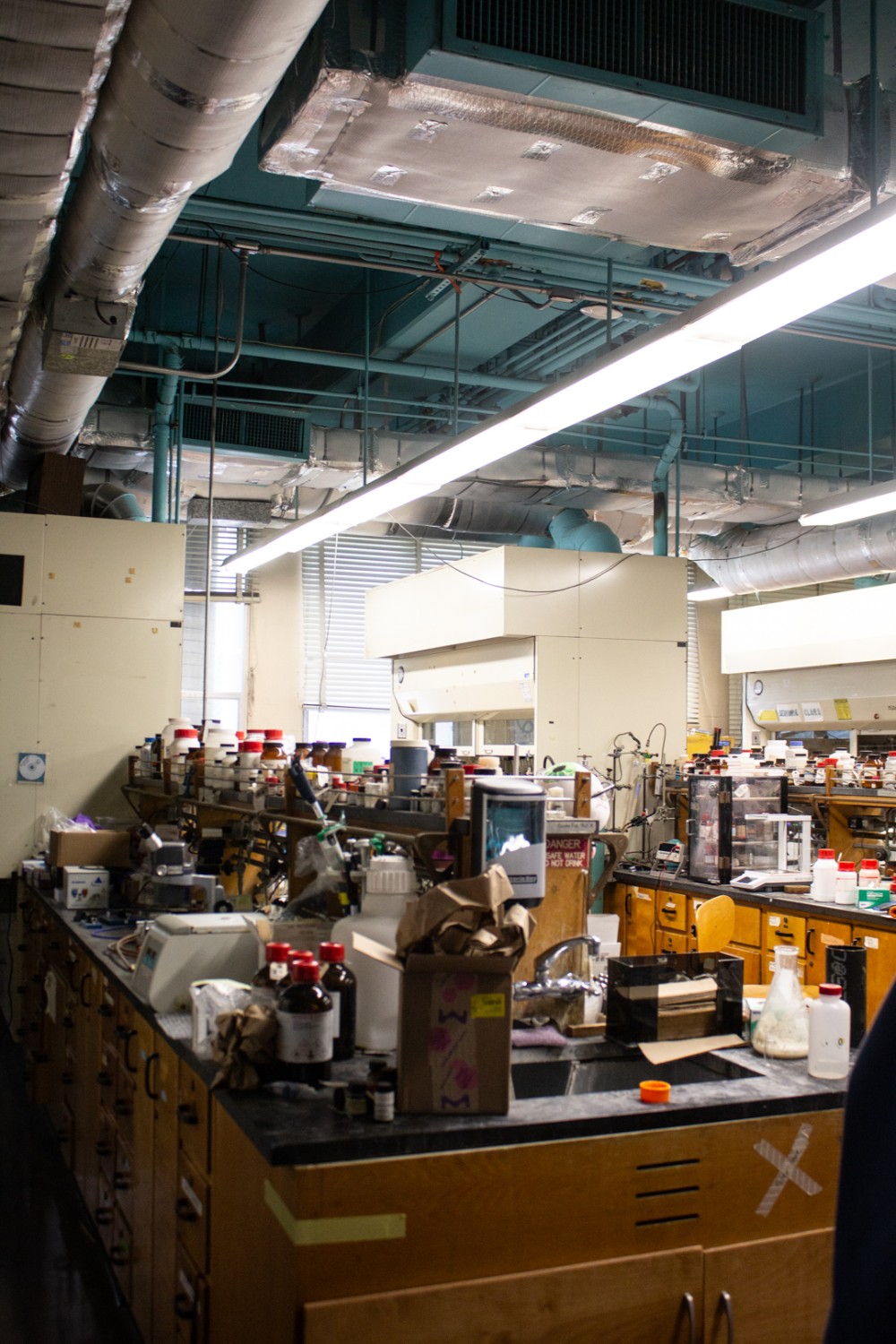
Chemistry laboratory inside Norris Hall of Chemistry at Occidental College in Los Angeles, CA. March 27, 2026. Marty Valdez/The Occidental
Organic Synthesis Lab
Raul Navarro, associate professor of chemistry, leads an organic synthesis lab focused on building molecules with potential applications in human health.
“Organic chemists like to build molecules in the lab, so I like to think of us as sort of molecular architects,” Navarro said. “The molecules that we build in my lab often have some relevance to human health.”
Navarro said his lab works on developing chemical reactions that allow researchers to build complex molecules more efficiently. These molecules are often inspired by natural compounds and may contribute to future pharmaceutical research.
“We ask the question, ‘Can we make these molecules and can we make them as efficiently as nature does?’” Navarro said.
Marisol Carrano (sophomore), who works in Navarro’s lab, said her research focuses on creating cyclopropanes, a triangular carbon structure found in some pharmaceutical compounds.
Carrano said she entered the lab without prior research experience and began by shadowing.
“After reaching out to Professor Navarro, I shadowed [the lab] for a semester and then started working on the project,” Carrano said. “Coming into Oxy, I didn’t have any chemistry research experience.”
Carrano said the transition required learning new techniques and becoming comfortable working independently in the lab. According to Carrano, research often involves repeated attempts before achieving results.
“Reactions don’t always work on the first try,” Carrano said.
According to Carrano, one of the most important moments in her experience came when she successfully ran an experiment on her own.
“I was able to set up my first reaction fully on my own,” Carrano said. “I was like, OK […] I’m confident in my abilities.”
Navarro said undergraduate students play an active role in the lab’s research process.
“To see a student become independent and troubleshoot, come up with ideas for next experiments […] is such a heartwarming experience,” Navarro said. “They are coming out with such a sense of purpose and excitement for what’s to come, and I think that is probably the most rewarding thing for me over the last eight years.”
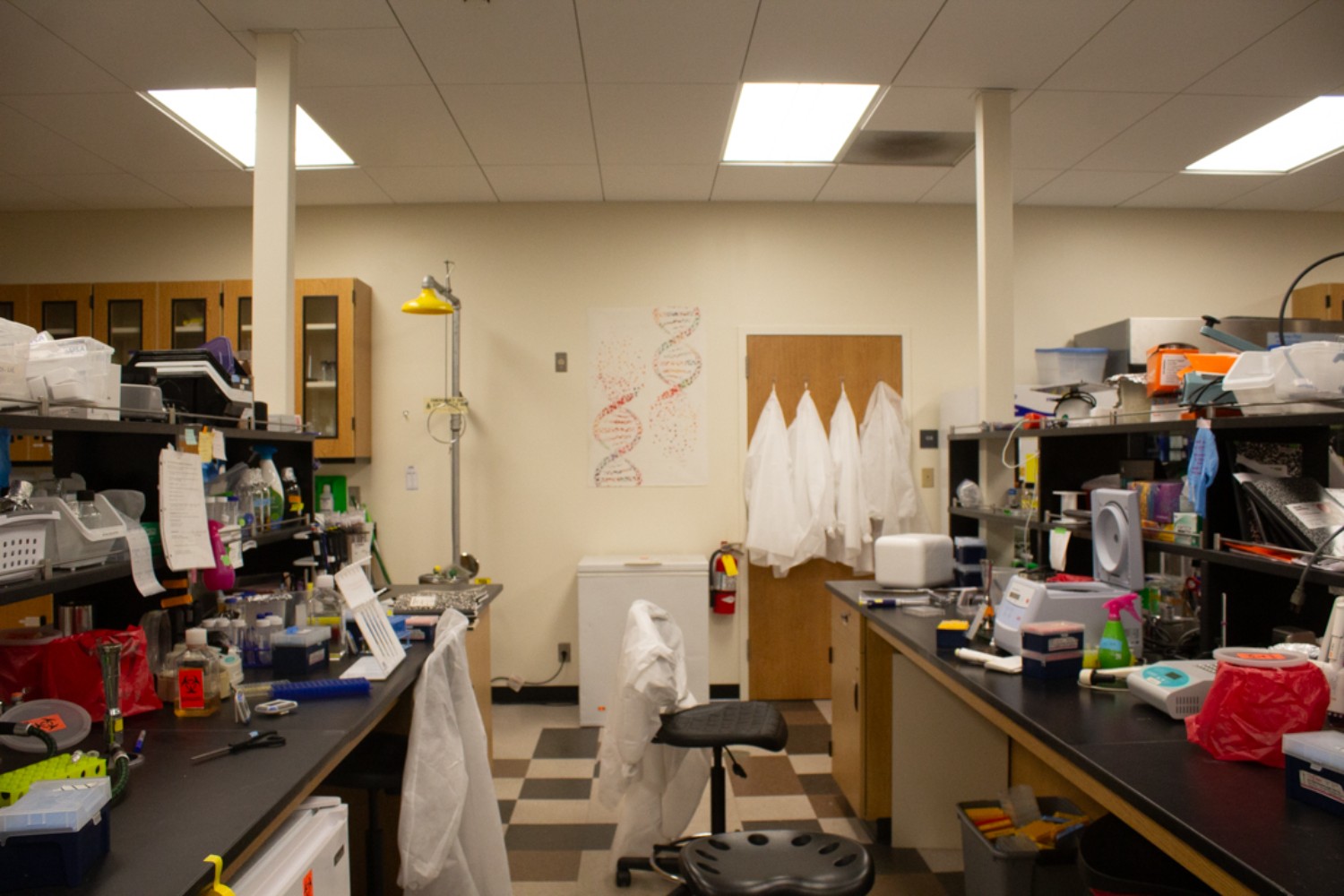
Biology laboratory inside the Bioscience building at Occidental College in Los Angeles, CA. March 27, 2026. Marty Valdez/The Occidental
Canine Intelligence Lab
Zachary Silver, assistant professor of psychology, leads a Canine Intelligence Lab where students study how dogs think and interact with humans.
“Our work explores the social origins of cognition and how specifically dogs have come to understand the complex social world that they live in,” Silver said.
Silver said dogs are particularly ideal for studying social cognition because of their long history alongside humans, which dates back about 40,000 years.
“It is an evolutionary framed research program, where we are comparing dogs’ intelligence to other animals like humans to get a sense of what elements of human cognition are unique and instead what might be shared across animals for which we have evolved alongside or spent a lot of time with over the course of our evolutionary history,” Silver said.
According to Silver, the lab uses structured experiments involving games and puzzles to measure behaviors such as decision-making, emotional perception and self-control.
“Our current research explores social decision making, emotional perception, inhibitory control and executive functioning,” Silver said.
Silver said undergraduate students are heavily involved in the lab’s work.
“I have anywhere between 15 to 20 students in a given semester that are working on both developing projects and executing those projects,” Silver said.
Silver said the lab relies on participation from the surrounding community, with dog owners bringing their pets to campus for research sessions.
“Our work is entirely community-driven,” Silver said.
Danielle Levin (senior), a psychology major, said she joined the lab after taking one of Silver’s classes and later conducted a URC-funded summer research project in the lab.
“I was looking at self-control and working memory in pet and shelter dog populations,” Levin said.
Levin said a typical day in the lab involves running experiments with dogs in scheduled sessions.
“We schedule dogs to come in for about 30-minute time slots,” Levin said, “and run whatever studies we have going on at the time.”
Levin said the experience helped her apply concepts from her coursework in a practical setting.
“It’s been really cool to take things that I learned in evolutionary psychology and developmental psychology and physiological psychology, and actually see practical applications outside of class,” Levin said.
Levin said her experience at the Canine Intelligence Lab has influenced her plans after graduation.
“Right now I’m very set on going to grad school and continuing to pursue research, which is definitely not something that I would have been exposed to if I had not been able to join a research lab in the first place,” Levin said.
Occidental College Undergraduate Research Association (OCURA)
Some students conduct research outside of traditional lab settings, working directly with participants in community spaces. Riley Cochran (sophomore), a member of the Occidental College Undergraduate Research Association, said they became involved in community research by reaching out to a professor during their first year.
“I was like, I would love to be part of research on campus and he said, ‘Do you want to join mine?’” Cochran said.
Cochran said their research focuses on how children evaluate information and determine whether it is trustworthy.
“We were working with children’s judgments on fake news and whether they thought the stories were true or false,” Cochran said.
According to Cochran, the project involved collecting data from children in public spaces such as parks.
“We go to parks and administer a survey to children 5 to 12 years old,” Cochran said. “Then we’d ask them whether or not they thought certain stories were true or false and the reasons why they might think those are true and false.”
Cochran said working in public settings requires flexibility and communication skills.
“You get really good at learning how to take a no, but working with kids is always so rewarding,” Cochran said.
Cochran said their involvement in research also led them to take on a role within OCURA, where they help connect other students with similar opportunities.
According to Cochran, OCURA collaborates with the URC to share information about available programs, funding and ways for students to get involved, particularly for those who may not know where to start. Cochran said part of their role involves encouraging students to reach out to professors and consider research earlier in their college experience, as having access to research opportunities early on made a significant difference in their own academic path.
“It really made me realize how accessible [research] is to me,” Cochran said.
Val Nguyen* (sophomore), the founder of OCURA, said the organization plays an important role in helping students navigate research opportunities.
“While the URC is an institutional resource, OCURA is more of a student-led community,” Nguyen said.
Nguyen said OCURA focuses on connecting students with resources and opportunities that may not always be visible through formal institutional channels.
“We focus more on supporting first years and […] students who are generally systematically marginalized within academia,” Nguyen said.
Nguyen said the organization additionally connects students with opportunities beyond Occidental.
“We also connect Oxy students with outside resources and outside professors rather than focusing on just the Oxy community,” Nguyen said. “So we serve more of a bridge rather than an institutional resource.”
According to Nguyen, high attendance at OCURA events and outreach efforts reflects student and faculty interest in research.
“Whenever we have events, there are many students and many faculty and many staff who reach out to us because it is a need […] and something that everyone is excited about,” Nguyen said.
Tylor Lee (senior) conducting research in the BioScience building at Occidental College in Los Angeles, CA. March 27, 2026. Marty Valdez/The Occidental
The Future of Undergraduate Research at Occidental
As research opportunities continue to expand across campus, Logvinenko said sustaining such growth will require continued support, particularly through funding and institutional resources.
According to Logvinenko, recent changes in federal funding have already begun to affect the scale of some research programs.
“A couple of major programs have ended,” Logvinenko said. “There’s just general federal funding issues.”
Logvinenko said programs such as Humanities for Just Communities and the Research Early Access Program (REAP) supported groups of students through grant funding, but have recently scaled down or ended.
“The Research Early Access Program was a grant-funded program that ran for three years,” Logvinenko said. “This year [the group] is going to be very small, and so I think everybody’s aware of some of these issues.”
According to Logvinenko, programs impacted by funding cuts often support students who have had limited previous exposure to research.
“[REAP] brings first year students who may not have a lot of experience with labs or haven’t had access to science education,” Logvinenko said. “We try to give opportunities to students from underrepresented backgrounds to get involved in research early, get into the pipeline.”
According to Logvinenko, Occidental relies on internal and endowed funding sources to support student research.
“We continue to have a lot of internal support, we have our endowed funds that support research,” Logvinenko said. “That really hasn’t changed.”
Logvinenko said the loss of large external grants has shifted how programs operate, but student and faculty engagement and interest in research remains high. According to Logvinenko, maintaining and expanding research opportunities will require continued prioritization across the college.
“It’s something that we as a community need to prioritize and make […] a big point of pride at Occidental,” Logvinenko said.
*Val Nguyen is a former Staff Writer at The Occidental.
As part of a new 10-week summer program, the Hollywood Bowl-Occidental College Internship program offers 10 internship opportunities for Occidental students to immerse themselves in experiential learning. Students will be provided with a $6000 educational stipend each to remove financial barriers. These opportunities include, but are not limited to, placements in orchestra management, production, communications, marketing and philanthropy, at The Ford, Walt Disney Concert Hall and the Hollywood Bowl.
Executive director of the Hameetman Career Center Jamila Chambers. Courtesy of Jamila Chambers
According to Jamila Chambers, Executive Director of the Hameetman Career Center, the internship program allows students to gain firsthand experience as they are placed across departments inside a globally renowned institution where arts, culture, and innovation intersect. Chambers said this partnership is particularly exciting because Occidental students are provided with access to the full ecosystem as contributors, not just observers.
“This internship grew out of a shared vision between Occidental College and the LA Phil to deepen experiential learning opportunities for students—particularly in Los Angeles, where access to world-class institutions is a defining advantage of an Oxy education,” Chambers said via email.
Chambers said this program aims to bridge classroom learning with real-world application through hands-on, meaningful and multifaceted work at a world-leading cultural institution.
“The program formally launched as a three-year pilot, supported by philanthropic investment to ensure that students can participate regardless of financial background,” Chambers said.
Aliza Jetha (sophomore) on the Hameetman Career Center patio at Occidental College in Los Angeles, CA. March 26, 2026. Maile Brucklacher/The Occidental
Music major Aliza Jetha (sophomore) said she was drawn to apply for the orchestra management internship by a desire to get a better understanding of the music industry before setting foot in the workforce.
“I want to work in the music industry as a composer,” Jetha said. “I feel like it would be a great opportunity, understanding how such a large-scale production works, [because] I know that there’s so many moving parts in the LA Phil.”
Gloria Lum at the Booth Hall Courtyard at Occidental College in Los Angeles, CA. March 26, 2026. Maile Brucklacher/The Occidental
Gloria Lum, Occidental private lesson cello instructor and Linda and Maynard Brittan Chair at the LA Phil, said getting a professional opportunity with the LA Phil as a musician is incredibly competitive. Lum said over 120 applicants auditioned for one or two positions in the violin section.
According to Lum, this new internship opportunity allows students to learn about different moving parts of a very large organization such as management, development, fundraising, publicity and stage management.
“Being able [to] have an internship and get a peek into all that’s going on and all the [work it] takes to get an orchestra on stage […] would be a great experience for anyone who’s curious and who has the motivations to […] try out what’s it like to be in an art organization,” Lum said.
Jin-Shan Dai, Occidental private lesson violin instructor and violinist with the LA Phil, said getting the opportunity to work with The Hollywood Bowl will provide an eye-opening experience in which students will learn about how the professional orchestra world works.
“The Hollywood Bowl does a massive operation — probably one of the biggest […] musical operations in the world,” Dai said. “I don’t think there are many in the world that [do] as many different programs in the summer like The Hollywood Bowl. It’s really incredible.”
Lum said opportunities such as the Hollywood Bowl-Occidental College Internship are important stepping stones into careers. According to Lum, to participate in more professional opportunities, students should begin creating meaningful connections.
“There [are] a lot of people who started in management, they work their way up through an organization,” Lum said. “So, a lot of it is you get into a situation, you start knowing the people — this is where networking becomes incredibly important.”
According to Chambers, a core value of the program is transformation — to prepare Occidental students to lead and contribute meaningfully to their long-term careers. Chambers said the program helps students build skills, networks and confidence to enter competitive industries in the arts and cultural sector.
“The program also emphasizes mentorship and professional development, with structured learning sessions led by LA Phil leaders and opportunities for students to engage in cross-functional experiences throughout the summer, ” Chambers said.
Oxy Arts hosted an evening of poetry with Sholeh Wolpé, Iranian-American poet, writer and librettist March 28. The evening featured readings from her own poetry collection “Abacus of Loss: A Memoir in Verse” and her works in translation, “The Conference of the Birds” and Attar of Nishapur’s “The Invisible Sun.”
According to Assistant Professor of English Claire Grossman, the event coincided with the exhibit of 2025-26 Wanlass Artist in Residence Roksana Pirouzmand, an Iranian multidisciplinary artist.
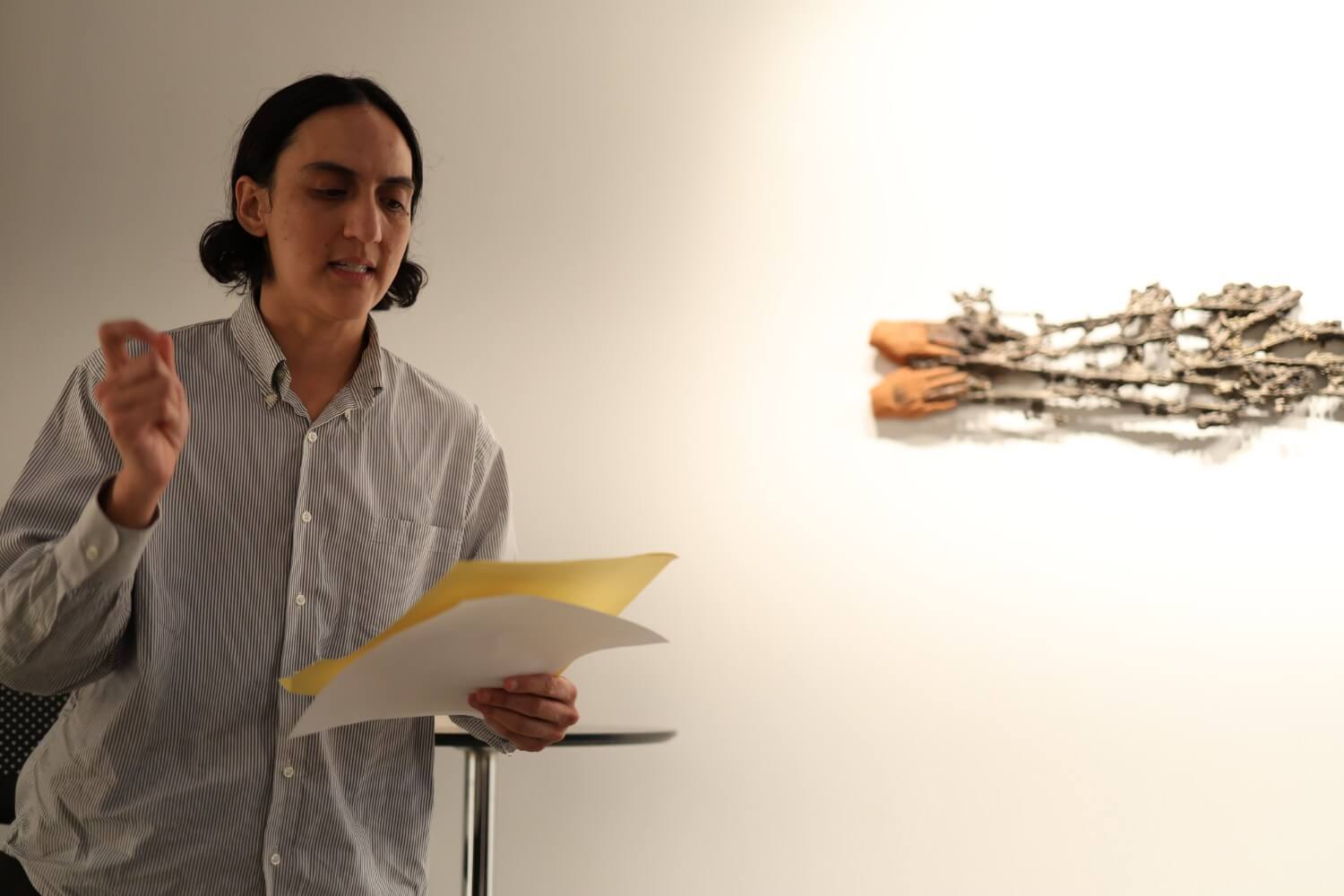
English professor Claire Gossman reading an introduction for Sholeh Wolpé at Oxy Arts in Los Angeles, CA. March 28, 2026. Amy Wong/The Occidental
“This reading is performed in conjunction with the exhibit, showing the ways we are connected and disconnected through time and space,” Grossman said.
Grossman said Wolpé’s poetry and Pirouzmand’s sculptures are similar in their energy and mission.
“Wolpé’s poetry has the same tactile sense; it compacts, outstretches, flings it against a hard surface knowing it will bounce back,” Grossman said. “She asks the question: Is home a place to go back to?”
According to Ruby Jeschke (junior), she attended the event as part of class and was grateful for the experience.
“I came to the event as part of my American Experience in Literature class,” Jeschke said. “The experience was so cool. I felt really grateful to be in a space dedicated to the creation and appreciation of art.”
Jeschke said the sculptures in the Oxy Arts exhibit played a role in the event, allowing attendees to hear the poetry and see the space in tandem.
“Experiencing the poetry while being in a space surrounded by sculptures that [explore] both connection and drifting apart made the work resonate on a deeper level,” Jeschke said.
Jeschke said the idea of the individual’s journey and experience presented throughout the night was something that stood out to her.
“When we have only one narrative about a whole group of people, it can be really harmful,” Jeschke said. “I wanted to hear more people’s stories, and the importance of perspective really stuck with me.”
According to Wolpé, the first of her readings, “Abacus of Loss: A Memoir in Verse,” is organized in the same way our minds visualize the past.
“I organized this book the way memory works,” Wolpé said. “If you think about one thing, your mind is flooded with images of that.”
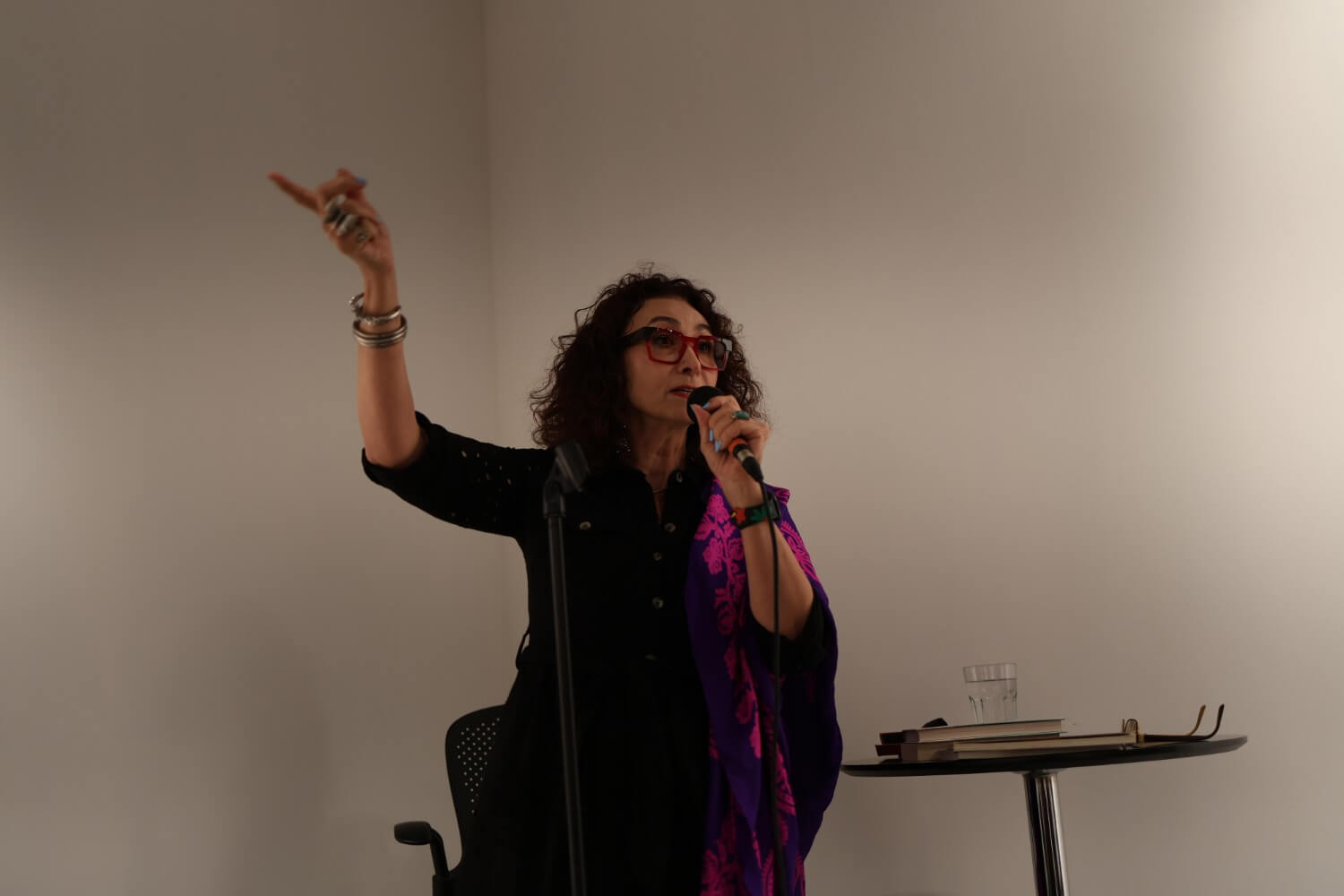
Sholeh Wolpé speaking at Oxy Arts in Los Angeles, CA. March 28, 2026. Amy Wong/The Occidental
According to Wolpé, the title creates an image of tallying the past, to see how everything has added up in the journey of her life.
“It’s called ‘The Abacus of Loss’ because I am counting my losses and gains to see what I have in the end,” Wolpé said.
According to Wolpé, her works in translation, “The Conference of Birds,” and “The Invisible Sun,” originally written by Attar of Nishapur, speak to the world of all humans.
“‘The Conference of the Birds’ compares humans to the birds telling a story of the birds of the world gathering to their sovereign,” Wolpé said. “The birds are us. They represent our fears as the wayfarer, walking to wherever you end up.”
According to Wolpé, Attar’s poetry speaks to the path each person takes on their journey in life.
“Attar says, ‘All of us are journeying to a great ocean, but on a different path,’” Wolpé said. “Those who stop and judge others are only delaying their journey.”
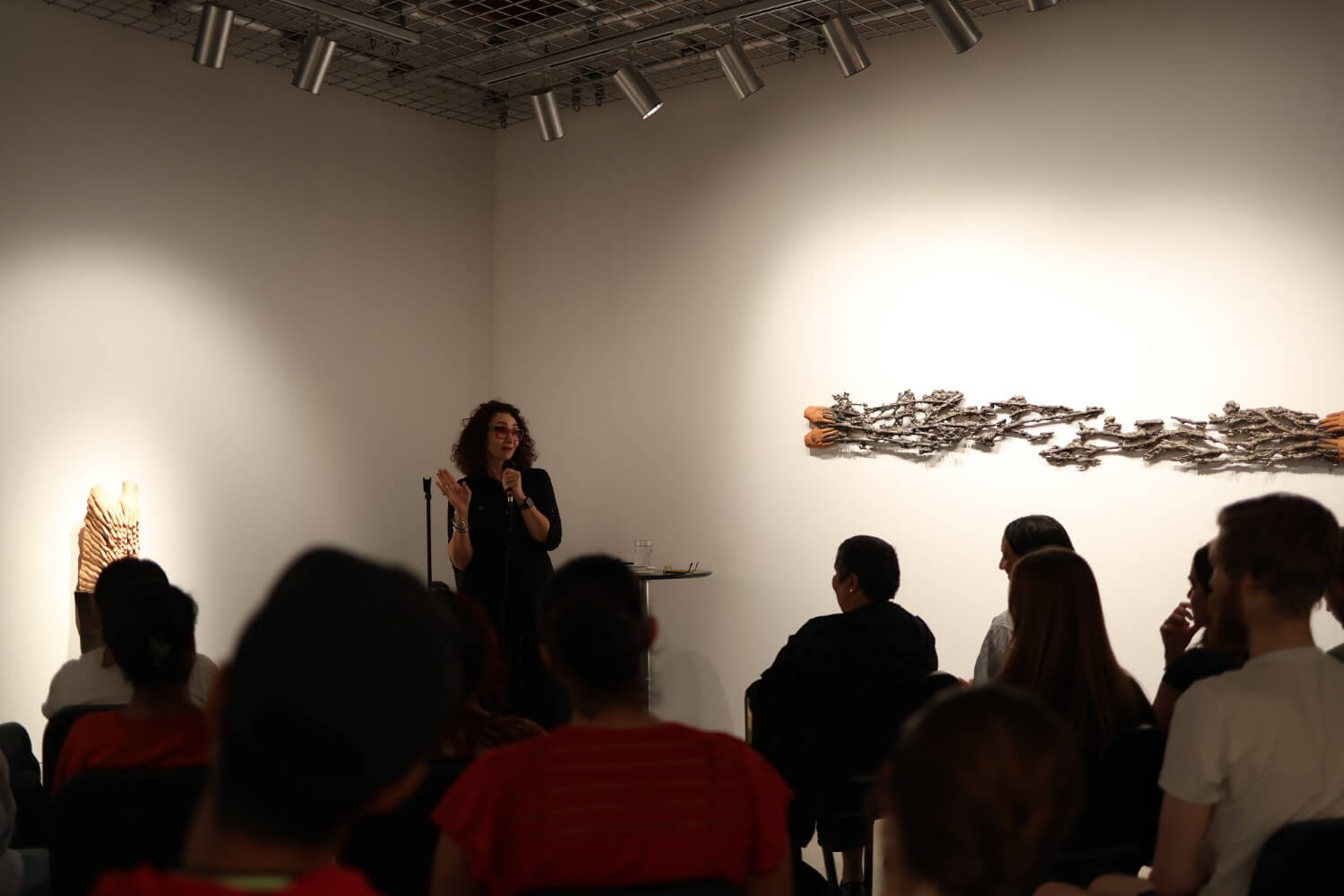
Audience members listen to Sholeh Wolpé at Oxy Arts in Los Angeles, CA. March 28, 2026. Amy Wong/The Occidental
Wolpe said the metaphorical writings of Attar perpetuate the image of the ocean and give advice on the way a person can walk that path.
“You need to get rid of your ego-self. If you do, you become a drop of water which joins the ocean at the end of the journey,” Wolpé said. “If you don’t let go, you wrap yourself in your ego and arrive as a pebble; the ocean welcomes you but you sink to the bottom.”
According to Wolpé, her translation of “The Invisible Sun” can be used as a guiding text for any day.
“These are my favorite writings of Attar,” Wolpé said. “Open to a page at random, and that will be your answer for the day.”
Wolpé said when she reads Attar, she is reminded of her experience as a kid visiting the religious practitioners and offering prayer.
“We’d go to pray, the Mullah would blow prayer into the balloon,” Wolpe said. “You had to buy as much prayer as you wanted, put your face in front of the balloon, and let the prayers blow against your face.”
Wolpé said she wanted the audience to understand the importance of poetry in light of the current world events.
“As the world is getting stranger, I wonder where we are going,” Wolpé said. “I believe in us and the power of the feminine — not only women, but the power of [the] feminine in all of us.”
Wolpé said she hopes to alter the image of Iranian people through her poetry by showing the reality and beauty of her life.
“I believe we should use our powers to make the world a little better,” Wolpé said. “[There is a] beauty [in] this culture against the terrifying image painted of the Iranian people.”
Nine cultural dance performances by Occidental students and staff took the stage in the Dance Studio as part of the first United Nations Week Global Dance Night March 26. The event showcased dances from Mexico, South Africa, Myanmar, China and more, and featured styles ranging from flamenco to ballet to reggaeton. The event was part of a collaboration between the Diplomacy & World Affairs Department (DWA), PULSE Dance Club and IntOxy, Occidental’s international student association. According to the DWA website, the college has hosted UN week for over twenty years, aiming to raise awareness of global issues through informational and community events on campus.
According to Samantha Stever-Zeitlin (junior), DWA holds UN Week annually, led by a student organizing committee and faculty members. Stever-Zeitlin said while hosting a UN keynote speaker, alumni panels and a trivia night, the committee also wanted to incorporate visual arts and performance into the programming.
“I thought [Global Dance Night] would be a great way to engage people not just in a strictly academic sense, but also in a cultural sense,” Stever-Zeitlin said. “Dance really connects people from different cultures and different places around the world, and I think it’s something universal that we should celebrate.”
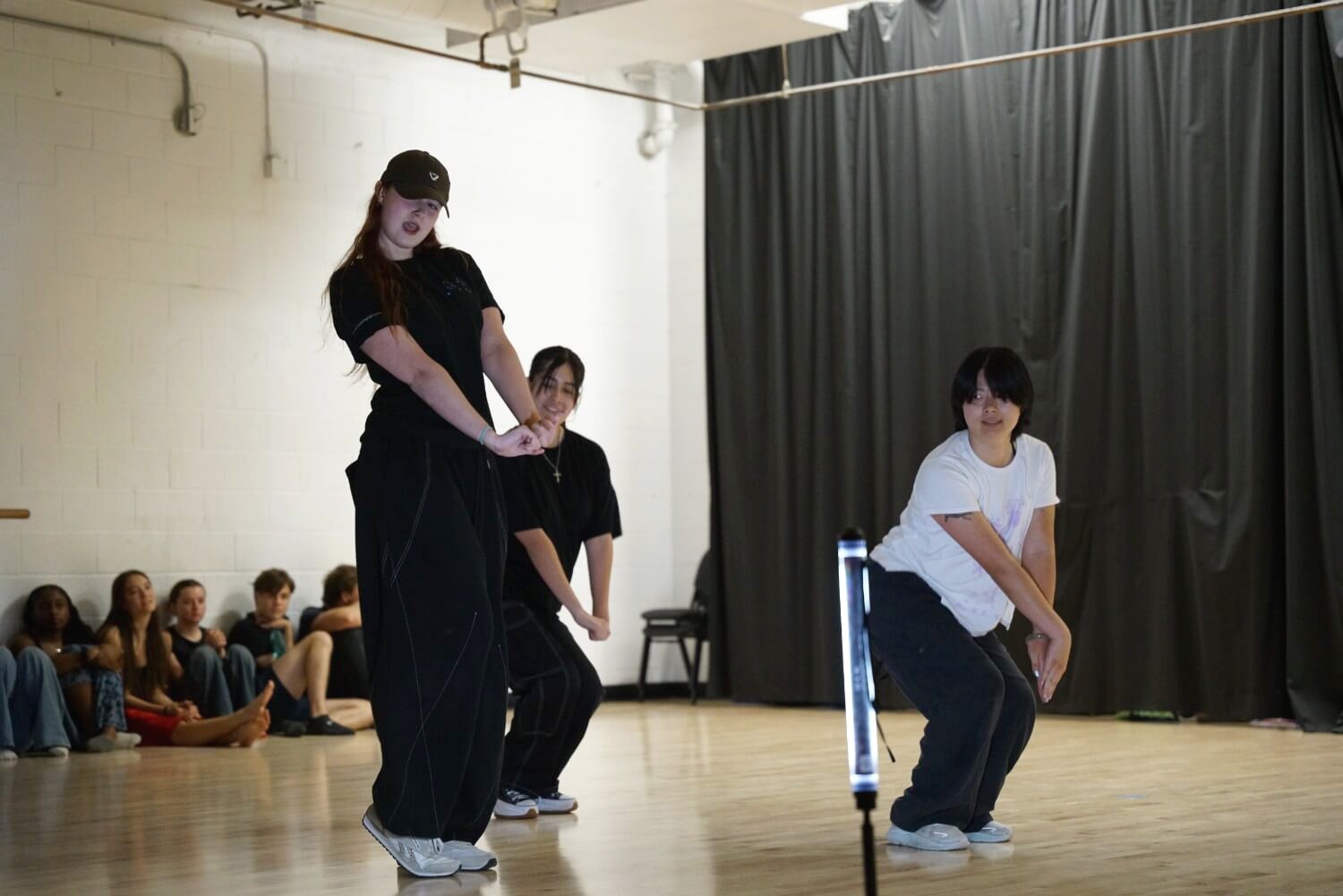
K-Tigers club perform a K-Pop Medley in the Dance Studio at Occidental College in Los Angeles, CA. March 26, 2026. Anthony Cordova/The Occidental
Stever-Zeitlin is president of PULSE, a club that hosts two student-led dance workshops each week, in addition to other performances throughout the year. Stever-Zeitlin said she jumped at the opportunity to connect her passion for global affairs and her experience in the performing arts when fellow DWA major, Kimaya Hegde (sophomore), proposed a dance-centered event at one of their meetings.
“There’s always been a little bit of global art infused into UN Week, but we’ve never done anything related to dance since I’ve been here,” Stever-Zeitlin said. “The student committee organizes additional events and really brings it to life, I would say.”
One of the intentions with the event was to highlight styles of dance that do not have as visible a platform for performances, Stever-Zeitlin said. According to Stever-Zeitlin, while PULSE has hosted cultural dance workshops before, the Global Dance Night is an event of a much greater scale because of the addition of an audience.
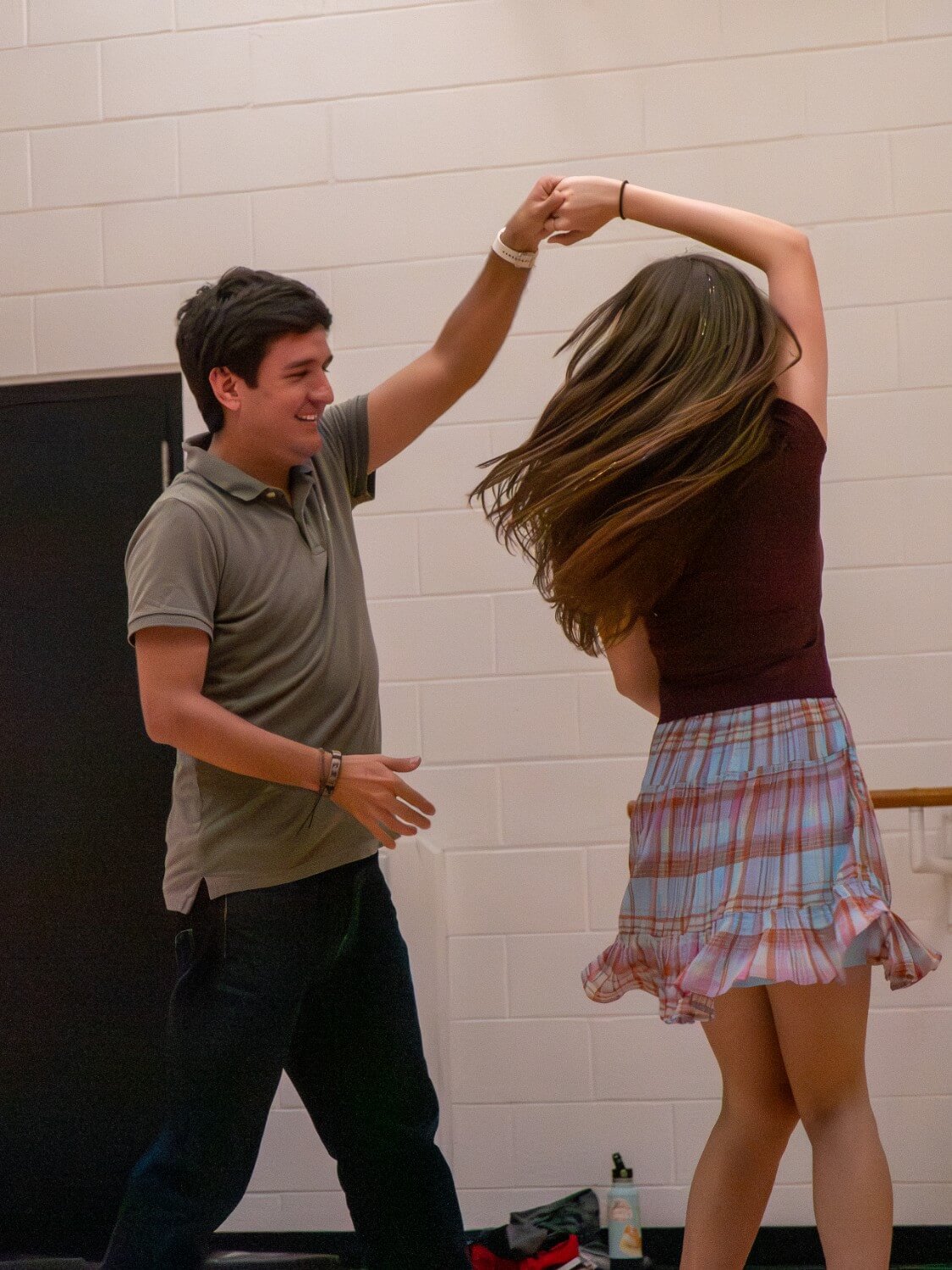
Computer science professor Hector Camarillo Abad and Violet Tong (first year) perform the bachata in the Dance Studio at Occidental College in Los Angeles, CA. March 26, 2026. Anthony Cordova/The Occidental
Violet Tong (first year), who performed as part of the Folk & Historical Dance Troupe, said she was excited to participate in the performance and see so many enthusiastic supporters who had come out to enjoy the show.
“I was impressed with the turnout, that was really cool, there was very high energy the whole time,” Tong said. “I love that they opened the show with how dance is a universal language — that it doesn’t matter where you come from and what language you speak, we can all connect through dance.”
Tong performed a bachata duet later in the night with Assistant Professor of Computer Science, Hector Camarillo Abad. Their performance, which was not choreographed in advance, earned a standing ovation from their fellow dancers in the Folk & Historical Dance Troupe.
Camarillo Abad also performed a solo flamenco number with which he said he wanted to emphasize the theatrical, dramatic style that he had practiced since he was young. Camarillo Abad said his passion for dance began when he joined a Spanish folklore group in his home city of Puebla, Mexico.
“I think I was very shy, but [dance] made me more outgoing and more comfortable in front of an audience,” Camarillo Abad said. “It also influenced me as a professor, because I see the classroom as an audience where I need to present something, which is kind of like a mini-performance.”
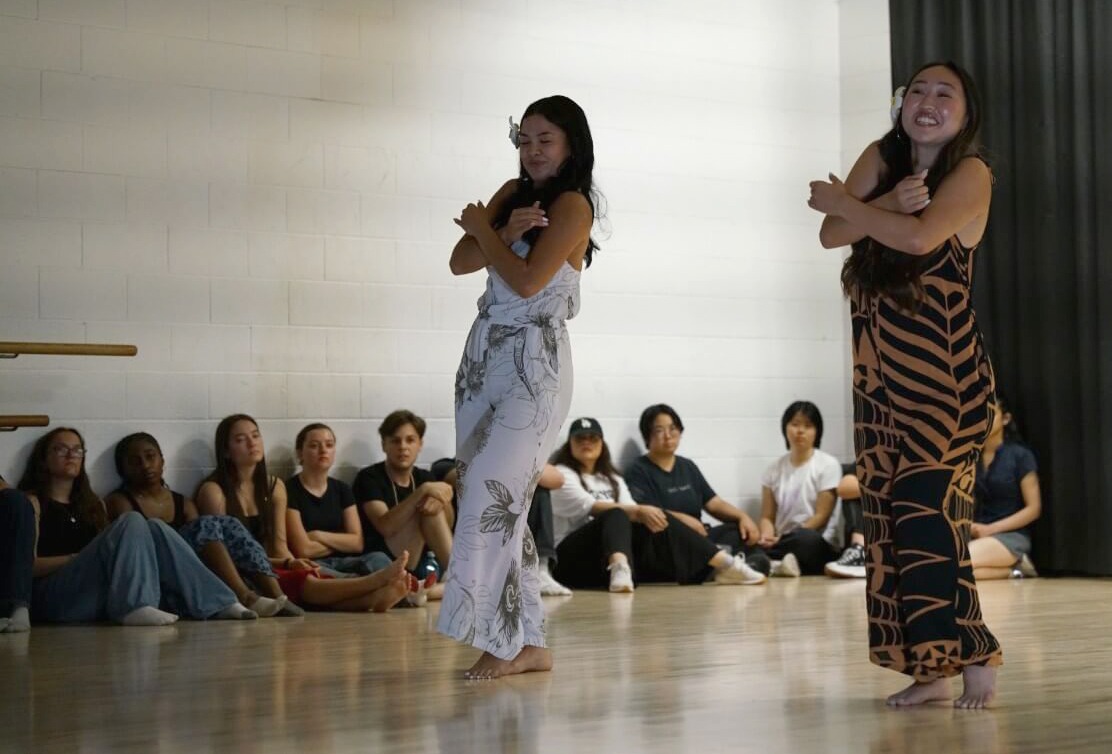
Dominique Cabading (senior) and Dara Tokeshi (senior) Hula dance in the Dance Studio at Occidental College in Los Angeles, CA. March 26, 2026. Anthony Cordova/The Occidental
Stever-Zeitlin said the purpose of the event was to raise awareness about the diversity of styles across the world and to provide a space for dances that are not regularly performed.
“I want the event to highlight the talent and artistry of dancers at Oxy who put so much effort into their dance styles, and yet they’re not seen that much on campus,” Stever-Zeitlin said. “One goal is to give people who do non-American dance styles a moment to shine.”
Tong said unity through performance was a theme that underscored the event and a value held by all of the dancers who performed.
“I think in a perfect world, dance could create peace,” Tong said. “We’d be able to appreciate each other for our differences, and our similarities at the same time.”
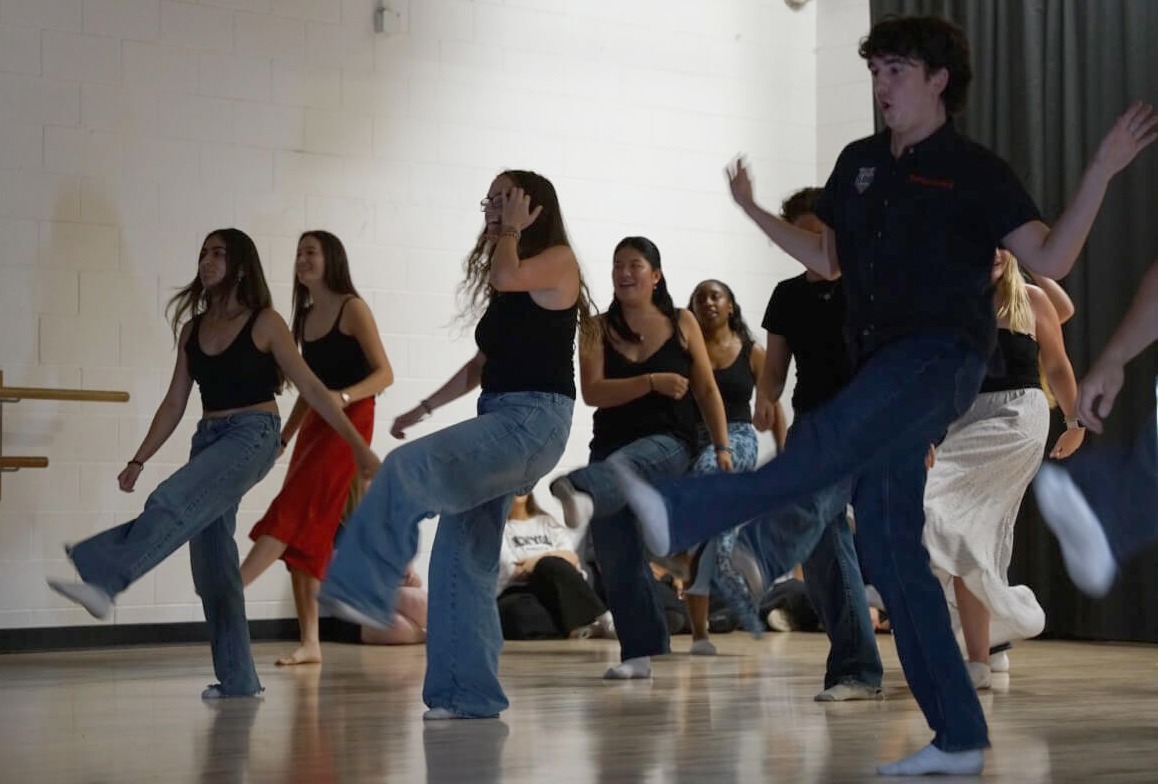
Dancers performing Pata Pata in the Dance Studio at Occidental College in Los Angeles, CA. March 26, 2026. Anthony Cordova/The Occidental
According to Camarillo Abad, an energetic audience and encouraging hosts elevated the performances, and helped create an uplifting sense of community among everyone involved.
“I felt very welcomed by [the audience], they really supported me,” Camarillo Abad said. “They just had such great energy, and it reminded me of the times when we were doing performances back in my city of Puebla at the theatre, where everyone was just so excited and we all had worked so hard.”
Stever-Zeitlin said Global Dance Night was meant to be emblematic of how powerful it can be when people of different cultures come together to celebrate one another. Stever-Zeitlin said she hopes that the event will continue next year and beyond as a crucial component of UN Week.
Naisha John (first year), Margot Wallace (first year) and Mellena Leong-Pearson (first year) performing the Royal Ballet’s Raymonda in the Dance Studio at Occidental College in Los Angeles, CA. March 26, 2026. Anthony Cordova/The Occidental
“Dance transcends language barriers — so much of interconnectedness globally can be found through the arts and through dance,” Stever-Zeitlin said.
Camarillo Abad said she believes that dance should be a priority in our world because of the way it can connect us to our culture and to one another.
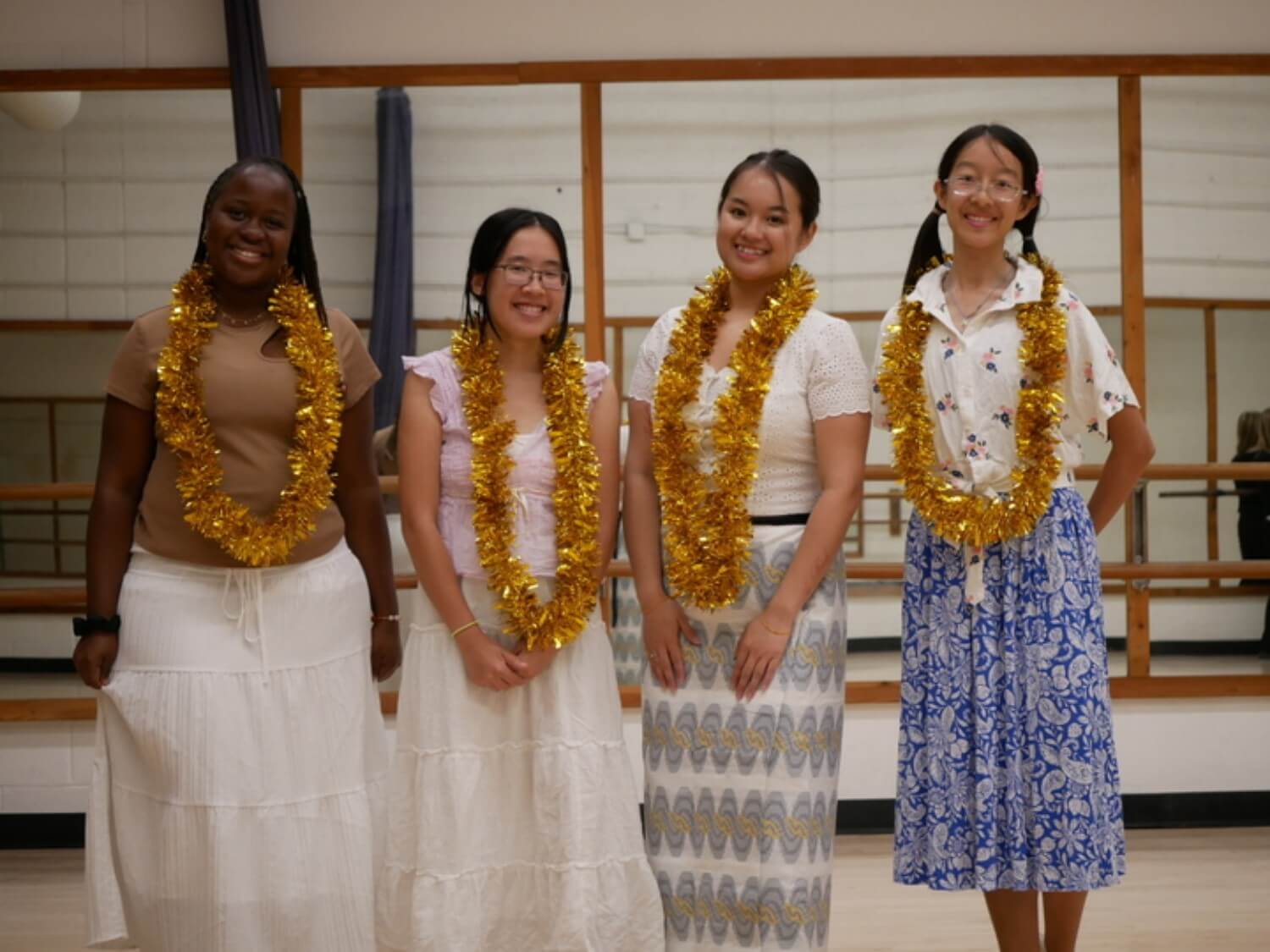
Elsa Sowah (sophomore), Jane Hutton (senior), July Paw (senior) and Marina Jiang (first year) in the Dance Studio at Occidental College in Los Angeles, CA. March 26, 2026. Anthony Cordova/The Occidental
“I think dance brings people together. It makes everyone happy, it gets the audience and everyone around to join in,” Camarillo Abad said. “I think dance is very important for us as human beings.”
Renovations will be taking place in Chilcott Hall to convert the common area into a 68-seat screening facility meant to serve the Media, Arts & Culture (MAC) program. Additional work to rejuvenate the surrounding outdoor spaces, which serve as communal gathering areas for students and faculty, are also planned. MAC Department Chair Katarzyna Marciniak said Occidental is planning to complete the theater by the Fall 2026 semester.
In a Feb. 2 email to the student body, Board of Trustees Chair Art Peck said the screening facility would be “state-of-the-art.” Marciniak said MAC faculty were elated at the news.
Marciniak said the new facilities, which have been years in the making, are a necessary part of the MAC department’s recent boom in enrollment, now the fourth largest major at Occidental.
“MAC has experienced absolutely amazing growth that we’ve called unprecedented, unexpected, wonderful, gratifying,” Marciniak said. “We consequently need more classes and more spaces for teaching.”
As part of that effort, Marciniak said changes to the MAC curriculum are being implemented to streamline the major in conjunction with the hiring of additional faculty across areas of expertise.
“One way to think about why this growth has been happening is because MAC has been allowed to grow in terms of number of faculty members who teach in the program,” Marciniak said. “We’re going to introduce some new classes, different paths and better advising.”
Associate Dean for Faculty Affairs and David B. and Mary H. Gamble Professor of Religious Studies Kristi Upson-Saia said while classroom space is a priority, the college is also working to ensure Chilcott residents will still have areas to congregate in after their common room is transformed.
“One of the hardest things that I’m constantly working on is how to maximize the use of classroom spaces,” Upson-Saia said. “This will add a classroom, which is great for us. [But] we don’t want to take away community space for classroom space […] There’s been more of a commitment to have more outdoor spaces for students to hang out.”
Upson-Saia said the Chilcott theater will bear similarities to the existing Choi Auditorium in Johnson Hall and will also be used to host screening events with special guests, and that the new theater will hopefully resolve issues caused by competition for the use of Choi.
“Choi is difficult, because the [audiovisual controls] in there [are] accessible to everyone all the time,” Upson-Saia said. “If I have a speaker and I go and setup [the theater settings] and walk away for an hour, someone could come in and change all the settings. There’s been some technical problems that are just not appropriate when you have high-profile guests.”
Owen Voigt (sophomore) said his job at the Cage, the MAC department’s gear rental service, allows him to hear lots of direct feedback from students. Voigt said he is excited by the renovations, but hopes further improvements to Weingart are in store as well.
“[Weingart is] one of the oldest buildings on campus. There are parts of it that need a little help,” Voigt said. “Watching the MAC program grow and seeing smaller spaces be renovated and rebuilt […] makes me excited because I think it means we have the opportunity to do bigger stuff that can benefit the program more in the future.”
Media Arts & Culture cage worker Owen Voigt (sophomore) on the Academic Quad at Occidental College in Los Angeles, CA. March 26, 2026. Maile Brucklacher/The Occidental
Upson-Saia said she hopes to incorporate more student feedback into renovation projects while continuing to juggle the many requirements such projects hold.
“We’re trying to balance department-specific needs and general-use needs,” Upson-Saia said. “But there is a strong desire among many people working on the project for [students] to be part of the process.”
Marciniak said faculty is constantly working to meet the needs and challenges presented by the department’s expansion.
“We are super proud of the growth and the fact that students seek us out, that they’re drawn to us,” Marciniak said. “It puts pressure and responsibility on us, faculty, to be careful, mindful about the way we guide students.”
The Intercultural Community Center (ICC) and Student Leadership, Involvement, & Community Engagement (SLICE) hosted the Dolores Huerta Days of Community, a two-day event including a community conversation and a field trip honoring Women’s History Month, March 27-28.
The event was originally titled, “Cesar Chavez and Dolores Huerta Days of Community,” but following the news of Chavez’s abuse of young women and Huerta’s March 18 statement in which she accused Chavez of raping her in the 1960s, the event was retitled to omit Chavez’s name.
Assistant Director of Student and Community Engagement Taína Morales and Director of the ICC Vanessa Gonzalez-Wright planned this event together, revitalizing an annual celebration for March 31 that stopped during the pandemic, according to Morales. March 31, which is usually Cesar Chavez Day, was renamed Farmworkers Day on March 26, only a day before this event.
“Last year, SLICE collaborated with Project SAFE, and we gave out kits to day laborers,” Morales said. “This weekend, technically, is the first Days of Community, rather than the Day of Service.”
The first Day of Community event, a “Community Talk,” took place Friday at the ICC backyard. Jesus Sanchez from The Eastsider LA, a NELA-based news organization, was present, along with Stephanie Rodriguez from Amara Colectiva,a nonprofit organization based in El Sereno.
“One of the things that I thought about with this event [was] highlighting local organizations,” Gonzalez-Wright said. “I was really trying to focus on Northeast Los Angeles especially, and so that’s why we ended up picking somebody from the Eastsider, our local newspaper, to talk about the impact of journalism, particularly in the Latino community. And then we had [Rodriguez] come speak about how she just saw needs in her community.”
Morales said after the news about Chavez broke, organizers immediately decided to make the event survivor-focused.
“How do we still go through with this event, still highlight the amazing work that has been done in the community?” Morales said.
A variety of cards on the tables in the ICC backyard had questions on them that said, “How have you been feeling since hearing the news about Dolores Huerta and Cesar Chavez?” and “How should we move forward with honoring this day at Oxy?”
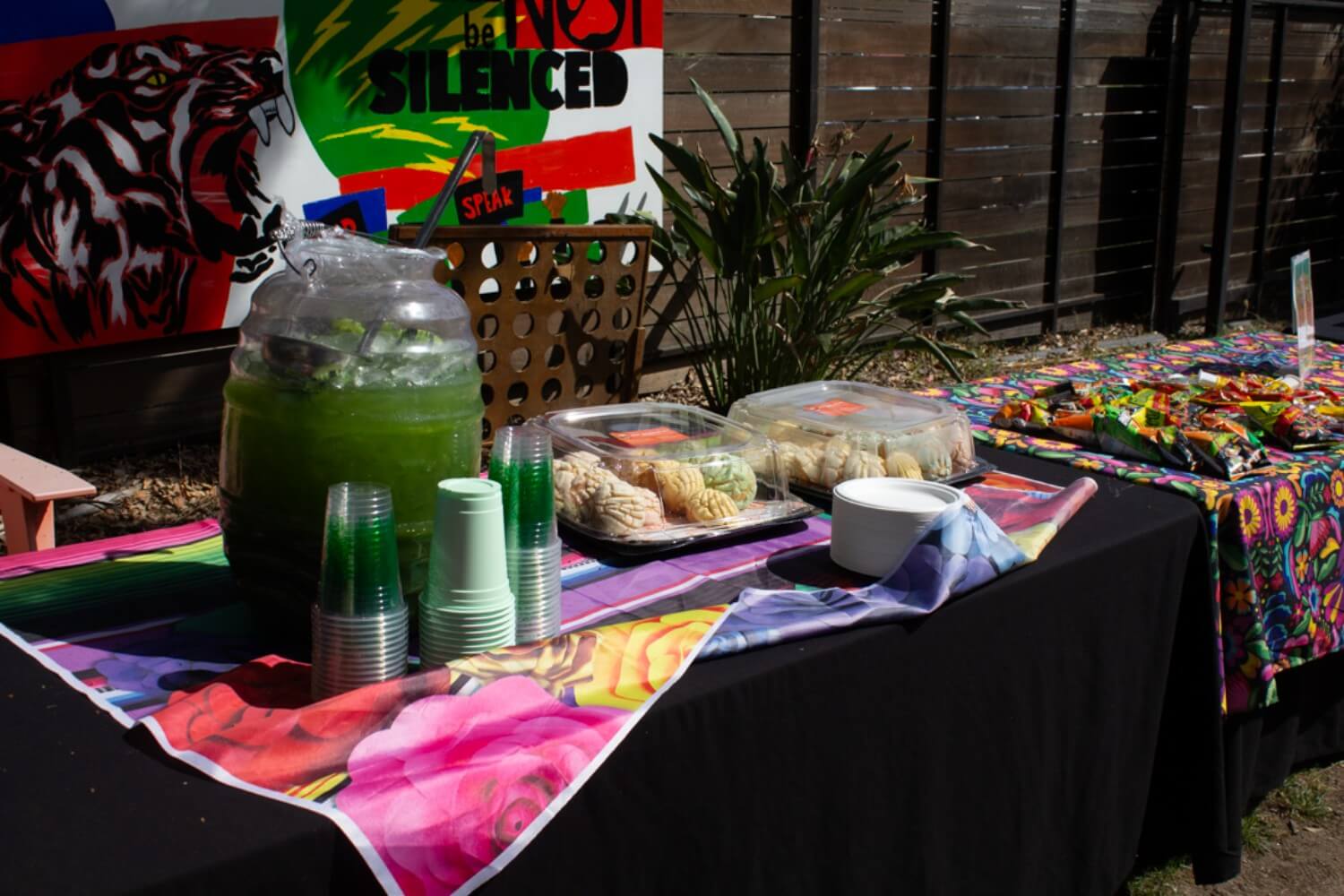
Food at the Dolores Huerta Day of Community at the ICC in Los Angeles, CA. March 27, 2026. Marty Valdez/The Occidental
Students, staff and community members at the event spoke about how or if they had learned about the Farmworkers Movement growing up, their connections to California and the Chicano identity and how the recent news had affected them.
“We wanted to honor the day with focusing on the history,” Gonzalez-Wright said. “But after hearing the news, we realized that we also wanted this to be a processing space for folks.”
Morales and Gonzalez-Wright planned the second Day of Community to take place off-campus. With free transportation provided, students had the opportunity to visit La Plaza de Cultura y Artes, Olvera Street and Mariachi Plaza in Boyle Heights.
“Our first stop, La Plaza de Cultura, there is a museum that […] takes you through Latina history in California,” Morales said. “There are so many students who are not from California, so we want to make sure we are creating spaces for those students to learn too. This is the history from start to finish, over the time that Mexico became California and everything that’s happened.”
Noemi Justino-Ruiz (junior), who attended the field trip, said the group received a tour of La Plaza de Cultura y Artes from a UC Riverside professor who has an exhibit currently on display there. According to Justino-Ruiz, the group ate taquitos at Cielito Lindo on Olvera Street and shopped at the stalls.
“As someone from outside of California, I had always heard about the community rather than actually [met] those identifying with the Chicano/Chicana label,” Justino-Ruiz said via email. “To then come to LA and Oxy, and see first hand how loud and proud this community is, warms my heart, knowing what it means for the Latino community as a whole.”
According to Gonzalez-Wright, when she started at Occidental, the college celebrated March 31 by having a Mexican-food themed menu at the Marketplace. Gonzalez-Wright said she hopes these Days of Community can continue to be an important celebration for the college.
“I hope that we continue to honor the past, how it’s influenced the things that we do now and make intentional time for that reflection, to bring the Oxy community together,” Gonzalez-Wright said. “I hope we can continue to honor this day, but I’d be curious to know how students would like to recreate this day or how they would like to use it moving forward.”