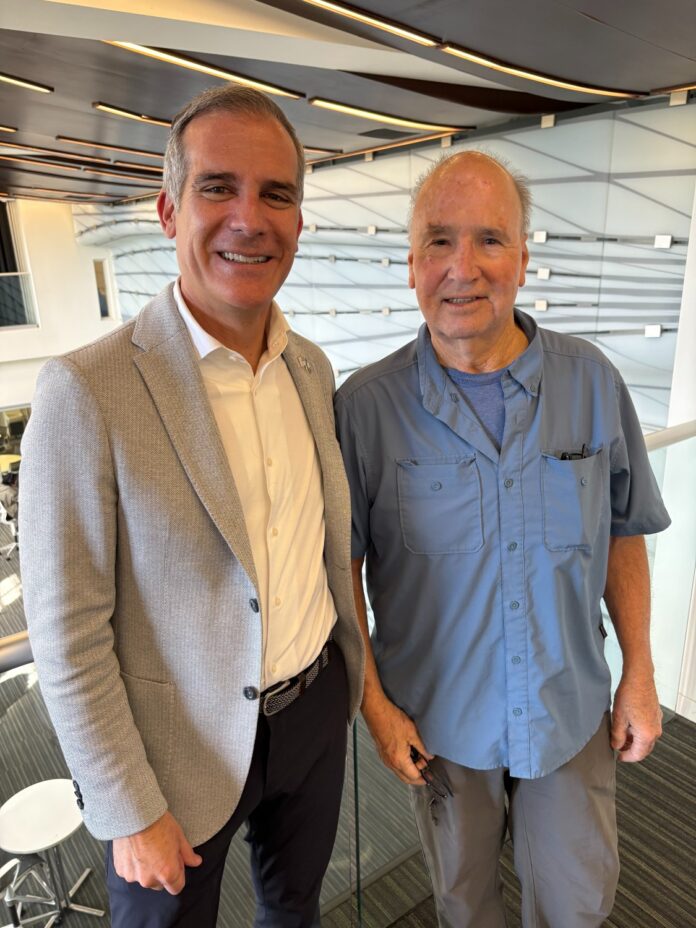
Eric Garcetti, mayor of Los Angeles from 2013–2022, President Biden’s Ambassador to India and a former professor at Occidental, spoke about international relations and his career in Choi Auditorium Monday, Feb. 23.
Garcetti discussed his LA roots, his experiences in India and his political evolution with Emeritus Chevalier Professor of Diplomacy and World Affairs Derek Shearer, who served as the US ambassador to Finland from 1994–1997.
Garcetti opened the conversation about his upbringing as a fourth-generation Angeleno. As a child, Garcetti’s parents used their savings to take him and his sister on trips to places like China, Rwanda and — when he was 14 — India.
When Garcetti taught at Occidental, he said he told students that you can see the face of the world on the streets of LA.
“But if you grew up in LA, you [have] the inverse, too,” Garcetti said. “You see the face of LA on the streets of the world. So that I could be in Cairo, I could be in Mexico City, I could be in Tokyo, and it looked familiar.”
Garcetti said growing up in a global city led him into human rights activism as an undergraduate at Columbia University, and eventually to Myanmar (then Burma), where he worked with pro-democracy dissidents.
“I went two summers to the jungle, and taught the members of the underground about a nonviolent resistance, and how to scale up an operation to overthrow the government,” Garcetti said.
According to Garcetti, he got class credit for his activism in Myanmar.
“But the second time, I just went for fun,” Garcetti said.
As a 29-year-old Occidental professor, Garcetti decided to run for LA City Council on a progressive platform.
“When I ran, people said, ‘Well, aren’t you a professor of international relations? What are you doing running for city council?'” Garcetti said. “And my response would be, ‘Have you seen LA?’ And if you understand LA, you understand that local politics is global politics.”
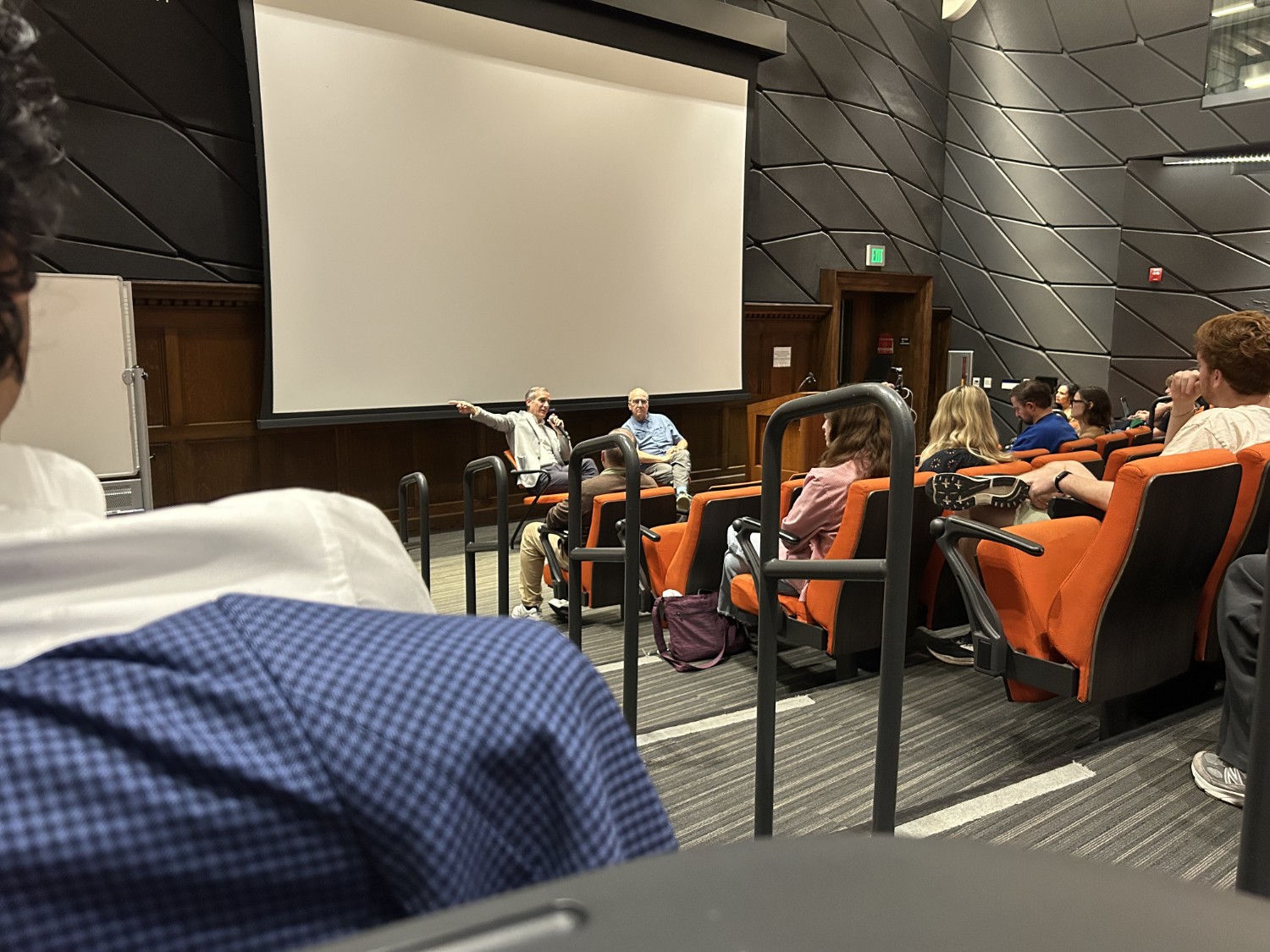
In his answer to a student’s question about ethnic discrimination in Myanmar towards the end of his talk, Garcetti said, “you can’t let your idealistic values trump your effectiveness.”
“You’re not going to be very effective in this world, even outside of government, if those values are so principled that you can’t engage with people you dislike,” Garcetti said. “Nobel Peace Prizes have been given to the most horrible people, who are the only people who can sometimes make the peace. And the whole point of it is to reward them when they do. And that’s a tough lesson.”
A student asked Garcetti how academic international relations paradigms such as realism, liberalism and constructivism helped him in his career. Garcetti said even the most realism-based politicians are not devoid of values.
“They still got into this because they want to actually accomplish some things,” Garcetti said. “So they’re idealistic in that sense.”
Garcetti said the human skills needed in diplomacy — and life — are not taught enough.
“Diplomacy isn’t a profession,” Garcetti said. “Diplomacy is something you all need to — whether you major in DWA or not — have, in life. If you’re not diplomatic, you’re not going to be successful in your family. You’re not going to be successful in your love.”
Garcetti said Indians are great negotiators, and that in some weird way, President Trump has negotiated with India like an Indian.
“Trump is getting more breakthroughs than the polite Democratic and Republican administrations that came before,” Garcetti said.
Garcetti said that when he was the president of the LA City Council, someone told him to treat the rest of the council as 5-year-olds to understand their true essences.
“Not treat them condescendingly, but when you’re 5, one person wants to be in the sandbox,” Garcetti said. “Another person wants you to see the art piece they’ve created. Somebody just wants to not be bothered. Each of our personalities is different, and so often, we project our personality onto others, thinking they’re not understanding when they don’t respond the way we want […] and we often do that in a cultural way instead of a personal way.”
Garcetti said he is not done with public service.
“I’m here to state I have no secret plan — there’s still two weeks left where I could declare for governor, if the governor’s race was a year or two from now, I might have jumped into it,” Garcetti said.
During his talk, Garcetti called LA an “imperfect paradise.”
“It gets to the optimism and the positivity without whitewashing or trying to overstate that we’re perfect,” Garcetti said, explaining his nickname for LA.
According to Garcetti, after having “been to the mountaintop” as a politician — which he said comes with a huge personal cost — he doesn’t have the itch to be in the limelight.
Garcetti said President Trump has thrown a “volatile cocktail” into a “building” —made of “all the international institutions you study” and “the way we do government” in the US. Garcetti said that even if Trump never came along, it was time for the “building” to “come down.”
Building on his building metaphor, Garcetti said political thinkers need to act like engineers and architects, instead of being firefighters.
“What are we going to build next?” Garcetti said. “It’s not going to be as big and grand and stable as what we’ve lived through in our lifetimes. But it’s necessary for some thinkers who aren’t running for office, and who aren’t in office, to be thinking about what that looks like.”
Contact James Miller at jmiller4@oxy.edu