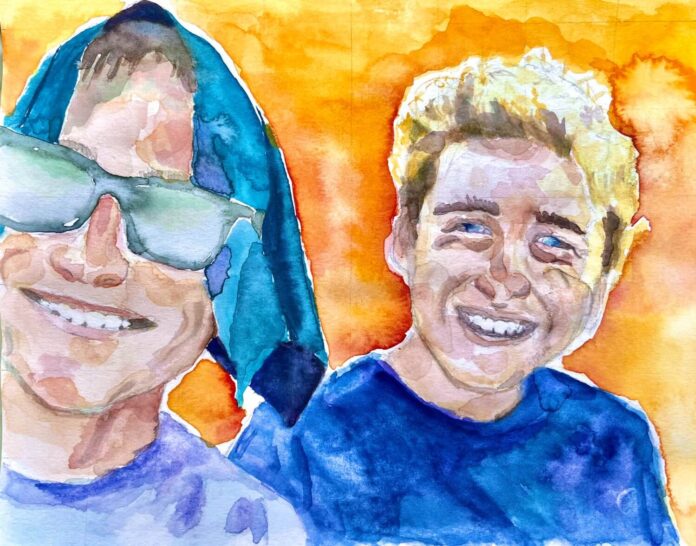
Nathan Crawford reminded me to have fun when I was trying my hardest to grow up.
In other words, we were boys.
I met Nathan, who died Feb. 18 from cancer, in a First Year Seminar (FYS) about the Ottoman Empire. We should have met earlier, in the FYS we also shared our freshman fall. That class, “The Examined Life,” considered how to live well according to books like Patti Smith’s counterculture memoir “Just Kids” and Svetlana Alexievich’s portrait of the Soviet Union’s waning days, “Secondhand Time.” I sat near the head of our discussion table and talked to no end. Nathan sat farther down the table and spoke little, but with eloquence when he did. Funny enough, that class taught me how to live.
The spring of our freshman year, Nathan, another friend from our FYS named Henry Dorosin and I spent many afternoons talking in the Stewie common room. I don’t remember what we talked about, but it hardly mattered in the first place. Nathan was about the best small-talker I knew: ever polite, interested, casual. He had a dignified way of asking how you were doing that was both engaged and lighthearted. He filled ordinary spaces like the Stewie common room or the Cooler, where we met between classes, with a sweet poise.
Nathan and I got to know one another by talking about politics. We were both interested in the world but responded to its problems differently. Nathan was a rational person who believed that institutions could serve people if run well, while I was confused and gleefully pushed at his earnest beliefs. In our first year, mostly to get a rise out of him, I’d comment on the news of the day in ways I hoped were cunning. Nathan would eye-roll and exclaim at my hyperbole, and more often than not, we’d converse about what we would do if we ran things.
By sharing our ideas about how the world should be, Nathan and I showed each other how we wanted to live in the world we had. Nathan lived with grace. He responded with common sense to the political problems I overthought. I found comfort in his quiet convictions when I lacked the courage to believe them on my own.
Nathan and I knew each other at this point, but we became friends when we goofed off. True friends don’t just understand one another, they have fun together. And Nathan knew how to have fun.
I remember playing catch on Stewie Beach one afternoon during the final weeks of our freshman year, as spring turned to summer. We tossed lightly at first, but backed up slowly until we were hurling the ball as far as we could. I’d thrown out my shoulder by the end of the afternoon, but I still felt like a little kid, playing just to play.
I felt childlike in so many moments with Nathan, like that day on the field. Early in college, I spent too many nights working in the library or adventuring in LA, looking for the city and myself. Unlike me, Nathan was steady. His demeanor taught me to find meaning without searching for it. I think of his calm attitude in the face of social and academic stresses — to say nothing of his cancer later on — when I need to breathe.
At the start of our sophomore year, Nathan was the fundraising chair of the men’s Frisbee team, and we decided to raise money for the team by selling popsicles. Nathan worked at a popsicle shop in his hometown of Seattle, Washington in the summers, so I thought he made popsicles. With his recipes and my gusto, we would open a small business on campus by the time our treats froze. As we shopped for ingredients at Target, I devised a profit model and convinced myself, and maybe Nathan, that we could each make a couple hundred bucks — for the Frisbee team, of course. The popsicle molds were our only fixed cost, so we’d be rich in no time.
To my surprise, Nathan didn’t know how to make popsicles. By the end of the day, we’d made a mess of watermelon pulp, simple syrup, lemonade and coconut milk on the linoleum floor in his dorm — and a few concoctions in Dixie cups with popsicle sticks. When we came back a few days later, my coconut milk freeze tasted bland and most of the lemon-watermelon fusions I thought Nathan mastered were sour beyond belief. With that said, Nathan’s family lemonade recipe — equal parts lemon juice and simple syrup — came out pretty well frozen, at least when we got the ratio down, which was harder than you might think. In the end, Nathan and I weren’t destined to be dorm room entrepreneurs, but we had a ball pretending. I think the Frisbee team settled for Otter Pops.
Nathan cared about my ideas even when they were half-baked or half-frozen, yet he showed me that I didn’t need most of them to care about others and myself. I’ll remember his laugh, his grin and his voicemail from middle school which he never changed. It was good to be boys.
Contact James Miller at jmiller4@oxy.edu