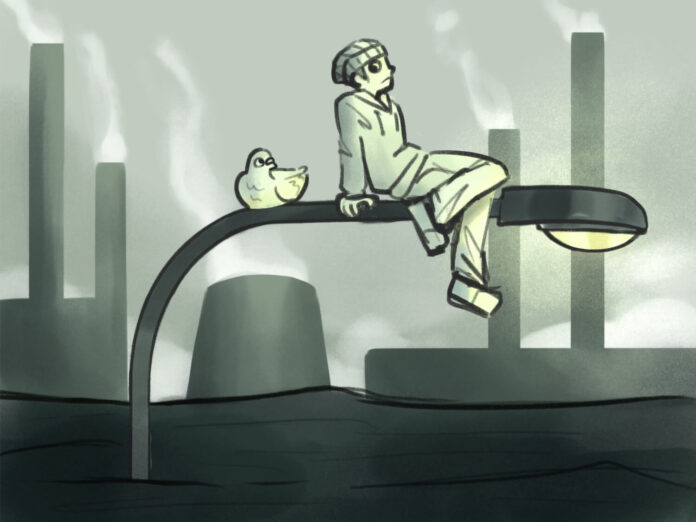
Last month, the federal government tossed 17 years of climate policy out the window. The Environmental Protection Agency (EPA) voluntarily gave up its power to regulate greenhouse gases, the chief cause of global warming. Dozens of regulations on everything from oil drilling to vehicle pollutants are now in danger of being repealed. The head of the EPA, Lee Zeldin, celebrated the move as the “single largest deregulatory action in the history of the United States.”
This is bad. The last ten years have been the ten hottest on record. Decades of research show that global warming is one of the most pressing threats to our nation’s health and general welfare. Even before our government abdicated its responsibility to protect its citizens from global warming, the scientific consensus was that more, not less, needed to be done.
To understand how big a step backwards this is, we need to understand how far we’ve come.
When my dad was a kid growing up in 1970s LA, there were days when the smog was so thick he could feel it in his lungs. In elementary school, there were frequent “smog alerts” when everyone had to stay inside for P.E. class. Striking photos from the ’70s and ’80s show LA’s skyscrapers barely peeking out above a dense blanket of toxic haze.
The smog problem was not limited to LA. The national danger posed by smog and pollution would force the government’s hand, and in 1970, Congress would amend the Clean Air Act to impose several strict pollution standards. It was a textbook case of effective government intervention, and the profound decrease in LA smog levels since has meant the city I grew up in looks a lot different than the city my dad knew as a kid.
While the original Clean Air Act strictly regulated dangerous hydrocarbon compounds that formed LA’s infamous smog blankets, the act did not cover greenhouse gases. Smog causes acute, direct health consequences — unlike greenhouse gases. Scientific experts at the time knew that greenhouse gases were behind the creeping rise in global temperatures, but lawmakers were hesitant to regulate. The legendary scientist Carl Sagan, testifying on greenhouse gases’ warming effect before Congress in 1985, warned government officials, “If you don’t worry about it now, it’s too late later on.”
22 years “later on,” our government finally took action. When I was barely four months old, the Supreme Court ruled that — just like the smog my dad knew as a kid — greenhouse gases were air pollutants, and that the EPA had the authority to regulate them. Two years after that decision, the EPA officially recognized that greenhouse gases posed a clear and present danger to public health.
Since its establishment in 2009, this official recognition, known as the “endangerment finding,” has served as a critical piece of our government’s efforts to fight global warming and the danger it poses to Americans. The finding allows the government to set emission standards that regulate the amount of greenhouse gases emitted by cars, planes, oil wells and power plants: disincentivizing the use of greenhouse gas-producing fossil fuels.
That is, until last month. The EPA repealed the endangerment finding — the foundation of all these efforts. Greenhouse gases, welcome back.
Global warming should not be a partisan issue. Backed by decades of research, the threat it poses ought to stand above politics. But, as with almost any issue that demands action from our government, it has been warped to serve political purposes.
A rather infamous example is a 2002 memo from Republican strategist Frank Luntz, which advised his clients to use the term “climate change” instead of “global warming,” as it would make the issue appear less pressing and therefore enable them to cast doubt on the dangers it posed more effectively. Similar strategy memos served as one of the many hallmarks of an anti-climate regulation political movement that would grow in power in the following decades, fueled by millions of dollars from the fossil fuel industry. Zeldin, the head of the EPA and the man behind the repeal of the endangerment finding, was appointed by President Donald Trump, who received nearly $100 million in campaign donations from fossil fuel interests. While many Americans don’t vote with global warming in mind, we are now led by a government unwilling to protect its citizens from it.
As citizens, we ought to place our faith in a government that will act to protect us from threats we cannot tackle alone. We need strong regulations on greenhouse gases to protect us from the dire consequences of global warming. It’s worth taking action, however small, to hold our government accountable on climate issues, whether that’s signing a ballot petition for local pollution limits or voting for lawmakers who prioritize our environment. I think about what my childhood might have looked like in an LA that never implemented smog regulations, with the issue left to fester for decades — yet global warming is far more sinister.
With Carl Sagan’s words in mind, we need to worry about this now.
Contact Julian Levy at jlevy@oxy.edu