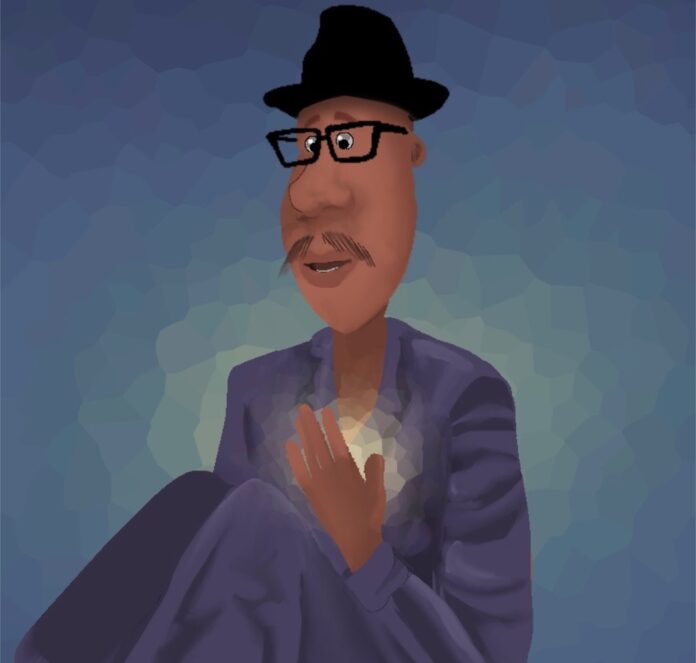
The purpose of life is a daunting question. Existentialists have long tried to find an answer, turning to philosophers like Martin Heidegger or Søren Kierkegaard. Out of all the ways great thinkers have approached the question of life’s purpose, I don’t think any can compare to my favorite animated film of all time: Pixar’s “Soul.”
It’s been a while since I first watched this movie during the COVID-19 pandemic. With May right around the corner, many seniors — myself included — are graduating soon, and the current job market isn’t the best. I think now, more than ever, “Soul” is an important reminder of what is truly important in life.
The film’s protagonist, Joe Gardner, dies almost immediately. The aspiring musician finally gets the musical gig he’s been dreaming of his entire life, before falling down an open manhole. Joe wakes up in The Great Beyond (the movie’s representation of the afterlife), but manages to escape to the You Seminar (formerly known as The Great Before), where souls prepare for life on Earth by filling out their Earth pass. Souls here receive mentors to help them find their spark, but no one explains what a spark is. Joe is mistaken for a mentor, and is partnered with a soul named 22. 22 has been at the You Seminar for quite some time, unable and unwilling to find her spark. Joe takes this as an opportunity to help motivate 22 to find her spark, so that he can use her completed Earth pass and return to his body in time for the gig.
At first, a spark appears to be what a person is most passionate about in life. Joe and the other mentors watch a montage of various souls exploring interests in the Hall of Everything, ranging from archery to photography. Joe — much like the viewer — believes that a spark is equivalent to a purpose: what you’re meant to do in life. It’s comforting to know that you have a purpose in life, whether or not you know what that purpose is. Maybe that’s why we, as viewers, are so inclined to align with Joe’s interpretation of a spark.
However, the definition of a spark is never confirmed. Rather, the connection between a spark and a purpose is ridiculed towards the end of the film. I find it fascinating that we are never explicitly told what a spark is, and yet we immediately assume that it’s a soul’s purpose (likely influenced by Joe’s own interpretation of the term). I think the best part of this film is the creative choice to keep the meaning of a spark undefined. All we get are glimpses, teases as to what it could be. The only thing we know for certain is that a spark isn’t a purpose. Like Joe, we’re left wondering. If a spark isn’t a purpose, then what is it? What is my spark?
There’s something so beautifully ironic about omitting an explicit definition of the spark. Joe’s arc teaches us that attributing our life’s purpose to a single goal doesn’t mean you’ll magically become happier once you achieve it. Joe finally achieves his dream: he absolutely kills the jazz show, but he still isn’t happy. This moment of realization was when it all clicked for me. I wasn’t necessarily as passionate about anything as Joe was about music, but I could relate to that heavy feeling of unmet expectations.
I attended the University of California, Santa Barbara (UCSB) for my first year of college, and I thought college would make everything fall into place. Up until that point in my life, college was the goal. But once I achieved that goal, it wasn’t at all what I anticipated. Along with the heavy imposter syndrome and debilitating homesickness, I realized I had been blinded by the idea of college and that admission to UCSB wouldn’t suddenly make me happier.
After Joe returns home from his gig, he sits at his piano bench and tries finding solace in music, as he always has. He places his fingers on the keys, and they drag as he’s unable to bring himself to play anything substantial. But then he looks over at his side table with all the things 22 collected during her journey in his body: a seed, a pizza crust, a mostly-eaten bagel, a lollipop and a spool of blue thread. Things neither he nor we would’ve thought 22 would keep, and yet she did. He reminisces about the memories she made associated with each item and goes further still to his own life. He remembers his mom helping him take a bath, listening to records with his dad and watching fireworks with his parents on the roof of their New York apartment. This recollection of nostalgia is Joe’s epiphany.
That’s what we have to learn from “Soul.” Whatever purpose we might have on this planet is unimportant. If we become obsessed with a perceived purpose or with trying to find one, we’ll become disconnected from life and ignore all the little things that give it meaning. There’s nothing wrong with having goals or wanting to strive toward some perceived purpose, but the minute it becomes an obsession is when you’ve become disconnected from life. That is our purpose: to wander aimlessly, unaware of whatever purpose we might have.
As a senior, I’ve applied to jobs like crazy for the past month, but I haven’t let my desire for stability get in the way of everyday moments. I don’t know what a spark is, nor do I want to know, but what I do know is that I’m going to live every single moment of my life.
Contact Amy Wong at awong3@oxy.edu