When the Atlanta Hawks announced “Magic City Monday,” it initially felt like just another themed game night. The promotion promised lemon pepper wings, exclusive merchandise and a halftime performance from T.I., all in tribute to one of Atlanta’s most well-known institutions. Then the backlash began.
San Antonio Spurs center Luke Kornet publicly called for the event’s cancellation, arguing that celebrating a strip club made the league “complicit in the potential objectification and mistreatment of women.” Within weeks, the National Basketball Association (NBA) stepped in and canceled the promotion, citing concerns from across the league.
The story moved quickly. It sparked debate, generated headlines and then disappeared just as fast. But the question it raised did not.
I grew up watching men’s basketball, and even as a kid, something felt off. The players on the court were celebrated, their names on jerseys, their stats debated at school. The women on the sidelines wore different uniforms for different reasons. I remember asking my mom why the women weren’t playing. She didn’t have a great answer. Looking back, that silence said more than any explanation could have.
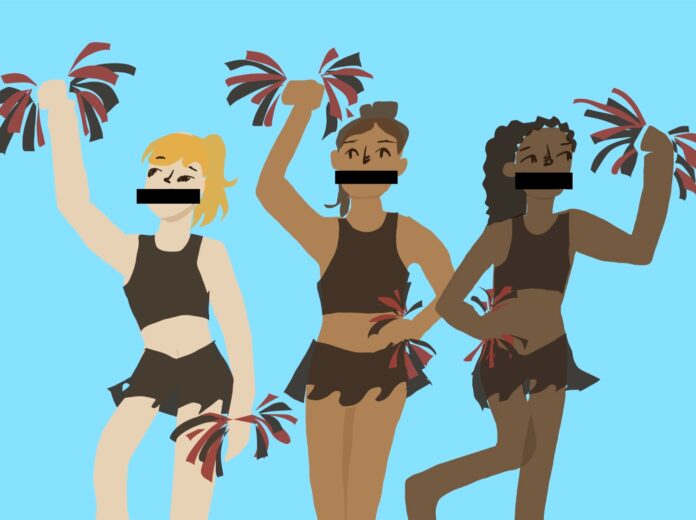
Long before “Magic City Monday,” women were already part of the NBA’s product. Every game features a dance team. Every performance is choreographed, costumed and built into the entertainment of the night. The format is so familiar that it rarely registers as noteworthy, which is exactly what makes the reaction to Magic City feel different. The concern was not about the presence of sexualized performance. It was about acknowledging it.
At a typical NBA game, dancers perform in coordinated routines while male athletes command the court and the salaries. The structure is not subtle, but the league rarely frames it as controversial. Instead, it presents it as tradition, entertainment and part of the overall experience. League officials do not issue statements on objectification, nor do they call for reform. But when the same dynamic becomes explicit through a strip club collaboration, the response shifts immediately. The distinction is less about what is happening and more about how visible the league allows it to be.
Philosopher Martha Nussbaum describes objectification as reducing a person to what they provide for others, treating them as instruments rather than as agents. From this perspective, the issue is not simply whether sexualized performance exists. The issue is who controls it, who benefits from it and whose labor the public chooses to overlook. Kornet’s statement reflects this tension. His call to protect “daughters, wives, sisters, mothers” frames women through their relationships to men, a language that often appears in conversations about protection. Although the sentiment may be well-intentioned, it shifts the focus away from women as workers with agency and toward women as people whose value derives from someone else.
At the same time, the women already working within professional sports entertainment remain largely absent from the conversation. The conditions they face are not new. Reports over the past decade have documented low wages, strict appearance standards and limited labor protections in cheer and dance programs. Lawsuits, including one filed by Houston Texans cheerleaders in 2018, have described systems of surveillance and control that extend far beyond performance. Those realities have not generated the same level of urgency. Instead, outrage appears most forcefully when the association becomes too explicit, when the boundary between “respectable entertainment” and adult labor becomes harder to maintain.
Even then, the workers themselves often get excluded from the discussion. In the case of Magic City, several dancers expressed support for the collaboration and described their work as performance, even art. Their perspectives circulated far less widely than the criticism. The debate, in other words, did not center on these women.
Supporters of the NBA’s decision might argue that the league has a responsibility to maintain a family-friendly environment and to avoid explicitly associating itself with adult entertainment. From that perspective, canceling the promotion was not about denying existing dynamics, but about setting reasonable boundaries for what the league chooses to endorse publicly. Professional sports operate as mass entertainment, and preserving a broadly accessible image is part of that role. That argument carries weight. Leagues do have to consider audiences, sponsors and public perception. Not every form of cultural expression translates seamlessly into a stadium setting.
However, that distinction becomes less convincing when the underlying dynamics remain unchanged. If the concern were truly about objectification, it would extend to the structures already embedded within the game-day experience. Drawing the line only when the association becomes explicit suggests that the issue is not the dynamic itself, but its visibility. It is tempting to interpret the NBA’s decision as a protective measure, a clear line drawn in defense of women. However, the line is selective. The league did not dismantle its dance teams, nor did it address working conditions. It canceled a promotion. That distinction matters.
Professional sports rely on carefully managed images. Certain forms of performance are acceptable as long as they remain contained, stylized and familiar. Others, even when they closely resemble what already exists, are treated as crossing a line. In this case, the league is not protecting women as much as it is protecting its own image. That image depends on a careful balance. The spectacle can include stylized versions of femininity, but only within limits. It must remain suggestive without becoming explicit, and visible without being acknowledged too directly. “Magic City Monday” disrupted that balance by making something explicit that usually remains implicit. When that happened, the league did not reevaluate the system. It restored the boundary.
The promotion was canceled, but the underlying structure remained unchanged. What appeared to be a stand against objectification ultimately aimed to manage how that objectification was perceived. The league did not remove the dynamic; it simply reinforced the conditions under which it remains acceptable.
Contact Samhita Krishnan at krishnan@oxy.edu