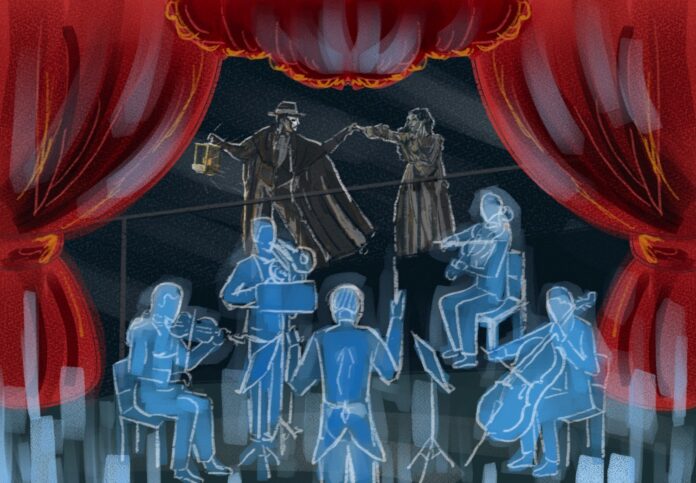
“The Phantom of the Opera” is one of the most recognizable musicals ever, if I may be so bold. When asked to think about it, what do you see? The half-mask? A rose? Maybe the iconic chandelier? A variety of images may come to mind. Now, what do you hear? There is an almost ubiquitous answer. How could it be anything other than the chromatic scale of the musical’s opening motif? Instantly recognizable, the chromatic scale, performed at the beginning of every showing, is one of the highlights of a live performance of this musical. But what if I told you that if you were to see “The Phantom of the Opera” live today, those iconic scales would likely be a recording?
Since the show’s first run, the original 27-member orchestra has been cut multiple times as a result of budget, spacing and various other factors. The current American tour orchestra sits at half of its previous force, with 14 musicians. This is not a problem unique to “The Phantom of the Opera”; lots of musicals use keyboards and recordings to pad out the soundtrack. After all, how audible is the difference anyway? Well, that’s not really the underlying issue. Yes, sound quality is hugely important in live performances, especially in music-centered productions like musical theatre, operas or ballets. But the shrinking of “The Phantom of the Opera’s” orchestra is indicative of a larger systemic issue with Broadway, musical theatre and the performing arts as a whole.
Actor Timothee Chalamet recently stated, “I don’t want to be working in ballet, or opera, or things where it’s like, ‘Hey, keep this thing alive, even though like no one cares about this anymore.’” As someone with no strong feelings or thoughts towards Chalamet, his comment made me reflect on the state of our public arts today. His comment ignited an online firestorm about the role these forms of media played in shaping the modern theatre and cinema scene. Despite being a fan of the opera and the ballet, I couldn’t help but agree with his sentiment to an extent. Even in online discussions, Gen Z does seem to accept that these arts are in decline. As a generation, we seem less inclined to continue supporting the opera or the ballet. Yet, this decline may not be completely intentional.
Earlier this week, my friends and I were looking forward to seeing the musical “Hadestown” at the Cerritos Centrer in Riverside. While shopping for tickets, we realized that we had effectively been priced out of seeing the show. Good visibility seats (e.g., stalls or second balcony) often cost anywhere from $135 to $360. Now, I’m sure some of you are jumping out of your seats to remind me that pricing is proportional to a good view, and that if I wanted cheaper seats, I should be willing to sacrifice something. I won’t disagree with that point of view, but I do believe the arts should be accessible to everyone. As a college student, I’m lucky to occasionally get access to student discounts or free tickets for the LA Philharmonic and other local events. For others who don’t have access to these benefits, attending live theatre is costly.
Since the pandemic, our generation’s spending habits have changed. Culturally, our generation has been raised to consider frugality and practicality in our spending. Simply put, to engage in these types of arts frequently, you have to have enough money.
Of course, there are other reasons for a decline in attendance. Danny Feldman, an artistic director at Pasadena Playhouse, said in an interview with the LA Times, “The passive arts experience is less interesting to [Gen Z]. The trend is that they’re makers, content creators.” But is that really the case? According to a recent study published on Playbill, over 67% of Millennials and Gen Z are “Broadway curious.” The article acknowledges that the most common reason for hesitating to purchase tickets is pricing, yet notes that 83% of respondents want to use the theatre as a space to disconnect from the internet.
Ultimately, the issue seems to boil down to finances. Producers cut down the orchestra or the cast to save money, and people can’t attend because the tickets are out of their price range. The result? High ticket prices draw audiences to older shows they already know, where they can guarantee a satisfactory experience, dooming new shows to increasingly precarious openings.
As old-fashioned as it sounds, I think patronage should make a comeback. No, not patronage in the traditional sense, where patrons have extra control over productions or management, but something adjacent. Millionaires and billionaires sit on their dollars, and use this money to wage war, exploit workers and police our bodies. My solution? A millionaire tax that funds and subsidizes the arts for the general public. They shouldn’t know which exact production their funds go to, to limit interference over thematic disagreements, but maybe allow some privileges, like nicer seating or free tickets every once in a while, to keep them incentivized.
I’ve always thought the arts are the soul of humanity; to be cut off from them or limited by finances is a shame. Artists and audiences alike want to be a part of these vibrant experiences. Why should we let money stop us from having the communities we’ve been yearning for? Maybe recordings will continue to replace orchestras, but those recordings can’t recreate the music’s soul. Operas and musicals like “The Phantom of the Opera” have been driving forces behind my motivation and sparking creative ideas for years. In their performances, actors, musicians and crew remind us to push boundaries and continue appreciating the arts around us. I hope the passion we each carry for music, dance and the performing arts drives their continued adaptation and survival.
Contact Levi Lee at leev@oxy.edu