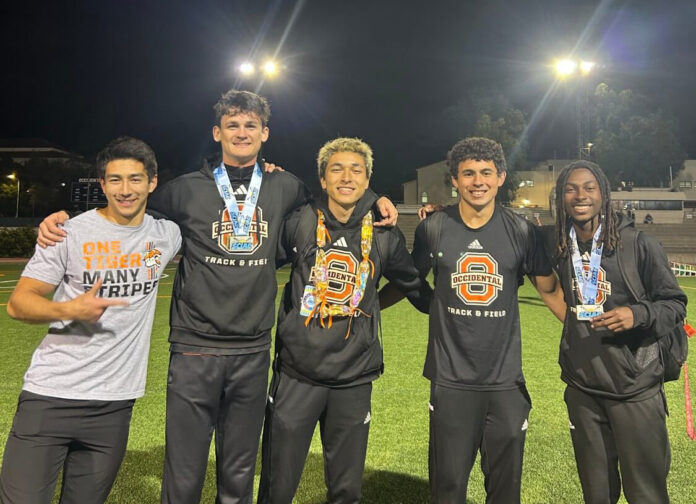
At the Pomona-Pitzer Salo & Crenna Invite Feb. 21 the men’s 4×100-meter relay team, made up of Collin Glick (sophomore), Shane Kawakami-Williams (junior), Emerson Ames (junior) and Zachary McGraw (junior), ran the relay in 40.97 seconds — a personal best and the fourth-best time in program history.
Collin Glick, First Leg
The 4×100-meter relay is exciting, according to Glick, because it is a team race that relies not only on talent, but also on team chemistry.
“There is always some sort of ambiguity to [the race],” Glick said. “You can always improve handoffs, you can improve how you run on the curve. Everyone puts in the work and you know that it’s a team effort.”
During meets, such as the Salo & Crenna Invite, Glick said the relay team completes a group warm-up and then a separate relay warm-up.
“We warm up a little bit earlier than some of the other events,” Glick said. “A lot of relay teams will still [practice] handoffs [at meets]. We don’t really do that, I think we have good chemistry [as a] team.”
Before the race begins, Glick said he checks in with his teammates, but that once he is on the starting blocks, he focuses only on his job — running a hard opening leg.
“As the first leg, I’m thinking ‘Alright, I just need [to] hand off the baton [and] execute what we’ve been doing in practice,’” Glick said.
When he is done running, Glick said he hands off the baton to Kawakami-Williams, who takes off on the straight-away for the next 100 meters.
“I trust [Kawakami-Williams] when I give the baton off to him,” Glick said. “I know he is really fast, and will catch some guys. Usually, we get that lead and once I see it go over to [Ames], that’s kind of when the race ends and I am not worried. That’s the difference between individual events and the relays, you need to have faith not only in yourself but [also] in your teammates.”
Shane Kawakami-Williams, Second Leg
According to Kawakami-Williams, the baton hand-off from Glick is often quick and that the team is looking to improve upon the fast transition.
“Sometimes I have a very poor reaction, so I’m thinking: ‘Let’s react,’” Kawakami-Williams said. “I’m watching [Glick] and then as soon as his foot hits the line, I just run while keeping calm.”
At the NCAA 2025 Track & Field Nationals, Kawakami-Williams placed 19th in the 100–meter dash. However, Kawakami-Williams said he sometimes struggles with the relay in comparison to the solo events.
“There’s so much pressure [during] the relay because you’ve got your three other teammates depending on you,” Kawakami-Williams said. “That would get to my head and I’d somehow run worse.”
Kawakami-Williams said for this season, he is trying to focus on the mental aspect of running his leg.
“I try to get out of my own head — low stress, low cortisol — just keep as calm as possible,” Kawakami-Williams said. “I am reminding myself that this is the same distance [as my solo runs]. It’s 100 meters. Even though I have a baton in my hand, it’s the same distance. It helps.”
After his leg, Kawakami-Williams said he tries to run through the spot where Ames is waiting for the baton, in hopes for a smooth and quick hand-off.
“After I pass, I consistently will yell at [Ames] something like ‘Go, go,’” Kawakami-Williams said. “I scream at a very loud volume, louder than everyone else in the race.”
Emerson Ames, Third Leg
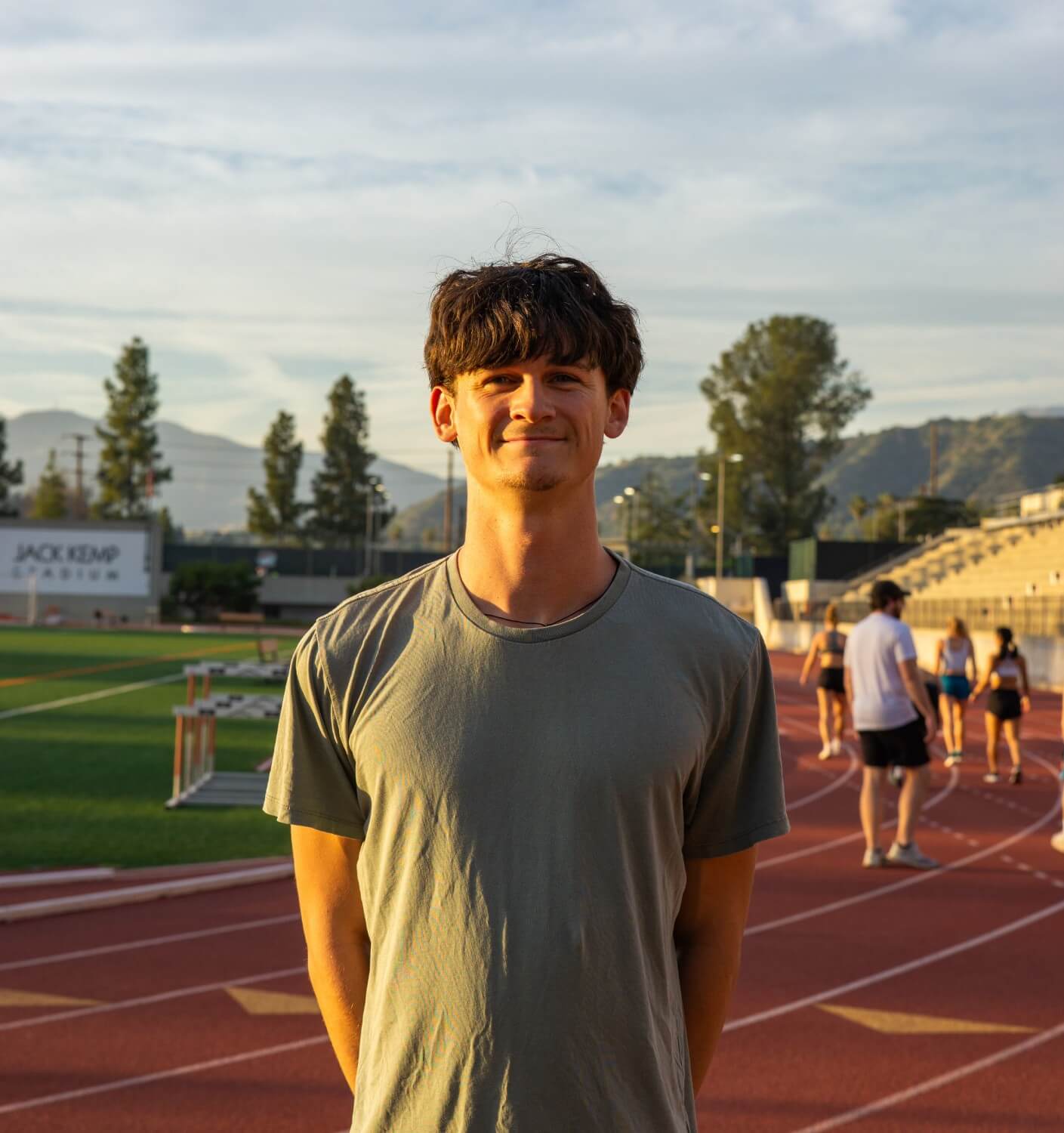
Once the baton is passed from Kawakami-Williams, Ames said he tries to remain intentional about running through McGraw — their anchor.
“Focusing on that one goal allows [me] to execute properly,” Ames said. “Track is very mental. You need to keep your head in the race instead of scattered.”
According to Ames, the relay team’s recent success at the Salo & Crenna Invite is a culmination of all of their off-season work.
“We’re stronger [and] faster than we were last year,” Ames said. “And we’re all returning to the same team, so we’ve got that chemistry already there.”
Ames said the relay team’s personal best of 40.97 seconds is just the beginning for this season.
“We have almost four more months of training and we’re already running faster than we’ve ever run as a group,” Ames said. “Our goals [for the season] are definitely going to be very high.”
One of those goals, according to Ames, is to make nationals.
“[I want to] make the finals at nationals,” Ames said. “It’s been a very long time for our coach, and it’s never happened for us.”
When he runs, Ames said he only focuses on the race and getting the baton to McGraw. Once he completes the hand-off, Ames said he also shouts encouragingly at McGraw.
“We all just put our faith into each other,” Ames said. “[Shane’s] yell kind of exemplifies that faith. I definitely do the same thing.”
Zachary McGraw, Anchor
Since McGraw is the final leg of the race, he said he is normally set up in a position to succeed.
“It’s been lucky for me since [the first three legs] have been able to get leads most of the time,” McGraw said. “I haven’t really had to worry about competition as long as I’m able to get the baton, which is good.”
Especially when it comes to executing the small details of the race, such as receiving the baton, McGraw said he relies on the team’s experience and training.
“We’ve done basically the same order [of legs] all of our time at Oxy,” McGraw said. “It’s about trusting the work we’ve done.”
McGraw said his goal for the relay team is to win SCIACs and qualify for nationals, but that for now, they are focusing on beating the clock. McGraw, Ames, Kawakami-Williams and Glick all said that a time of 39 seconds is their ultimate goal — the Occidental record.
“We’ve been doing the [4×100-meter relay] for a couple of years, and we’ve been kind of waiting for a breakthrough,” McGraw said. “We got that at [Salo & Crenna]. We have a lot of chemistry and these guys are so much faster than they were last year […] I am so excited.”
Contact Nora Youngelson at youngelson@oxy.edu