
























Occidental College was ranked 151st out of 257 American colleges for its “free speech climate” by non-profit organization the Foundation for Individual Rights and Expression (FIRE) in its 2026 Free Speech Rankings, with an overall grade of 56.6 out of 100, according to the website.
“Student perceptions present a sharp contrast. While Occidental places in the top 25 for ‘Openness,’ it also ranks in the bottom 25 for ‘Political Tolerance,’ indicating student reluctance to welcome speakers with opposing viewpoints,” FIRE writes on its website.
FIRE’s Chief Research Advisor Sean Stevens said FIRE partners with a polling organization called College Pulse, which surveys panels of undergraduate students at various colleges to collect data on a wide range of political topics and demographic information. They target around 125 to 150 students at smaller liberal arts colleges, and 200 to 250 at bigger state schools to collect representative samples, according to Stevens.
The data is based on a roughly 20-question survey that was given to 151 anonymous students from Occidental, according to FIRE’s website. The questions cover the state of administrative support, comfort expressing ideas, self-censorship, disruptive conduct, political tolerance and openness, as well as gathering the demographics of the respondents. Stevens said that while the survey has been mostly the same since 2021, FIRE might add or change questions based on current events or trends.
Stevens said FIRE uses three databases to make the ranking that quantify speech controversies at a school. The first focuses on school events, like talks, performances, movie screenings and art exhibits. The second is called “Scholars Under FIRE,” focusing on professors and researchers, and the third is called “Students Under FIRE,” which looks for students who were targeted for using their freedom of speech, according to Stevens. No significant controversies in 2025 were recorded for Occidental in the ranking.
Associate Professor of Comparative Studies in Literature & Culture Jacob Mackey said he has been a card-carrying member of FIRE since 2020. According to Mackey, it is important that organizations like FIRE exist because First Amendment rights require constant vigilance to be defended, and one cannot count on the government to do that for its citizens.
“[Repressing free speech has been a] very frequent occurrence, especially over the last 10 years. The colleges and universities have violated their own principles of academic freedom and free speech,” Mackey said. “Who is going to step in and attempt to force them to respect their own principles of freedom of expression, if not some kind of civic organization like FIRE?”
Mackey said it is not just the college institutions themselves that suppress the freedom of speech, but also faculty, the administration, students and outside groups that play a role.
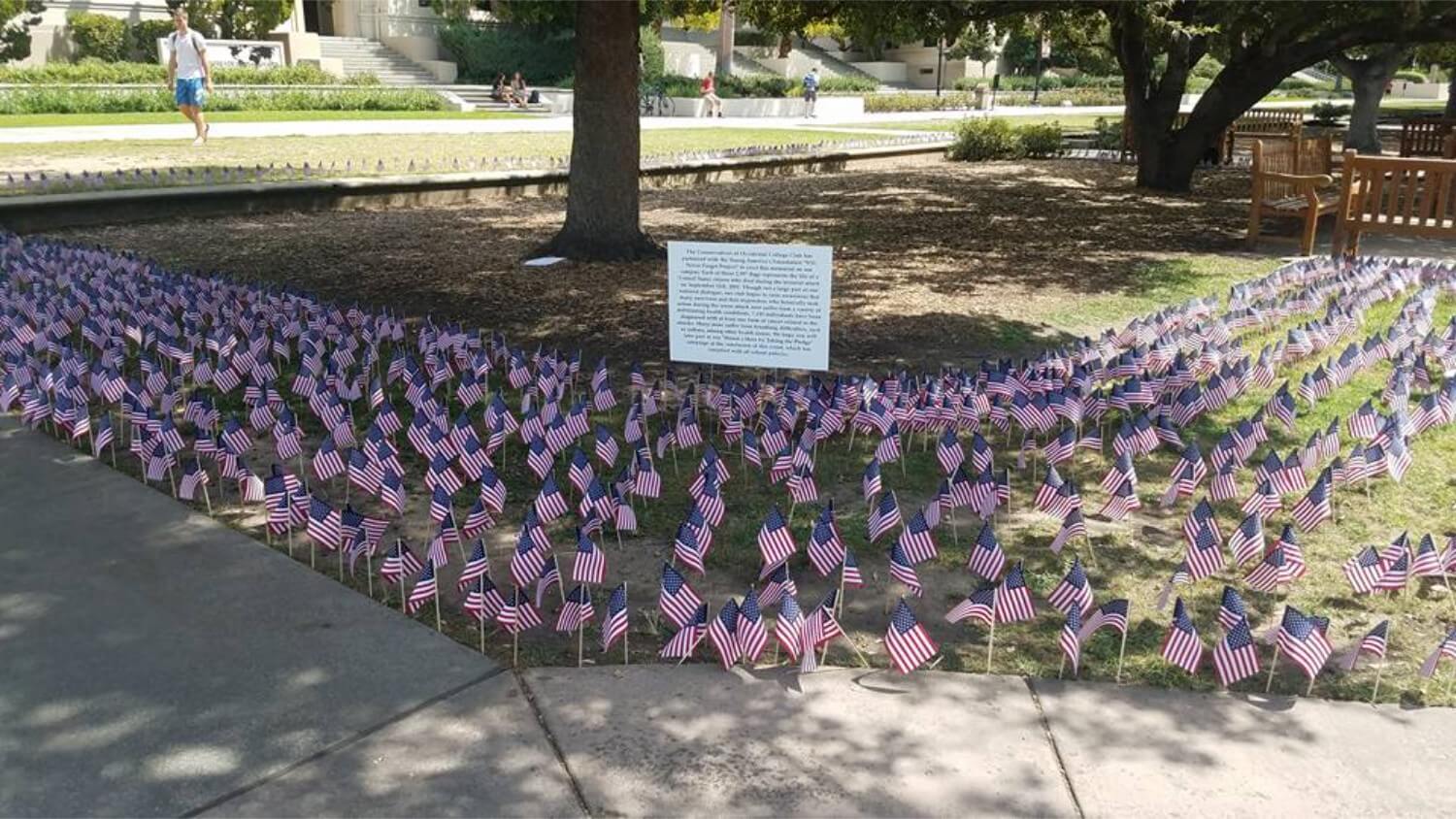
Sumner Schwartz ’18, who was responsible for the passing of the Faith and Conscience Policy in Spring 2017, was an e-board member of the now-disbanded Occidental Conservatives Club. Schwartz said there were many instances — one of which being the vandalism of a 9/11 memorial the club planned — throughout his time at Occidental where he felt that his freedom of speech and that of his peers had been suppressed due to their conservative values.
Schwartz said in his junior year, he and members of the then Republican Club received approval to set up a 9/11 memorial. They planted 2997 flags on the quad for each victim of the terrorist attack. The next morning, the flags had been taken and thrown in trash bins.
Tejas Varma* (senior) said he believes having political discourse with conservative voices is a beneficial aspect of a college education, even though he considers himself left-leaning.
Varma said he enjoyed having debates with Occidental’s Professor Emeritus of Economics, Daron Djerjian, whose contract the college did not renew. According to Varma, Djerjian strengthened his views on the political economy, despite Varma identifying as a democratic socialist, and Djerjian a free-market economist. Varma said he and many others believe Djerjian’s conservative views may have been one of the reasons why the college failed to renew his contract.
Occidental Students for Justice in Palestine (SJP) spokesperson Tobias Lodish (junior) said he believes the college has not been supportive of on-campus protests that it felt would tarnish the college’s reputation, and has increasingly become hostile toward them.
“Every year the school restricts acceptable policy compliant protest and free speech,” Lodish said. “For example, in [the summer] of 2024 they disallowed protests from the hours of midnight till 6:00 am. They disallowed the use of what they called semi-permanent structures as well as sound amplification.”
Mackey said a point of contention between student protestors and colleges is time and place and that colleges do not respond well to anything that interrupts them from fulfilling their mission of delivering education to students.
“There is this tension where protesters have a motivation and incentive to break rules, but by the same token, the institutional authorities have an incentive not to respond favorably to the breaking of rules, right?” Mackey said.
Varma said the college should recognize that the lack of differing opinions and censorship towards opposing voices is a problem and should make changes accordingly. He said he believes Wesleyan University has set a good example of what colleges should do.
“They devoted $3 million in funding to a specific initiative to help expose students to ideas outside of the liberal consensus,” Varma said. “That’s something that I feel the institution could do.”
The college’s Jack Kemp ‘57 Distinguished Lecturer Series is meant to bring conservative speakers on campus. Mackey said the series has failed in recent years to bring speakers with different perspectives since they have all been anti-Trump conservatives.
“All you want to hear is your own opinion but in the mouth of someone who has conservative credentials,” Mackey said. “I think [the series] is not performing any truly useful service when it comes to viewpoint diversity and educating the Oxy community about what other people in America think.”
Xander Campbell-Singer (first year) is a member of Persuasion Club, where he said club members gather to have productive, rather than combative, dialogue.
Campbell-Singer said he believes the campus overall is a free space for students to express their opinions, but that there is an implied social sanctioning effect because students assume that no one can say anything that goes against the college’s mostly progressive consensus.
“Whatever the dominant worldview is, like the progressive consensus in this case, a lot of people who didn’t agree with that, but they don’t not agree with it for hateful reasons,” Campbell said. “They just don’t agree with it because the way they understand the world objectively is different from what some people do.”
Contact Francine Ghazarian at ghazarian@oxy.edu
*Tejas Varma is a staff writer for The Occidental.

Great article and a nice diversity of perspectives from students. Reasonable time, place, and manner restrictions are well-established in First Amendment jurisprudence — restrictions only break constitutional law when they veer into viewpoint discrimination. Ergo, disallowing protests from midnight to 6am is completely reasonable (and legal) as long as that prohibition isn’t selectively used based on the viewpoint of the individual/group that wants to protest.