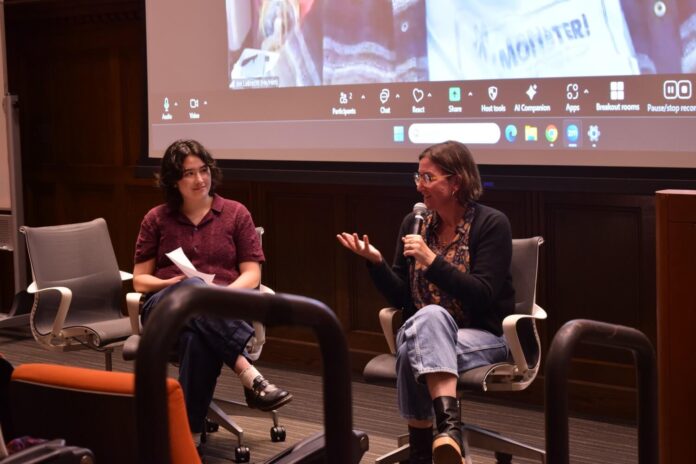
Oscar-nominated directors James LeBrecht and Nicole Newnham were on campus Nov. 3 for a screening of their documentary “Crip Camp,” organized by the Disabled Student Union (DSU) and Disability Services. “Crip Camp” centers on a group of young disabled people who met at a summer camp for disabled teens at the start of the politically turbulent 1970s. The film follows this group, which includes figures like internationally recognized disability rights advocate Judith Heumann and director James LeBrecht himself, for nearly two decades as they go on to become some of the founding members of the American disability rights movement.
Assistant Director of Disability Services Felicia Flores said the screening of “Crip Camp” was chosen as a way to wrap up the month of October, which is Disability Awareness and Acceptance Month. Flores said that Disability Services wanted to highlight how interconnected the history of the disability rights movement is with the broader civil rights movement, which was ongoing during the period the film covers.
“You had these young individuals who would get together every summer, and discover that they had the same challenges,” Flores said. “Having a disability can be isolating, but by discovering their shared struggles they decided to come together to organize, to fight for the right to accessibility.”
Flores said the disability rights movement grew in connection with broader social changes happening in the United States in the ’60s and ’70s. According to Flores, the disability rights movement, which started at Camp Jened (the eponymous “Crip Camp”), was supported by other contemporary movements fighting for the rights of marginalized people. One of these groups was the Oakland chapter of the Black Panther Party.
“At one point, during a takeover of a federal building [by the disability rights advocates], they shut off the electricity,” Flores said. “So the Black Panthers, who were fighting for the same values, stepped in. They brought food, buckets of water, washing supplies and other things that allowed the activists to take care of their basic needs.”
In the Q&A that followed the screening, Co-director Nicole Newnham also mentioned this moment, which is captured in the documentary.
“I think what made the movement so successful was that so many people in San Francisco really supported the people in [the occupied] building,” Newnham said. “We’ve had screenings where people started applauding during the scene where the Black Panthers showed up. It wasn’t just about charity, it was about human rights.”
The second half of “Crip Camp” focuses on the struggle of the Camp Jened activists to get Section 504 of the 1973 Rehabilitation Act signed into law. Section 504 prohibits discrimination against individuals with disabilities in programs and activities that receive federal financial assistance. LeBrecht, who was part of the 504 movement, said that the progress made back then was recently put in jeopardy by the Trump administration.
“The Trump administration has attempted to deem 504 unconstitutional, but the outrage of many, many people caused such an uproar that they pulled back from that,” LeBrecht said. “We may not win every battle but we win some when we push back on stuff like that.”
LeBrecht said that he hopes the film will inspire young activists to get together and organize for change. He said that when the film first came out in 2020, it was used by some in the Black Lives Matter movement as a template for successful community organizing.
“In Portland and other places where demonstrations for Black Lives Matter were happening, people have shown our film as a way to help teach people how to organize, how to be activists,” LeBrecht said.
DSU President Ellie Chang (senior) said that disability rights organizer Judy Heumann, who is prominently featured in “Crip Camp,” is a longtime inspiration for her own activism. Chang said that she sees the film as an excellent introduction to the rich history of disability rights activism in the U.S., and that it holds a special significance to many in DSU.
“I think DSU has been a space where a lot of people begin to claim their identity as someone who’s disabled,” Chang said. “I was talking with the panelists the night of the screening about how the community we’ve built here at DSU feels a little like a mini version of Camp Jened, in the sense that it’s a space where people can be themselves without feeling the need to mask their disability. I think that’s quite special.”
Contact Adam Pildal at pildal@oxy.edu