






























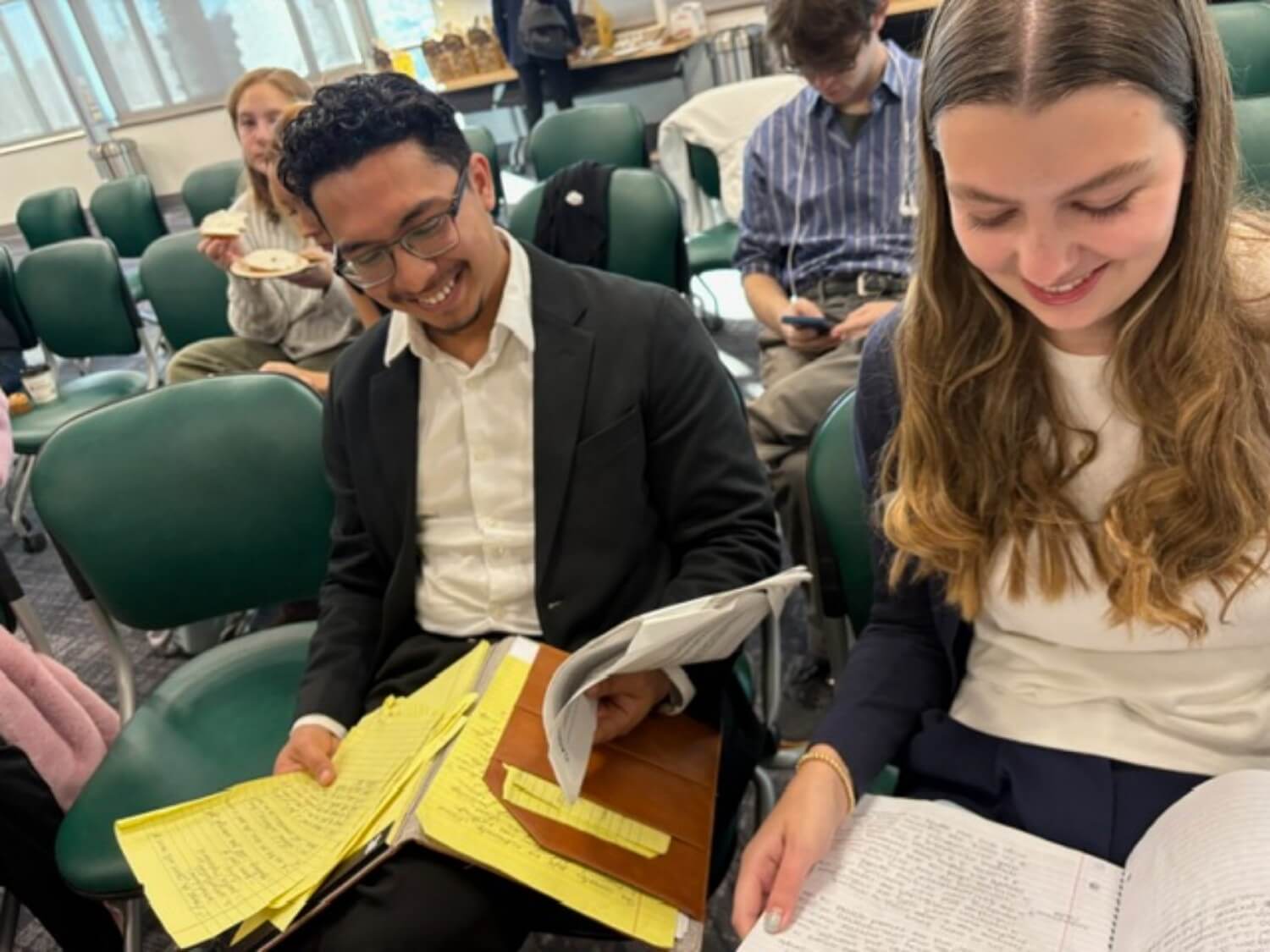
After competing in a regional Ethics Bowl tournament in December, the Occidental College team qualified for the national competition in St. Louis in March. There, students will represent the college in modeling ideal philosophical conversations, according to the team’s coach, Professor Erica Preston-Roedder.
The team was prepared through Preston-Roedder’s fall course,
Ethics Bowl: Contemporary Debates on Ethical Issues, which emphasizes developing thoughtful ethical analysis of cases and articulating these analyses both verbally and in writing, according to the Course Catalog.
Co-captain Edgar Zatarain* (senior) said going into the Dec. 11 competition, the team was prepared but nervous. Zatarain said teams get scored on three parts: their presentation, their response to the opposing team’s interrogation and a Q&A from the judges.
“There’s three judges, and each judge scores you,” Zatarain said. “The top four schools get to go to nationals.”
Zatarain said as the first match started, the other team was fumbling.
“They were talking too fast, they […] weren’t saying the right things, they weren’t answering the questions, and I was like, ‘Oh, I think we can win this one,’” Zatarain said. “We swept them.”
As the competition continued, Zatarain said Occidental’s team kept winning, becoming the first team to qualify for nationals.
Zatarain said the team’s win over club competitors in December caught them off guard, and now they are scrambling to prepare for nationals in March.
“It’s kind of hectic, but it’s […] exciting and fun,” Zatarain said. “It’s going to be a grind this next month.”
Coming from Medford, Massachusetts, co-captain Abby Sloan (senior) said that she had unique exposure to the Ethics Bowl at her high school, which partnered with Tufts University to foster a strong philosophy and ethics program. Sloan said that her familiarity gave her an advantageous perspective.
“It was definitely a very collaborative effort in our meetings, but I think on the day of the competition I was able to […] step up,” Sloan said. “It was helpful to have someone who could delegate.”
Sloan said that having a strong team and Preston-Roedder as a mentor prepared them well for the competition in December.
“Our experience at the competition was not only so much fun, but it was a lot of hard work from everyone,” Sloan said. “I feel like we really pulled together in the final moments.”
Preston-Roedder said her team did a terrific job at the qualifying competition in December.
“It’s always unpredictable what happens at the Ethics Bowl, but I was really pleased with the work that some of the students had done,” Preston-Roedder said. “When we beat Stanford in the early rounds, it felt pretty good.”
Preston-Roedder said the distinction between debate and Ethics Bowl is that with Ethics Bowl, students get to argue what they actually believe.
“Ethics Bowl is supposed to model an ideal philosophical conversation where you explain what you believe, why you believe it, acknowledge why someone might disagree and explain how you would respond to their concerns,” Preston-Roedder said. “It’s similar to debate, but maybe like a kinder, gentler, more authentic form of debate.”
Preston-Roedder said that in the Ethics Bowl, the team works together to decide their positions and arguments.
“It’s both relying on your teammates to know their stuff, but also agreeing with them about the material well enough that you trust each other,” Preston-Roedder said.
Preston-Roedder said team members have to learn when to stick up for themselves and when to compromise.
“When students do disagree about the case, sometimes what happens is one student will present the main argument, and then the student who disagrees will […] present the objections as forcefully as they can,” Preston-Roedder said. “The loyal opposition is an important part of a good argument.”
Zatarain said Ethics Bowl is collaborative, even with opposing teams.
“You guys are kind of working together to try and answer […] what is the right thing to do,” Zatarain said. “The other teams are also trying to fix the same problems, so it very much is collaborative in that way.”

Dylan Kuskin (senior) said that Ethics Bowl hones skills that could help everyone, from lawyers to actors.
“[Ethics Bowl] has given me the opportunity to […] mature my public speaking skills, to have more confidence in myself [and to] see between the lines,” Kuskin said.
Kuskin said emphasis on structured, respectful dialogue feels especially relevant now, during such a politically charged time.
“Ethical conversation has never been more important,” Kuskin said. “One thing Ethics Bowl does […] is gives you an opportunity to learn how to articulate divisive topics.”
Kuskin said this connects directly with what the competition itself is designed to do — engage with difficult topics in a more respectful and structured way.
Although most members of the team are humanities majors, Kuskin said he has seen many people outside of the humanities shine.
“You can be the most shy person on the planet and still excel at it,” Kuskin said.
Preston-Roedder said she has been trying to figure out if Ethics Bowl can bring on additional Occidental students for scrimmages in the future.
“I think it’s so important to avoid the groupthink in the room,” Preston-Roedder said. “As soon as we start talking to other people, we discover new ideas.”
Zatarain said he encourages any student interested in Ethics Bowl to give it a try.
“It’s a lot of public speaking and […] trying to sound eloquent in front of people, and I think that’s useful for anything,” Zatarain said.
Contact Zumyna Kabir at kabir@oxy.edu and Amelia Darling at adarling@oxy.edu
*Edgar Zatarain is a writer at The Occidental.
