






























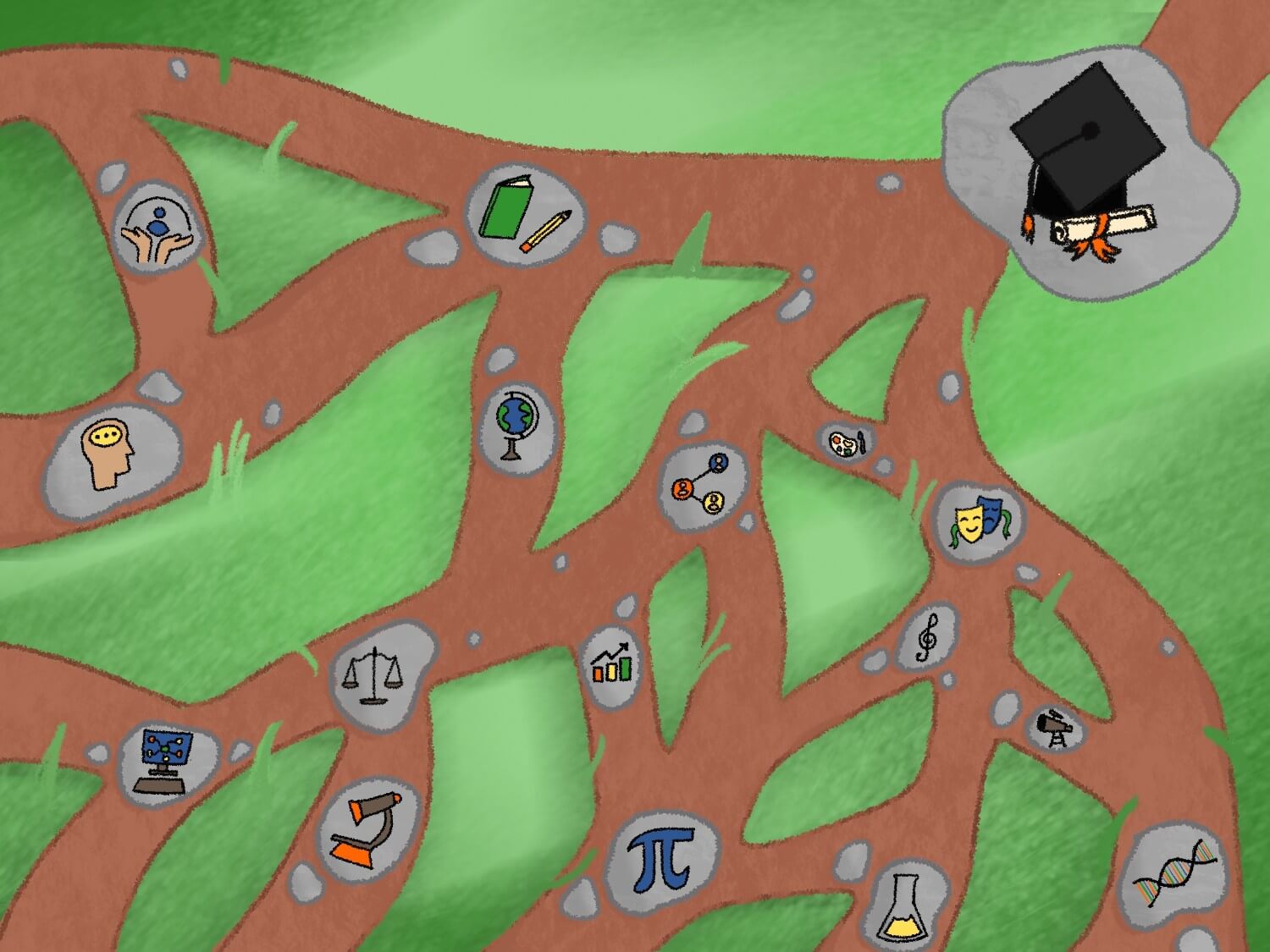
I like to say I didn’t choose my majors — my majors chose me. The department of Critical Theory & Social Justice (CTSJ) seemed like a natural progression from the Social Justice Pathway, a program I was a part of in high school. But for whatever reason, I didn’t take a CTSJ class in my first semester at Occidental.
I did take a First-Year Seminar about the Greek god Dionysus in the Comparative Studies in Literature & Culture (CSLC) department, which, up until that point, I had no idea existed. After being swept up by the magic of that class, I knew I would be incapable of choosing one major over the other. Less than a month into the spring semester, I had declared my double major.
Double majoring is not uncommon at a liberal arts college like Occidental. While an interdisciplinary approach is built into our graduation requirements, pursuing two distinct majors is a meaningful way of going in-depth into multiple fields. Still, I am questioned about how I reconcile being a member of both CTSJ and CSLC.
I understand why some would think critical theory and comparative literature exist at opposite ends of the humanities spectrum. However, CSLC emphasizes the role of storytelling in creating community, and that is what has the liberatory potential to sustain the social justice movements we work towards in CTSJ. The departments are intertwined and are even more powerful in collaboration with one another.
Double majoring is not only a way of supporting our learning as students, but also a way of forging connections between departments at a time when governmental support for the education system is at its lowest. Still, why would I subject myself to the trials of navigating two major requirements, which essentially pre-determine my schedule for the next three years? Not to mention the terrors of completing two senior comprehensive projects simultaneously.
There are many practical reasons to double major. Students automatically fulfill the required 64 credits outside of their major by virtue of taking classes across two separate disciplines. In specific cases, a class can even count towards both majors simultaneously.
Having two advisors to rely on for advice and mentorship is another incredible benefit. It creates a network of support while also opening up a line of communication between the two departments. My CTSJ advisor is the one who seriously encouraged me to double major in CSLC, with the hope that it will help foster future collaborations.
Perhaps most crucial is the unifying aspect of double majoring. As students representing two or more departments, depending on their minors, we have a responsibility to connect the work we are doing across our varied disciplines. Our coursework must not exist in a vacuum — we must take initiative to bridge the gaps that exist between different schools of thought and start conversations that may not arise without our presence in both departments.
Amidst issues of censorship, funding cuts and outright attacks on higher education institutions by the Trump administration, we cannot afford further division between the humanities and the sciences, and certainly not within departments. Rhetoric that pits majors against one another is harmful to students and faculty, and serves to further legitimize Trump’s plans to weaken the influence of colleges and universities.
The most radical thing we can do as students, while operating within the boundaries of the institution, is to seek out connections between our majors and constantly emphasize the relationships between them. As enrollment drops, each department needs every student it can get, and our participation in multiple areas is one way we can contribute to the preservation of diverse perspectives and ideas.
I acknowledge that fulfilling a double major, especially when the subject matter doesn’t overlap, can be a huge challenge. You have to navigate core requirements, study abroad considerations and personal interests to meticulously craft a schedule that allows you to graduate on time. As tuition continues to rise, the ability to stay enrolled all four years is a privilege, and one that those double-majoring must take into account to complete their requirements.
Despite these challenges, I believe double-majoring is worth the commitment. Not only am I academically exposed to a rich tapestry of ideas, but I also have the privilege of being part of two distinct communities that constantly inspire me.
In their seemingly contradictory nature, my majors actually complement each other by providing two equally integral perspectives. One teaches us the ways our society is unjust and how we can work towards repairing it, while the other reminds us why we are fighting for justice in the first place, and how to imagine a truly liberated world.
It is a labor of love to balance two departments on one’s shoulders. But as my CSLC professor reminds us so often, “χαλεπὰ τὰ καλά” — beautiful things are difficult. If you are fortunate enough to care about two subjects with such a deep passion, do not let campus bureaucracy frighten you from pursuing the departments that matter to you, even if the requirements may seem daunting. You might just be the thread that holds them all together.
Contact Athya Paramesh at paramesh@oxy.edu

This is so beautifully written and with such clarity. The ideas expressed and put forward are unique and thought provoking and insightful.
Great job!!