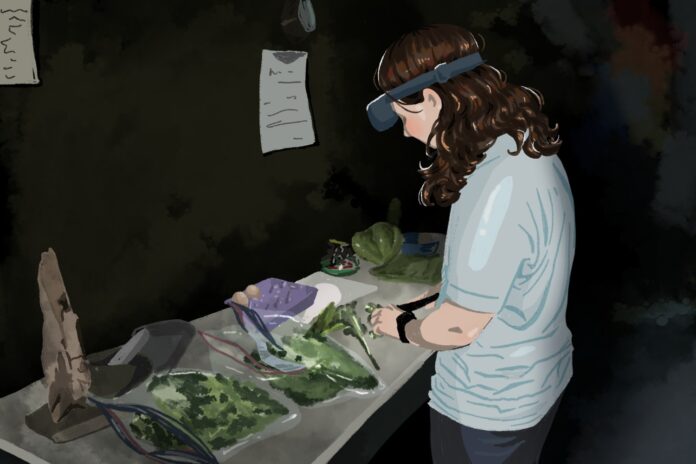
In the pine-needled winter of rural Georgia, I learned how to return to the bare necessities of living. Without running water, electricity and most, if not all, of the material comforts we have to come to enjoy in the modern era, I cultivated a gratitude for what Earth has to offer us without the disguise of capitalistic greed and competition. I spent time in an environment where the most pressing need was staying warm through the night, and I realized how trivial most of my daily anxieties seem compared to those that come with living off the grid.
Over winter break, I visited Salamander Springs, a permaculture farm in Milledgeville, Georgia through the WWOOF (Worldwide Opportunities on Organic Farms) organization. For 11 days, I weeded, built fires, cleaned a chicken coop, farmed fresh produce and experienced a life far different from the one I have grown accustomed to both at home and at college.
When I arrived at Salamander Springs, Debbie Waugh –– owner of the homestead and long-time sustainability educator –– showed me around the property and led me to my cabin. I found myself facing the reality of my situation, mainly the fact that there was no bathroom. If I wanted to go, I had to squat outside. At 3 a.m. I found myself outside of the cabin, trying to find somewhere to do my business, praying a bug would not crawl up my leg.
As I got more accustomed to life on the farm, the inconveniences I experienced at the beginning of my visit slowly morphed into simple daily habits. My days started at 7 a.m., when the crow of a rooster would jolt me awake and leave me rolling around in my sleeping bag on top of a dirty mattress. With temperatures reaching below freezing at night, I wore four layers on top, three on the bottom and two on my feet. Later on, I found myself naturally waking up at that time, excited to start the day. I always looked forward to my first sip of coffee in the morning: fresh grounds hot off the campfire stove. The food tasted infinitely better knowing it came straight from the chickens or the garden.
My day-to-day tasks varied, but I spent the most time weeding in the main garden area. I sat on a bucket for 3–4 hours, listening to the “Middle Georgia” radio station on a tiny wireless box set. During the day, all electronics stayed in the library, where they charged via indirect solar power. My screen time each day stayed below 20 minutes. When I was on my phone, it was in private and primarily to contact my family.
Staying off all electronics allowed me to connect with strangers in a way I didn’t think possible. One day while gardening, I had a three-hour-long conversation with two WWOOFers about socialism, artificial intelligence and the role of a university education. I had met them the day prior.
When I wasn’t working in the garden, I read, wrote, played board games and wandered around the property. Over the course of 11 days, I had started and finished an 800-page historical nonfiction book, written over 30 full pages in my journal and played “Bananagrams” more times than I can count. I walked on a slackline until the sun went down and played guitar and mandolin around a campfire.
It is easy to say I support environmental restoration without actually doing the work myself. Although my stay at Salamander Springs was at times physically and emotionally draining, in those 11 days I was able to reconnect with my own values regarding sustainability, community and open-mindedness.
During my first couple of days at the farm, the owner Debbie Waugh mentioned a documentary called Dive! in which a man dumpster dives at one Trader Joe’s in Los Angeles everyday and is able to feed his family for a year. I now realize how frequently I take for granted the food I waste, the amount of electricity I expend and the resources I take advantage of without understanding where they come from and who procures them.
I also realized how much I take amenities like sinks, toilets and laundry machines for granted. I have never wanted to wash my face and brush my teeth in a bathroom so badly. The space heaters I often assume are a given seemed luxurious compared to the stove furnaces we had to start a fire in every night. Eventually I stopped caring how I looked because most of my pants had chicken poop on them and because the “shower” was a hose nestled in a shed in the middle of the garden.
The experience taught me basic survival skills like how to build a fire, but I also experienced a world in which materialism and individualism did not and could not exist. Although I don’t own a homestead, I want to maintain a gratitude for nature in other ways: by reducing my food waste, lowering my phone usage and learning more about how I can personally contribute to a more giving, sustainable world. I now know I don’t need much to be happy; a loving community, firewood and mustard greens are more than enough.
Contact Josey Long at jlong2@oxy.edu