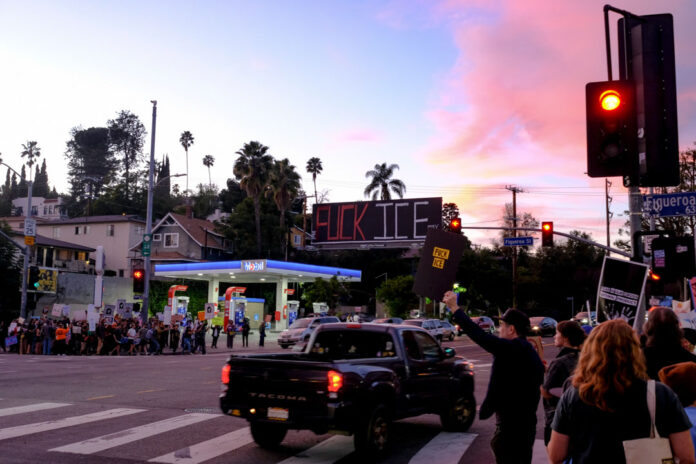
Occidental College students joined demonstrators in Northeast LA (NELA) Jan. 18 to protest Immigration and Customs Enforcement (ICE) activity in Highland Park, according to students and organizers who attended the protest.
The protest, known as “ICE Out of Highland Park,” took place at the intersection of Figueroa Street and York Boulevard and was organized by Native Elders in the region.
Casey Scott (junior), a Critical Theory and Social Justice (CTSJ) major, said his motivation to attend the protest stemmed from federal rhetoric surrounding immigration and its consequences.
“At the root level, what motivated me to attend the protests is the deeply authoritarian and xenophobic rhetoric being pushed in our country and informing policy conditions,” Scott said.
Scott said students should think critically about what follows demonstrations, and protests should be paired with sustained organizing rather than standing alone. Scott said protests can be emotionally and politically powerful, but their long-term impact depends on thoughtful follow-up, ongoing engagement and strategic action.
“The question is how protest actually changes systems of power rather than becoming purely performative,” Scott said. “It’s about affecting the cogs of the machine creating these conditions.”
Scott said safety and preparation are important when attending protests and recommended practices such as attending protests with others and remaining connected. Scott said students should be aware of rapid response networks.

“If students encounter ICE activity, they can reach out to rapid response networks like ICEout.org, CHIRLA or the Highland Park Community Defense Coalition,” Scott said.
According to Julia Wallace, an LA–based social worker, union member and longtime organizer, participants gathered in response to what organizers described as an increase in ICE raids across LA. Wallace said her involvement in anti-ICE protests is rooted in both her political identity and organizing history.
“I feel like it’s important as a Black woman and as a socialist, revolutionary person to be involved in the fights of the oppressed and the working class,” Wallace said.
Wallace said protesting remains necessary under current federal immigration policy and broader political conditions.
“I think it’s important to take a stand against the onslaught of far-right attacks and Trump’s continuing authoritarian measures,” Wallace said. “Protesting is one way to resist, and it shows that there’s massive discontent and unity against ICE and racism.”
Wallace said immigration enforcement is tied to broader systems of power and inequality.
“Racism is the bedrock of U.S. capitalism,” Wallace said.
According to Wallace, such protests combine celebration and resistance, creating space for both joy and anger.
“When I was protesting last June, there was a cumbia group playing music, and people danced in the streets,” Wallace said. “I felt a strong sense of pride, frustration and determination.”
Wallace said demonstrations can foster moments of collective realization and solidarity.
“It’s enraging to see what’s happening, but it also makes you realize how powerful working-class people and oppressed people can be when organized,” Wallace said.
An Occidental student who wished to remain anonymous said the protest felt urgent rather than symbolic, and the demonstration emphasized community care alongside resistance.
“These protests are a place to connect, organize and sustain the movement,” the student said. “There were tables giving out food and information, which made it feel like people were really taking care of each other.”

According to the student, protests also serve as an emotional outlet for participants, providing a space to express solidarity in response to social and political issues.
Assistant professor in Critical Theory and Social Justice Carla Macal said protest must be understood as collective and embodied action.
“Protesting has to be done communally,” Macal said. “There are many ways to protest, including organizing, boycotts and speaking out on campus.”
Macal said protests serve both immediate and long-term purposes by building relationships and sustaining political engagement.
“In the short term, protests build connection, and in the long term, they cultivate discourse, dialogue and networks,” Macal said.
According to Macal, protests are a deeply embodied experience rooted in solidarity.
“There’s a word in Spanish, acuerpar, which means embodiment,” Macal said. “It literally means to put your whole self on the line to be with others.”
Macal said collective survival is central to resistance.
“Solo el pueblo salva al pueblo,” Macal said. “Only the people save the people.”
According to Macal, students should recognize their agency and responsibility, particularly within academic institutions.
“Students forget how much power they have,” Macal said. “They have access to resources and platforms that many people don’t, and that gives them real responsibility.”
Wallace said student participation reflects an understanding of history as ongoing.
“History isn’t something we read about later,” Wallace said. “It’s happening now.”
Contact Samhita Krishnan at krishnan@oxy.edu.