






























Walking into the Ahmanson Reading room on the main floor of the Mary Norton Clapp Library, one of the first sights students come across is a low bookcase containing a collection of books dated to the early 20th century. These are original issues of La Encina, the college’s yearbook.
These yearbooks from Occidental’s early years contain descriptions of many things one might expect to find in modern issues of La Encina: club activities, fraternities, athletics and other aspects of student life. However, among the descriptions of the Occidental literary society and men’s baseball team, the yellowed pages of the old yearbooks also contain an aspect of the college’s past that has been largely forgotten a century later.
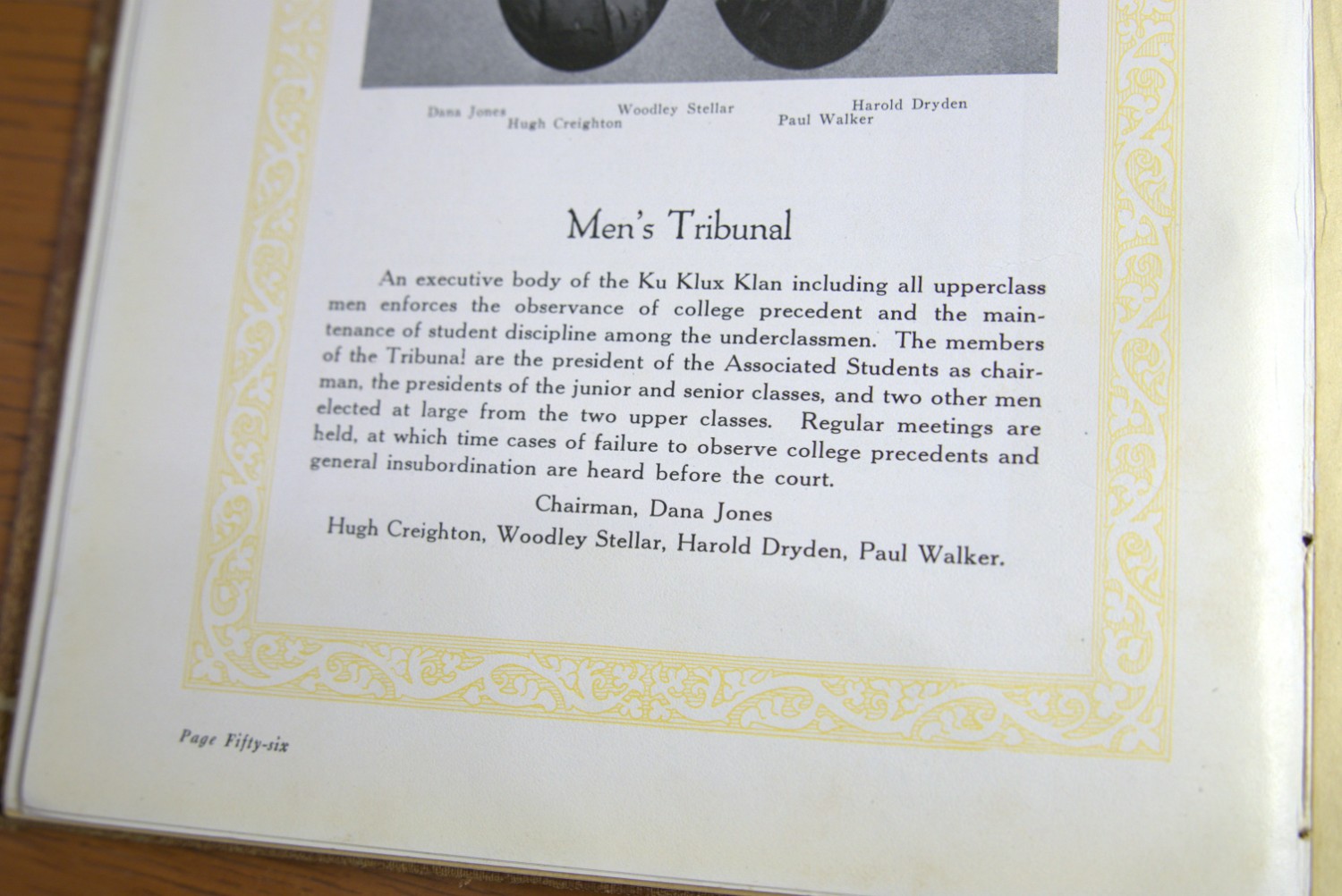
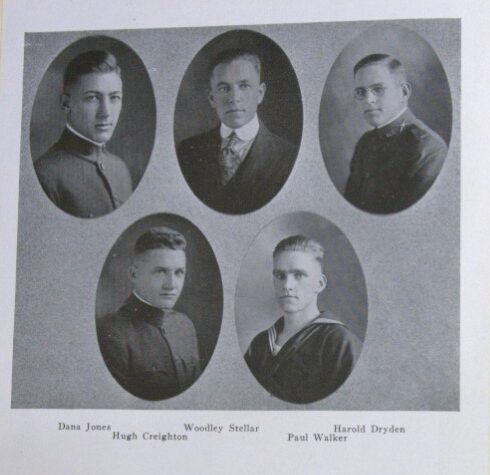
In issues of La Encina from the early 1920s, sections concerning the Associated Students of Occidental College (ASOC) contain a short description of the “Men’s Tribunal,” an exclusively male body of upperclassmen headed by the president of ASOC.
In the 1923 edition of La Encina, the tribunal is described as follows: “The men’s tribunal is the court of upper classmen which administers the affairs of the Ku Klux Klan. All cases of insubordination of freshmen and all violations of the rules of the Ku Klux are brought before this body for trial. Punishments are inflicted publicly upon the Upper Quadrangle, and extreme offenses are punished by periods in the stocks.” Elsewhere in the 1923 edition, a faded photograph shows a flyer depicting a hooded rider dressed in Klan garments and headed by the word “BEWARE” in gothic lettering.
References to the Klan are scattered throughout other issues of La Encina from the 1910s and 20s. Often, the group is mentioned in passing and referred to as an integrated part of college life, appearing everywhere from college calendars and old flyers to the annual section on ASOC.
These frequent and casual references to the KKK raise a range of questions. What was this organization, where did it originate and what was its purpose? How long did it last? Did it face opposition from the student body or faculty? And was this group affiliated with the racist organization which terrorized Black Americans for decades, or was it an unrelated organization appropriating the name and iconography of the infamous hate group?
Professor Erica Ball of the Black Studies Department said the group was almost certainly not directly affiliated with the national KKK. According to Ball, the group’s use of the name “Ku Klux Klan” was likely an attempt to emulate the Klan due to their notoriety and prominence in popular media rather than a signal that the group functioned as a subsidiary of the national organization.
Ball said this phenomenon was not unique to Occidental College. During this period, groups at other universities also sought to imitate the Klan by using their name and imagery.
“Eight years ago, I had a chat with some other historians at the American Historical Association, and I mentioned that at Oxy we had this Klan club,” Ball said. “Two other historians told me that yeah, they had one at their campus too.”
According to Professor Ball, the 1910s and 20s were periods when many of the traits now commonly associated with American college life were developing for the first time. At an almost exclusively white institution, as Occidental was at the time, a group which called itself the KKK was simply a secret society trying to intimidate other students.
“Teenage culture as we know it is coalescing in this time period at the beginning of the 20th century,” Ball said. “Young people are creating secret societies, fraternities and sororities for the first time, and so within this context it makes sense that students would create a secret society with a mandate to keep freshmen in line as a kind of hazing institution. The question then becomes why they would choose the name of this terrible racist organization.”
Ball said a likely culprit for the group’s name is the volume of popular culture which celebrated the Klan during the early Jim Crow period.
“They were characterized as romantic heroes, all-American in many respects,” Ball said. “There are several popular novels by Thomas Dixon which helped shape that narrative: books like “The Clansman,” “The Leopard Spots” and “The Traitor.” Those were made into traveling plays, and eventually in 1915 into the blockbuster film ‘The Birth of a Nation.'”
Ball said one of the most unusual things about the group at Occidental is that its existence predates the release of “The Birth of a Nation,” which was the longest and most profitable film ever made at the time of its release. Its popularity among white American audiences spurred a national revival of the Ku Klux Klan, which grew to an organization with millions of members by the mid-1920s.
As such, it would make sense if the Ku Klux Klan at Occidental had first come into existence around this time. However, Ball said this is not the case.
“When I first learned of the Klan club it was shocking, but also intellectually interesting,” Ball said. “The iconography was not that which we typically associate with the 20th century Klan — the lettering was different. I remember seeing the date of the material and thinking, ‘Oh my God, this club predates 1915.’”
The Ku Klux Klan existed in several main iterations. The first came into existence in the immediate aftermath of the American Civil War, during the Reconstruction era. According to Ball, the main purpose of this first iteration of the Klan was to conduct political terrorism against Black Americans to prevent them from voting. The second, which grew into prominence after the release of “The Birth of a Nation,” had a much larger membership than the first and sought to achieve a broader variety of goals.
“The Klan re-emerges at a time when two things are happening. One, it serves to legitimize and entrench the Jim Crow system and the elaborate architecture of racism that is woven into Southern state constitutions. It’s a celebration of a new kind of white supremacy and system which dominates the Southern states,” Ball said. “It also serves as an organization that pushes back against new waves of immigration that are reshaping American lives in other parts of the country. They’re anti-immigrant, they’re anti-Catholic, they’re anti-Jewish — they’re very busy.”
According to former Director of Communications Jim Tranquada, the fact that the Oxy KKK predates the rise of the second Klan supports the hypothesis that the group was founded as a hazing organization, not as a chapter or subsidiary of the national organization.
“On October 12th 1910, The Occidental reported that: ‘The Ku Klux Klan is an organization of nursery instructors who devote their very lives for the benefit of the raising healthy, right-minded Freshmen,’” Tranquada said via email. “The acceptance of a student organization with such a horrific name was seen not just on campus but in the larger community. Los Angeles-area newspapers — notably The Express — routinely reported on the Oxy Ku Klux Klan’s activities between 1910 and 1919.”
According to Special Collections Archivist Alanna Quan, the year 1910 seems to have been when the organization was first established, as that is when it is first mentioned in college archival material. Quan said 1910 may have held significance for upperclassmen of the college as the year when a rigid separation between classes was first established. According to Quan, the hazing dispersed by the Oxy KKK could have functioned as a tool for building intraclass solidarity between students, who for the first time viewed their status as under- or upperclassmen as significant to their identity.
“Early in 1910, the Occidental Academy was dissolved. The Academy was essentially like the high school equivalent of Occidental College,” Quan said. “There is probably a lot of identity founding happening in these years, and I’m wondering if there is a correlation between the college becoming a strictly four-year institution in the same year as the establishment of this hazing organization which served to enforce a strict freshman to senior hierarchy.”
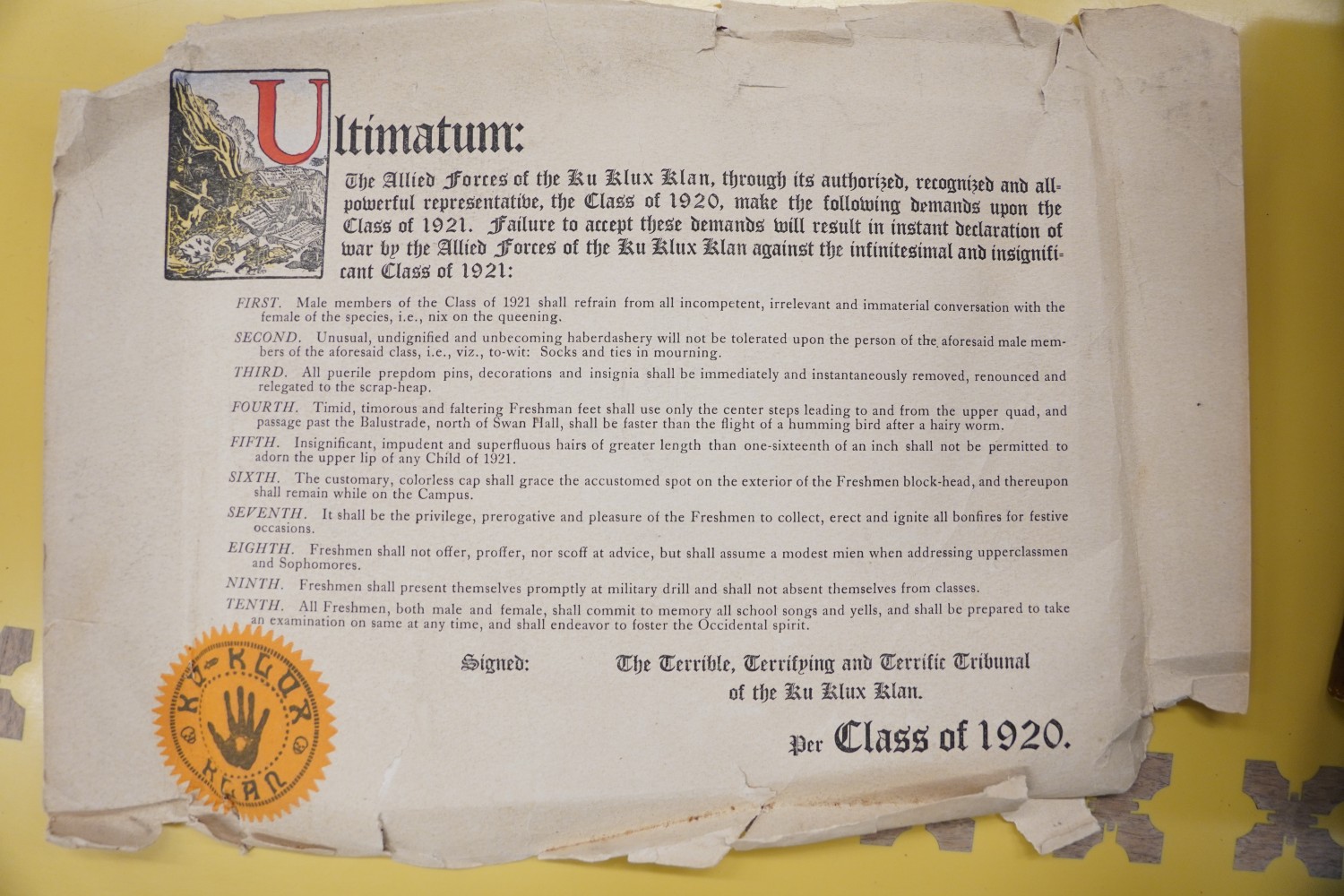
Materials released by the Oxy KKK during the years of their existence point to hazing as the primary function of the body. Flyers released by the organization contain a set of rules for incoming freshmen, the breaking of which would result in public humiliation rituals like spanking or time in a set of wooden stocks set up on what is now the Academic Quad.
Professor Ball said that although the group likely did not view itself as a political organization, its name is still indicative of the racist political environment at Occidental College at this point in history.
“The fact that the head of ASOC was the head of this group as well really demonstrates just how comfortable society was with this romanticization of the antebellum South and all the anti-Black violence which came with that,” Ball said.
Acceptance of the Oxy KKK by the wider Occidental community did not last forever. An article released by The Occidental in 1924 shows the group was forced to change its name that year due to pressure from both parents and members of the college administration, which at the time was headed by President Remsen Bird. According to the article, some parents threatened to withdraw their children from Occidental if the group’s name was not changed.
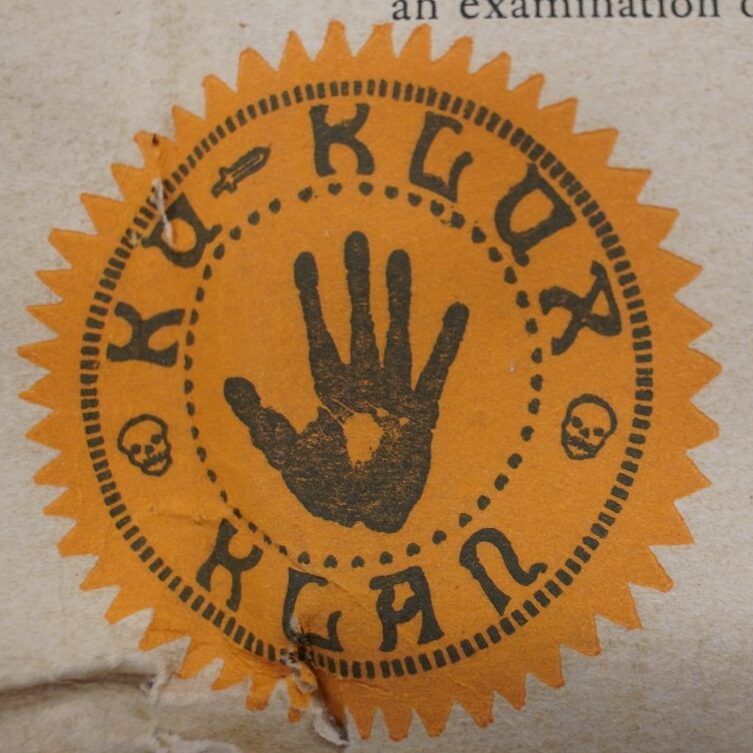
Quan said the group’s eventual name change from “Ku Klux Klan” to the less politically charged “Inquisition” is further evidence in support of the conclusion that the KKK moniker was chosen for its controversial and inflammatory quality, rather than as an explicitly political statement.
“The name change to the ‘Inquisition’ is what leads us to conclude that the naming was really more about the kind of mythos and power that this organization wanted to create around itself than any connection with the national organization,” Quan said.
According to Tranquada, the Oxy KKK’s name change in 1924 should be viewed in the context of wider political developments that were happening as the Klan expanded its influence throughout the United States.
“The Klan did not have a formal presence in LA until March 1921, when Grand Goblin William S. Coburn opened an office in downtown Los Angeles. Coburn went public that May, and by that summer he claimed there were six Klans in LA County: Los Angeles, Hollywood, Glendale, Covina, Venice and Culver City,” Tranquada said via email. “In April of 1922, an Inglewood police officer got in a shootout with a group of Klan members, wounding two and killing one — who turned out to be fellow Inglewood police officers.”
Tranquada said this incident in Inglewood led to a major scandal when the LA County District Attorney’s Office seized a cache of KKK membership records as part of a subsequent criminal investigation.
“KKK membership records embarrassingly showed the extent of Klan membership in law enforcement, local government and elsewhere,” Tranquada said via email. “All the negative publicity no doubt played a role in the controversy that led to the Oxy KKK changing its name.”
According to Professor Ball, another factor that soured opinions on the KKK among the wealthy white demographic dominating Occidental in the 1920’s was an incident in which the Grand Dragon of the Indiana Klan was charged with the kidnapping, rape and murder of a white woman, Madge Oberholtzer.
“This happened right around the time when the national organization was at its peak and had millions of members,” Ball said. “This state leader in Indiana brutally kidnapped, raped and abused a woman, and he was convicted of it. In the process, he and the organization lost credibility.”
Ball said an important source of the Klan’s legitimacy in the eyes of white America was the organization’s supposed defense of traditional moral values around sex and sexuality.
“In interviews with people who joined small town chapters of the Klan, they often say that they did so because the Klan kept people in order, they’d catch you if you were out on a date and so on,” Ball said. “So when this high-ranking leader was convicted of a brutal sexual crime, the organization lost any kind of credibility as a moral arbiter.”
By the late 1920s, any references to the Men’s Tribunal or any other ASOC body in association with the name “Ku Klux Klan” were absent from La Encina. In the 1928 edition of the college yearbook, the Men’s Tribunal is described as an organization of upperclassmen that “functions solely with the intent of acquainting the frosh with the customs and traditions of Occidental.”
Interclass hazing continued for many decades after the Oxy KKK ceased to exist. According to Tranquada, it was not until the 1960s that the practice began to decline in importance for the Occidental community.
“Tradition had a much stronger influence than it does today,” Tranquada said via email. “As each entering class participated in the hazing ritual, it was a self-perpetuating practice that lasted until the 1960s, when college traditions of all kinds fell by the wayside amidst the major cultural shifts taking place at the time.”
Among the cultural shifts that occurred on campus over the course of the 1960s was an increasing demand for greater representation of non-white students at Occidental. According to Tranquada, the small number of Black students who attended Occidental at the time played an important role in pushing for that increased diversity.
“In January 1968, at a forum held in Lower Herrick, Black students openly critiqued Oxy’s lack of diversity,” Tranquada said via email. “That April, the first joint student-faculty meeting on race relations was held, and five college task forces were created, each to deal with a different aspect of racial justice. In May 1968, the Black Student Caucus, unsatisfied with the college’s approach, presented a list of demands, including new academic and support programs for Black students and a greater focus on recruiting a diverse student body. A two-day sit-in at the AGC was held in support of the demands.”
Still, according to Tranquada, the work of transforming Occidental from an almost exclusively white institution — as it was at the time of the Oxy KKK — to a more inclusive and diverse college was a project that took several decades and did not conclude in the 1960s.
“The number of students of color didn’t really begin to change until the latter part of the 1970s and the 1980s,” Tranquada said via email. “As Jesus Salvador Treviño wrote in his 2001 memoir, ‘Eyewitness: A Filmmaker’s Memoir of the Chicano Movement’: ‘At Occidental College I was one of only a handful of Mexican-American students. Of the 400 members of the Oxy Class of ’68, only a half dozen of us were Mexican Americans. … At the end of my freshman year in college, I was very close to dropping out. The alienation I felt from the predominantly white Occidental environment and my profound sense of inferiority about being Mexican had been overwhelming during the fall semester.’”
Vice President of Marketing and Communications Perrine Mann said that today, Occidental College remains committed to maintaining programs focused on diversity, equity and inclusion, despite recent minimization or elimination of these programs at universities across the nation.
“Oxy remains steadfast in our belief that our differences both strengthen our learning environment and prepare our students to have an impact on the challenges that plague our global society,” Mann said over email.
Ball said that from her perspective, the story of the Oxy KKK says less about the institution of Occidental College itself than about the culture of white America as a whole in the 1910s and ’20s. According to Ball, the existence of student clubs emulating the Klan at college campuses around the nation speaks to how normalized and socially acceptable anti-Black violence was in this period.
“By the late nineteenth and early twentieth centuries, the violent history of the Reconstruction-era Ku Klux Klan had been sanitized by popular novels and fantasies for stage and screen,” Ball said. “In this context, the romanticization of the antebellum South and denigration of Black Americans was so pervasive that college students at Oxy and elsewhere around the country easily incorporated the mythology of the Lost Cause into their campus culture. Whether they did so unthinkingly or with malicious intent, this appears to have been a national phenomenon. And this, to me, is a sobering example of the long reach of Jim Crow culture.”
Contact Adam Pildal at pildal@oxy.edu
