






























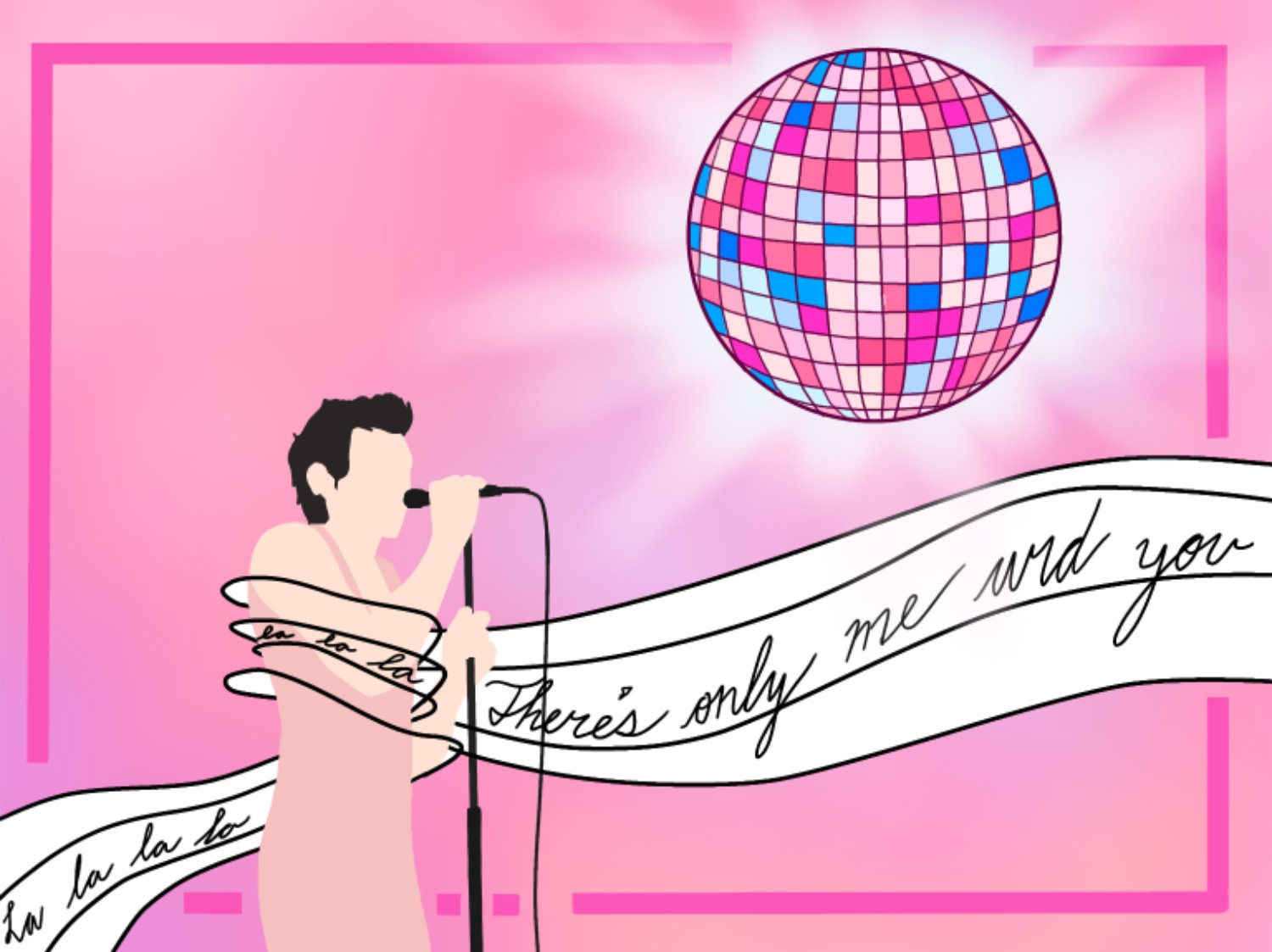
When Harry Styles released his new album, “Kiss All The Time. Disco, Occasionally” Mar. 6, I was so busy writing midterm papers, I couldn’t listen to it properly. To cope with my intense fear of missing out, I decided not to read any reviews or social media headlines until I had time to really soak up the album in full. When I finally did, I was instantly enamored. The songs felt fresh, eclectic and imbued with a sense of reckless joy I felt was noticeably missing from the last album.
When I returned to the flurry of incoming reviews, I was shocked to find that critics did not share my positive sentiments. In fact, “Kiss All The Time” received widespread scrutiny from day one, despite the popular appeal given Styles’ enthusiastic fanbase (myself included). The album has an average rating for production and has received even harsher criticism for its lyrics, which some have deemed “nearly incoherent.”
At first, I felt like my initial excitement about the album was simply a biased response to an artist I’ve loved since middle school. But in every subsequent listen, I’ve realized the album is being criticized for everything I find meaningful about it. Styles engages in a playful refusal of any type of norm, down to the unconventional album title, and opts to write songs that he finds personal catharsis in, rather than catering to expectations or capitalist barometers of success. Given the critical audience response, it is clear we are not ready for an album exercising this level of artistic freedom — and yet, why shouldn’t we be? The discourse, it seems, is getting in the way of our ability to disco.
For once in his career, Styles is trying to shed the image he has cultivated since he was 16, when he skyrocketed into boyband stardom as part of One Direction. Gone are the sequined outfits of his former self, replaced by pastel sweaters and graphic tees. His odd lyrics on this record don’t fit neatly in an Instagram caption, and his music can’t be manipulated into easily digestible sound bytes. I don’t see this transformation as a loss — I am rather intrigued by a mega pop star’s attempts to be ordinary, and in his words, boring.
Personally, I don’t care for internet gossip that tries to decipher who exactly the lyrics are about. Music is not always autobiographical, and Styles seems to use absurdism and paradox to counter the idea that songs must always have an objective, discernible meaning. The existential questions implicit in the album are underscored by a pervasive sense of loss, in which Styles seems to question his own decisions, reassuring his listeners that nothing is stable and that maybe instability is a good thing. These emblematic shifts in genre throughout are united by an analog feel that humanizes the larger-than-life artist, even when he isn’t necessarily confessing his sins (or his love) in the lyrical content.
The lead single, Aperture, is an instant rejection of industry standards. With a runtime of over five minutes and a beat saturated with synths long before lyrics start to kick in, Styles is not interested in radio replayability. The verses remain cryptic while the chorus bursts into celebration, yet an anxiety underlies the ecstasy. Right from the outset, we know this is an album dealing with the harshest of contradictions — the boundless freedom of the dance floor among friends and the walk home alone afterwards in the dead of night — both of which shaped the making of this record.
Even the live performances from this era in Styles’ career are breaking the mold. He returned to the SNL stage as host and musical guest Mar. 14. The second song he performed was the string-accompanied piano ballad “Coming Up Roses,” the only song on the album written solely by him. In the first verse, Styles faltered and lost track of his wording, humming a few notes before smoothly regaining his footing. In a song with the lyrics, “As I fumble my words and fall flat on my face through the truth,” it was a moment so genuine it nearly felt choreographed in advance.
It’s small gestures, even accidental ones like these, that illustrate the central thesis of the album: sometimes a fracture, a breakage and the perspective gained from distance is more intimate than an easily accessible, well-packaged vulnerability. “Kiss All The Time” asks the audience to make our own meaning out of the songs, to find our own rhythm in the cacophony of synths and bass lines. It’s an album that relishes in imperfections and lingers in the uncertainties. It’s a cheeky turn away from paparazzi camera flashes and the intrusion of the spotlight as much as it is a love letter to fans that offers us a glimpse into the man beneath all of the sparkle, albeit not in the ways we expected.
The disco itself is a kind of metaphor: don’t go looking for one singular message, because the album is a refraction of everything that has preceded it, as well as a projection of who we may become when we truly let ourselves go under the glimmers of light on the dance floor. Harry Styles is letting the light in, but he’s also spreading it out further and wider than he ever has before. It’s time we look up, beyond the review headlines, to see it for ourselves. It’s all waiting there for us.
Contact Athya Paramesh at paramesh@oxy.edu
