































The war in Iran began Feb. 28 after the United States and Israel bombed Iran, killing their supreme leader Ali Khamenei and continuing an ongoing military assault by the U.S. in the Middle East.
Most recently, U.S. warplanes and attack helicopters have been attacking Iranian drones and naval vessels in an attempt to reopen the Strait of Hormuz as the war approaches the three-week mark.
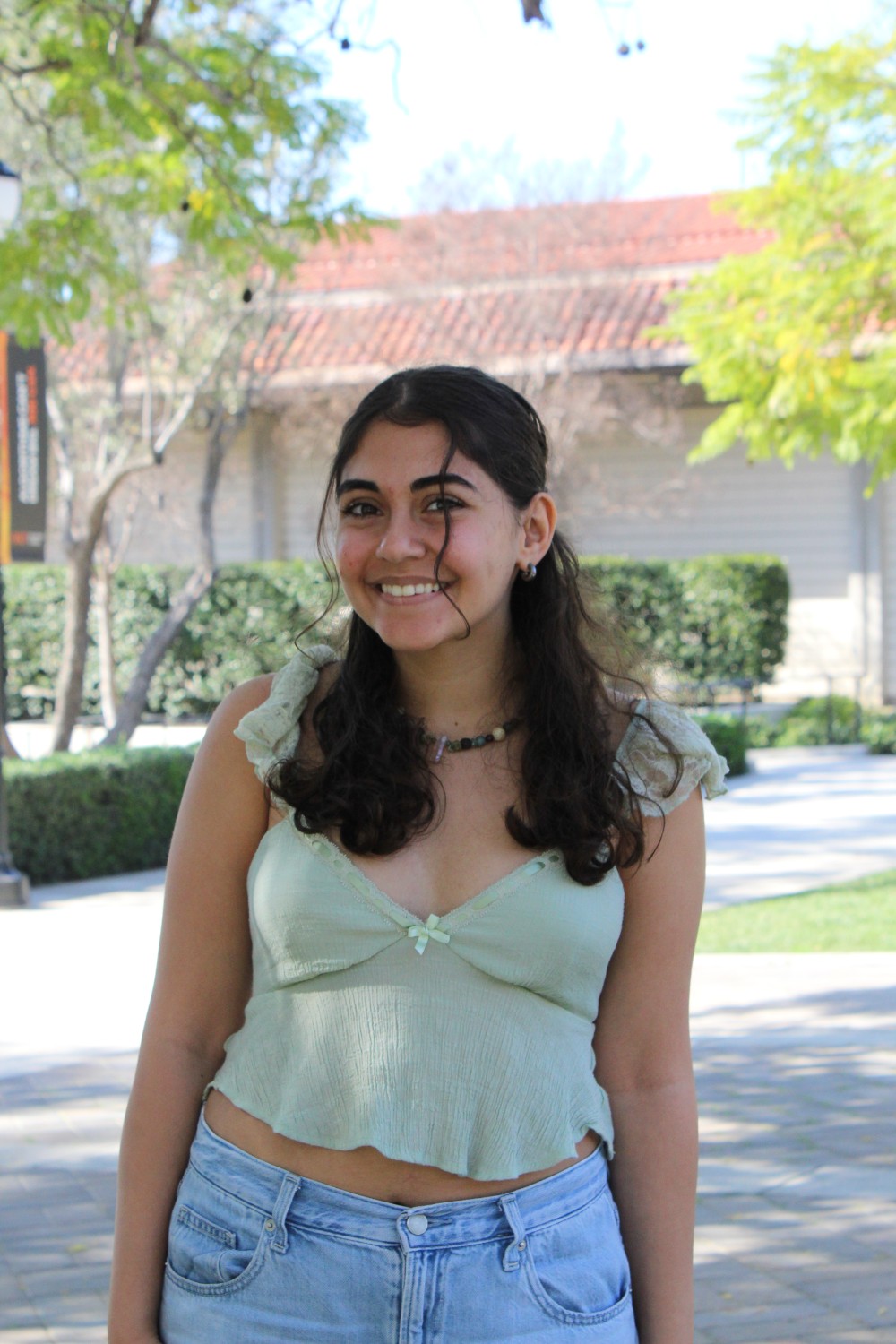
Sara Tina Kazemi (senior)
Kazemi said although she was born in the U.S., both her parents emigrated from Iran during the Iran-Iraq War. Kazemi said her father and mother came to the U.S. for a postsecondary education.
“After he left Iran, my father lived in Turkey, Austria and modern-day Serbia back when it was Yugoslavia,” Kazemi said. “Everywhere else he lived did not seem as promising as the U.S. [for postsecondary education].”
Kazemi said her first language is Persian and that she went to Persian school growing up. Kazemi said she has visited Iran a handful of times, although she has never spent longer than a month there.
“[Iran] is so many things to me,” Kazemi said. “Obviously it is my family connection, but it is also going to the market with my grandma and […] getting bread with her. It is finding out that I really like mountains and gardens when I was 9. [It is] my love of history, [which was] sparked by going to museums in Iran.”
Kazemi said she currently has family in Iran, but it is difficult to stay in contact with them because the regime has been cutting phone lines.
“Iranians right now constantly feel surveilled,” Kazemi said. “They can’t speak to their family outside of Iran. All we’re getting is from all these different news outlets.”
Kazemi said although she acknowledges the Iranian regime has violated queer and women’s rights, she does not think the U.S. and Israel are justified in bombing Iran and manufacturing consent from their respective populaces.
“I’m sick of all these propaganda campaigns,” Kazemi said. “People are justifying bombing Iran in the name of [queer] rights and women’s rights. Where were you a few months ago, or a couple years ago when every major protest movement [happened] in Iran? I’m sick of the people that are just speaking up now about Iranian suffering.”
Kazemi said she led a teach-in at Occidental about the U.S. and Israel’s war on Iran with another Iranian student March 5.
“Many of the Iranians at Oxy came, showed up and showed out,” Kamezi said. “It was so beautiful […] there’s a sense of unity, even. It takes a second to recognize, but it’s [there].”
Sophia Hoo (sophomore)
Hoo said her grandfather is from Iran and moved to the U.S. when he was 15. Hoo said she mainly connects with Iranian culture through food.
“My grandma can make really good Persian food, even though she’s Chinese, because my grandfather’s mother [taught her],” Hoo said.
Hoo said that while her grandfather moved to the U.S. at a young age, he has family currently living in Iran.
“My grandfather’s siblings [are] in hiding [in Iran],” Hoo said. “It is pretty scary to have people over there that you can’t really do anything about.”
Hoo said it is hard to embrace U.S. nationality right now because of the choices the administration is making, but that she does not agree with the Iranian regime either.
“The U.S. is being unnecessarily greedy, and none of it makes any sense,” Hoo said. “It’s too much chaos […] civilians just want peace. Nobody really wants this meaningless war.”
Hoo said the war in Iran has created a feeling of sorrow among Iranian students at Occidental, although they still frequently interact with Iranian culture.
“I don’t think it has affected the way we participate with the culture,” Hoo said. “But it has brought a sadness that [did not] exist last year […] As we talk about our families […] there’s a need to facilitate emotional check-ins.”
Alireza Tofangdar (first year)
Tofangdar said he moved from Iran to the U.S. when he was 8, but that most of his family members still reside in Iran. Tofangdar said his father served in the Iranian Revolutionary Guard for five years.
“His experience was terrible, so much so that he told me, ‘If you join any military you’re not going to have a good time — you’re going to change,'” Tofangdar said. “[My father] does not like military conflict. He experienced it firsthand in the Iran-Iraq War.”
Tofangdar said his family moved to the U.S. for better educational and financial opportunities, but also because of the Iranian regime.
“We don’t call ourselves refugees, because we’re not,” Tofangdar said. “People had it way worse than us. We just got lucky to be sponsored by a family member here […] but we did technically escape.”
Tofangdar said as a child in Iran, he was not wealthy and moved three times in the span of five years.
“We had no opportunities in Iran,” Tofangdar said. “My father didn’t have a stable job. My mom didn’t work at all. We were practically living off of my dead grandpa’s support. We didn’t have food […] water was just tap water […] Life was hard in Iran, and education was terrible.”
Tofangdar said upon moving to the U.S., he lost admiration for items and experiences he once saw as extravagant, like watching cable television.
“[In Iran], a lot of mundane things became cool to me,” Tofangdar said. “Once I went to the U.S., all those things became normal and they were no longer a luxury. I got accustomed to everything that used to be a privilege.”
Tofangdar said he and his family feel they have no right to comment on how Iranians feel about the war because they are safe in the U.S.
“Nothing’s ever gonna happen to us, regardless of what Iran says about what their weapons are capable of,” Tofangdar said. “No, they’re not gonna reach the U.S. We’re safe. [I’m more] worried about the people of Iran and [my] family members. [The regime] cares so much about winning that they would much rather see their own people die than lose […] They’ll take everyone down with them.”
Tofangdar said he thinks the U.S. and Israel do not know what they are doing, and that installing an Iranian leader of their own accord is a bad idea.
“Iranian people are not stupid,” Tofangdar said. “These are some of the smartest people in the world […] They know what they want, and they’re very passionate. They are more than capable of installing their own leader.”
According to the Occidental Mission Statement, the college aims to support international and multinational students by promoting diverse backgrounds, interests and ideas. Tofangdar said he feels welcome as an Iranian student at Occidental.
“It’s a blessing to be at a school like this,” Tofangdar said. “I’m sitting here in cowboy boots and boot-cut jeans. If I showed up in this outfit in Iran […] they would call me [names].
Tofangdar said the war in Iran is an internal battle, and that the U.S. and Israel are hypocritical for trying to install a democratic government in another nation.
“This is the Iranian government against [its] people,” Tofangdar said. “The most ‘liberal [countries] in the world’ want to come in and take over. What about that is liberal? What about that is free?”
Tofangdar said Occidental students should know Iran does not need help, and that Iranians were successful in protesting the regime through their own resistance efforts.
“You [need to] understand that instead of saying, ‘Help Iran’ [or] ‘Free Iran,’ the correct [saying] is ‘Leave Iran alone,’” Tofangdar said.
Contact Josey Long at jlong2@oxy.edu
