































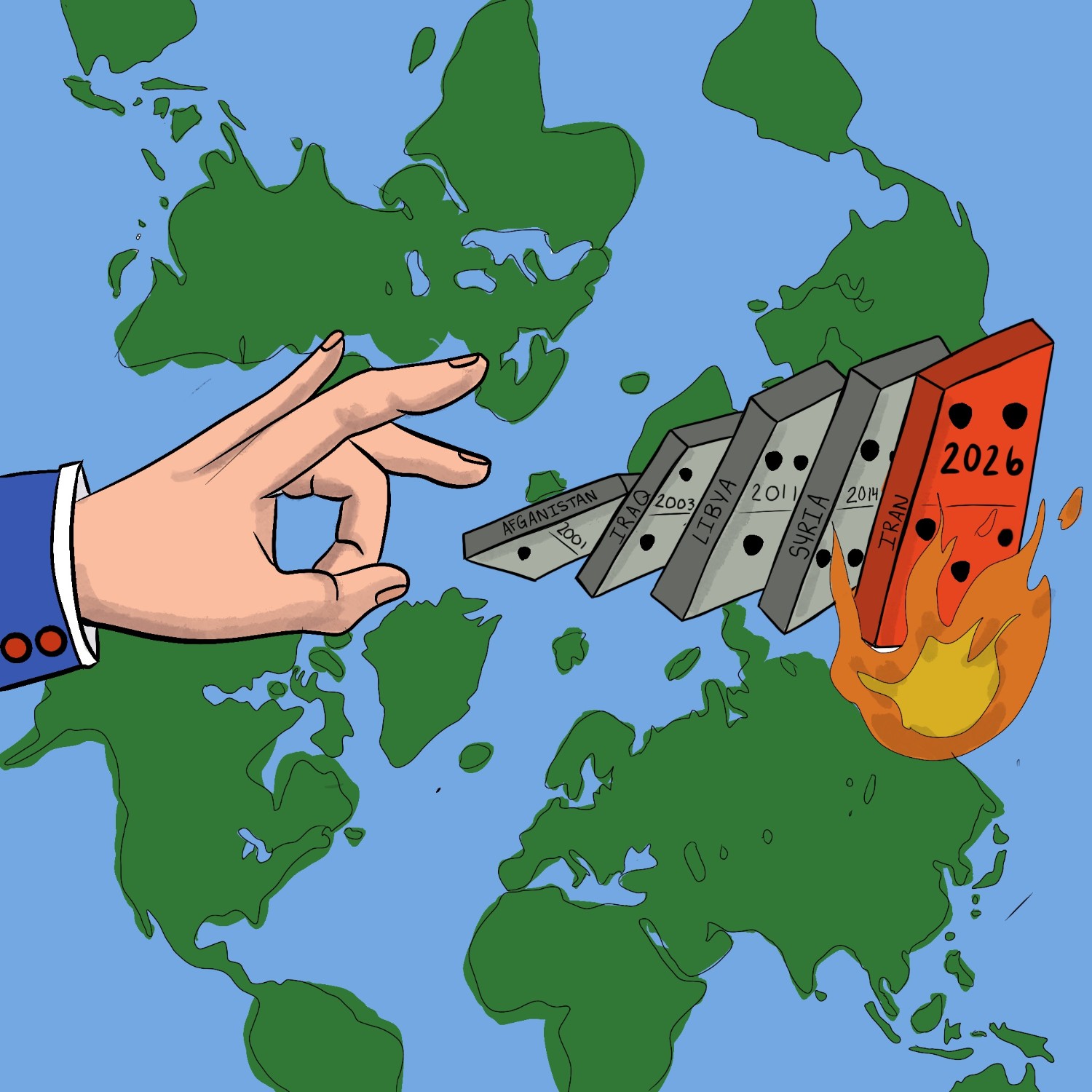
Since Feb. 28, it increasingly appears the President of the U.S. has started a pointless conflict he has no idea how to get out of.
The apparent successes achieved by the U.S. and Israel in this war against Iran so far — the assassination of the Ayatollah, the decimation of the Iranian leadership and the major destruction of infrastructure — are all rendered rather hollow given that they appear disconnected from any sense of strategy. Iran continues all it needs to do to cause maximal damage to the global economy: its blockade of the Strait of Hormuz and its attacks on oil and gas infrastructure in the Gulf in response.
Who can even confidently name the stated goals of this conflict when the responses have so often been vague and contradictory? Was the goal, from an administration high on capturing Maduro, a change of government in Iran? The protests of January have already been ruthlessly and brutally crushed, and the opposition shows no signs of revival even as the conflict progresses — many seemingly focused on survival rather than on change.
Ali Khamenei’s assassination has only led to his replacement by his perhaps more hardliner son. Besides offhanded considerations of arming Kurdish insurgencies or somehow facilitating the return of the former Shah, the main thrust of Donald Trump’s push for regime change seems to have been merely calling on Iranians to “take over their government,” with no explanation of how or why they should do so, which appears to have had the expected results.
So, is the objective the complete nuclear disarmament of Iran, a dream of finishing the job that was started in the Twelve-Day War? Despite their setbacks, Iran’s refined material remains in Isfahan and other sites, and the country will continue to have the capacity to construct one. If they weren’t building a nuclear bomb before, the current regime has certainly been incentivized to attain deterrence against future attacks. The Trump administration, having moved past demanding Iran give up nuclear enrichment, now weighs the possibility of a ground operation to recover the uranium there. It is an operation that innately holds an extreme degree of risk, and even if successful, would likely not eliminate the entirety of Iran’s supply. The U.S. and Israel appear to have hit a wall: even with all their vague aims that may be surmounted through escalation of force, they appear reluctant to cross it.
Meanwhile, the Iranian regime, in contrast to previous conflicts, clearly considers this an existential crisis. Their aim in this war is very clear: stay standing. As long as the regime makes it out the other side of this ordeal intact, they may claim they absorbed the blows and forced the other side to back down. In lieu of the capacity for direct retaliation, their strategy is to maximize the global economic pain this war will cause by leveraging their geographic position.
So far, the strategy, as desperate as it might be, appears to be effective. Oil and gas prices continue to rise as the conflict progresses and fears of a true energy crisis abound. Of course, few know what is truly going on within their government, but at the moment, Iran seems to show no indication of backing down in spite of the extensive damage done.
President Trump appears dismayed that the war has not ended already. In fact, some reports say that he seemed to believe he could facilitate the fall of the regime even before they could close the strait. He thus resorted to what appear as desperate measures, including removing sanctions on Russian oil even as the war in Ukraine continues. He has begun to demand that allies initially uninvolved in any kind of planning for the conflict join the U.S. in efforts to open the Strait.
One could argue, notwithstanding a miracle such as a coup by moderate Iranian officials, that there are two routes President Trump may take to resolve his current predicament. He may take what now looks to be the least poor option to exit the situation, and do what he has done over the last year with his bungled trade wars and previous foreign strikes: boldly declare victory to the press, claim that American objectives have been accomplished and then plead with Oman to get Iran back to the table — all while pressing Prime Minister Netanyahu for an end to Israel’s own strikes.
Otherwise, he may double down and lengthen the conflict. He may deploy boots on the ground to Kharg Island to seize the centre of Iran’s oil infrastructure, and at Isfahan to seize the uranium stored there, and further operations hoping to salvage the situation through escalation. He may take the risk of Iran retaliating by calling on the Houthis to block traffic through the Red Sea, or by striking more energy infrastructure, or by cyber-/terrorist attacks not yet seen. When the Pentagon, under Secretary Hegseth, appears ready to request $200 billion from Congress to fund this war, one cannot help but wonder whether the administration is leaning toward this outcome. It would leave every party involved much worse off, but has the current President ever cared about that?
Contact Ryan Kim at rkim3@oxy.edu
