































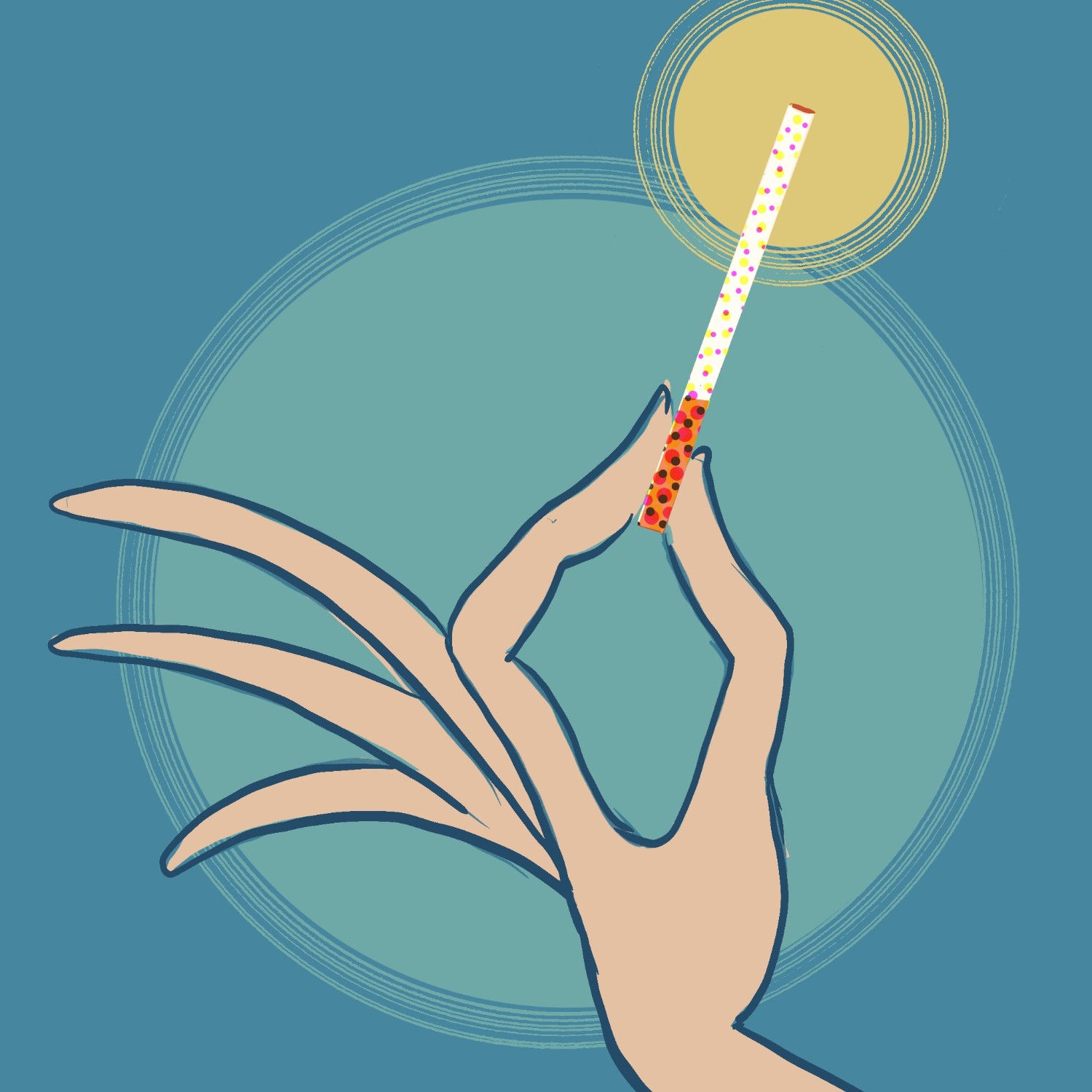
When I first arrived at Occidental, I didn’t notice the trees or the architecture. I noticed the cigarette butts — pressed into the pavement around the quad, scattered along staircases and collecting near doorways. They were everywhere, small and easy to overlook, but once I saw them, I couldn’t unsee them.
I grew up in the Bay Area, where smoking in public feels almost taboo. Not illegal, exactly, but socially out of place. So when I saw someone light a cigarette on campus, it didn’t feel routine. It felt deliberate. Less like a habit than a decision, something chosen and performed rather than absentmindedly done.
At first, it seemed easy to explain. Gen Z came of age in a culture obsessed with optimization: wellness routines, curated diets, the “clean girl” aesthetic and the constant pressure to refine and improve the self. Against that backdrop, the cigarette reads as a kind of refusal. A rejection of discipline. A visible indifference to the demand to be perfect.
But the more I paid attention, the less it felt like a rejection at all.
The same logic that turns green juice, intermittent fasting and sculpted abs into markers of discipline also shapes how the cigarette is read. It still revolves around control — control over consumption, the body and how one sees that body. Even what looks like carelessness begins to feel intentional, part of a larger aesthetic of restraint. Thinness, minimalism and even carefully constructed messiness all seem to speak the same language: your body is a project, and your choices should say something about you.
Sociologist Pierre Bourdieu describes taste in similar terms, not as pure personal preference but as a way of signaling identity and distinction. What we consume, and just as importantly, what we refuse, becomes a way of communicating who we are. Seen this way, a cigarette starts to function less as an act and more as a symbol — another choice that can be read, interpreted and understood.
That logic shows up beyond campus. Cigarettes have reappeared not just in practice, but in images. On runways, in beauty campaigns and across TikTok and Instagram, where influencers hold cigarettes as casually as they hold their iced matcha. Products like Lip Ciggies lipstick and cigarette-shaped makeup packaging have gone viral. Valentino Beauty has staged Studio 54–themed events with candy cigarettes as props. Even as smoking rates remain relatively low, the image persists.
It is tempting to read this as rebellion.
But it doesn’t quite hold.
We’ve seen this before. In 1968, Philip Morris launched Virginia Slims cigarettes, marketing them directly to women with slim silhouettes, glamorous imagery and the slogan “You’ve come a long way, baby.” Earlier campaigns, like Lucky Strike, were even more explicit, urging women to “reach for a Lucky instead” rather than eat. What looked like autonomy was often a repackaging of restraint: a way of aligning consumption with thinness and control.
Something similar is happening now, though the language has shifted. Today, discipline is framed as wellness, control as self-care and identity as something to be carefully constructed and displayed. Within that framework, the cigarette doesn’t disrupt the system so much as fit neatly inside it. It appears disordered while remaining legible as a style.
On a campus like Occidental, that dynamic becomes easier to see. Liberal arts spaces often pride themselves on cultivating individuality and critique. But when everyone is already trying to resist dominant norms, that resistance can start to look the same. It becomes something to perform, not just something to believe.
The idea of rebellion begins to feel less stable.
Much of contemporary culture places the burden of resistance on the individual — on personal choices, habits and aesthetics. But when resistance takes that form, it often remains contained within the very systems it is meant to challenge. It becomes visible, even expressive, without necessarily changing anything.
This is where Frantz Fanon offers a useful distinction. For Fanon, resistance is not just about opposing power on its surface, but about refusing to understand oneself through the terms that power imposes. It requires a deeper shift, a reorientation of how subjectivity itself is formed.
By that standard, the cigarette feels limited. It may signal disaffection, but it does not escape the framework that gives it meaning. It does not change the conditions it responds to, nor does it fundamentally alter how the self is constructed within them.
What looks like rebellion begins to resemble something else. Systems of power do not only suppress resistance; they can also absorb it, redirecting it into forms that are visible but ultimately harmless. The gesture remains, but its impact is contained.
Still, the appeal is understandable.
Wellness culture can feel suffocating. When the body becomes a project and habits become a measure of worth, even small acts of refusal can feel meaningful. A cigarette offers something immediate and finite, a break from the endless cycle of optimization. In a world shaped by algorithms and delayed gratification, that kind of immediacy can feel grounding.
But even that relief is not outside the system. Like hyper-curated wellness routines or the rise of GLP-1 weight-loss drugs, it exists within the same logic of visibility and control. It allows for a moment of deviation without challenging the structure itself.
The cigarette butts scattered across campus do not suggest an indifferent generation. If anything, they point to the opposite: a generation deeply aware of how it is seen, even in its attempts to appear not to care.
That is what makes this moment feel significant.
Not because smoking is fully back, but because harm has been reinterpreted as choice, and individuality has become a way of performing resistance rather than enacting it.
The cigarette, in this sense, becomes less a symbol of rebellion and more a symbol of something else entirely: a culture where even refusal can be absorbed, styled and made legible.
Contact Samhita Krishnan at krishnan@oxy.edu
