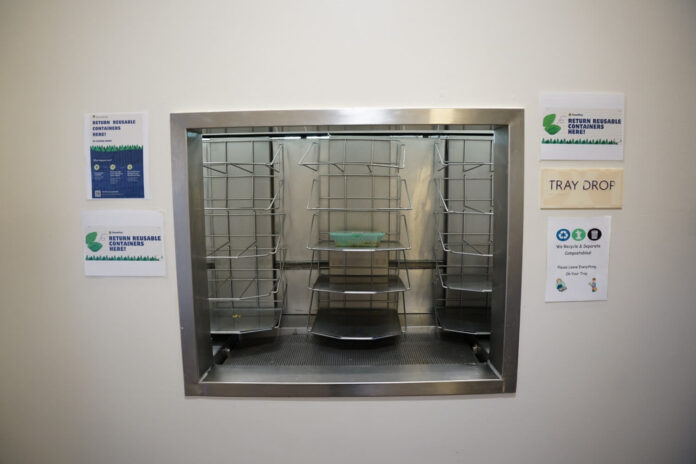
Sustainability Fund (Sus Fund) Student Body Officer Aiden Thatcher (sophomore) said sustainability is a core value at Occidental that is highlighted through its eco-clamshell program. An eco-clamshell is a reusable container that utilizes technology to keep people accountable for the containers, according to the company Occidental has partnered with, Topanga.
“The whole goal [of the eco clamshell program] is to reduce the waste, and students are a big part of that,” Thatcher said.
Associate Director of Campus Dining Robert Starec said the use of these eco-clamshells helps eliminate single-use plastics. According to statistics from Topanga, 111,192 single-use containers were avoided over 2.5 years at Occidental so far.
“We average anywhere from 300 to 400 checkouts per day, and our overall return rate over the 2.5 years since starting the program is 98%,” Starec said. “However, we have seen a decline in that number in recent months […] We’re losing 200 to 250 containers a month due to unreturned containers.”
In order to increase returns, Starec said an $8 fee is added to students’ accounts when eco-clamshells go unreturned and that the fee goes toward replacing them.
“You’re expected to return it within three days,” Starec said. “If, after three days you have not returned it, the Topanga automated system will send you a message to let you know the container is now late.”
According to Starec, after 10 days, the container will officially be considered late. This was increased from 6 days, Starec said, to accommodate eco-clamshell users who are only on campus certain days of the week to give more return opportunities.
“Sometimes people do question why they are being charged a late fee when they returned the container,” Starec said. “But in the majority of cases it isn’t actually a charge, but a part of [Topanga’s] automating messaging system to return it or else there will be a late fee.”
After two weeks, Starec said Topanga provides a charge report, seeing how many eco-clamshells were not returned. According to Starec, by implementing this fee into students’ accounts, there is a hope that there will be a more concerted effort to return these containers.
Thatcher said he feels as though there is a fundamental issue with this fee — students might not know they are being charged at all.
“I pay my own student account bills,” Thatcher said. “I feel like a lot of students don’t, so they don’t necessarily see that their account is getting dinged.”

Starec said it is important to educate students about the program and will continue to be moving forward.
According to Professor of Economics and Sus Fund Faculty Advisor Professor Bevin Ashenmiller, a version of the program has been around since 2013, and she attributes the creation of the program to Emma Sorrell ’13, Occidental’s first sustainability coordinator.
Starec said the original program had tokens, which would be traded in for an eco-clamshell.
“One of the challenges with the token system is accountability. So people would take containers but wouldn’t return them,” Starec said. “So we felt that it was important to have a program that had an element of accountability to ensure that the containers always remain available for reuse, which is the sole intention of the program.”
Starec said Occidental then decided to partner with Topanga Aug. 2023.
Starec said he has been at Oxy for 32 years and sustainability has always been important for their community and students. Starec said he feels it is a responsibility for Campus Dining to be sustainable.
“It may require modifying the current program or […] meeting with similar programs to see if there are opportunities where we can improve upon what we are doing,” Starec said.
To find a solution for lost eco-clamshells, Thatcher said he thinks there should be more clearly visible drop-off locations, such as at the library or at the marketplace patio. A culture change is also necessary, Thatcher said, to instill the habit of returning clamshells in users’ routines.
“Clamshells are a privilege, not a right,” Thatcher said.
Contact Emma Williams at ewilliams4@oxy.edu