

























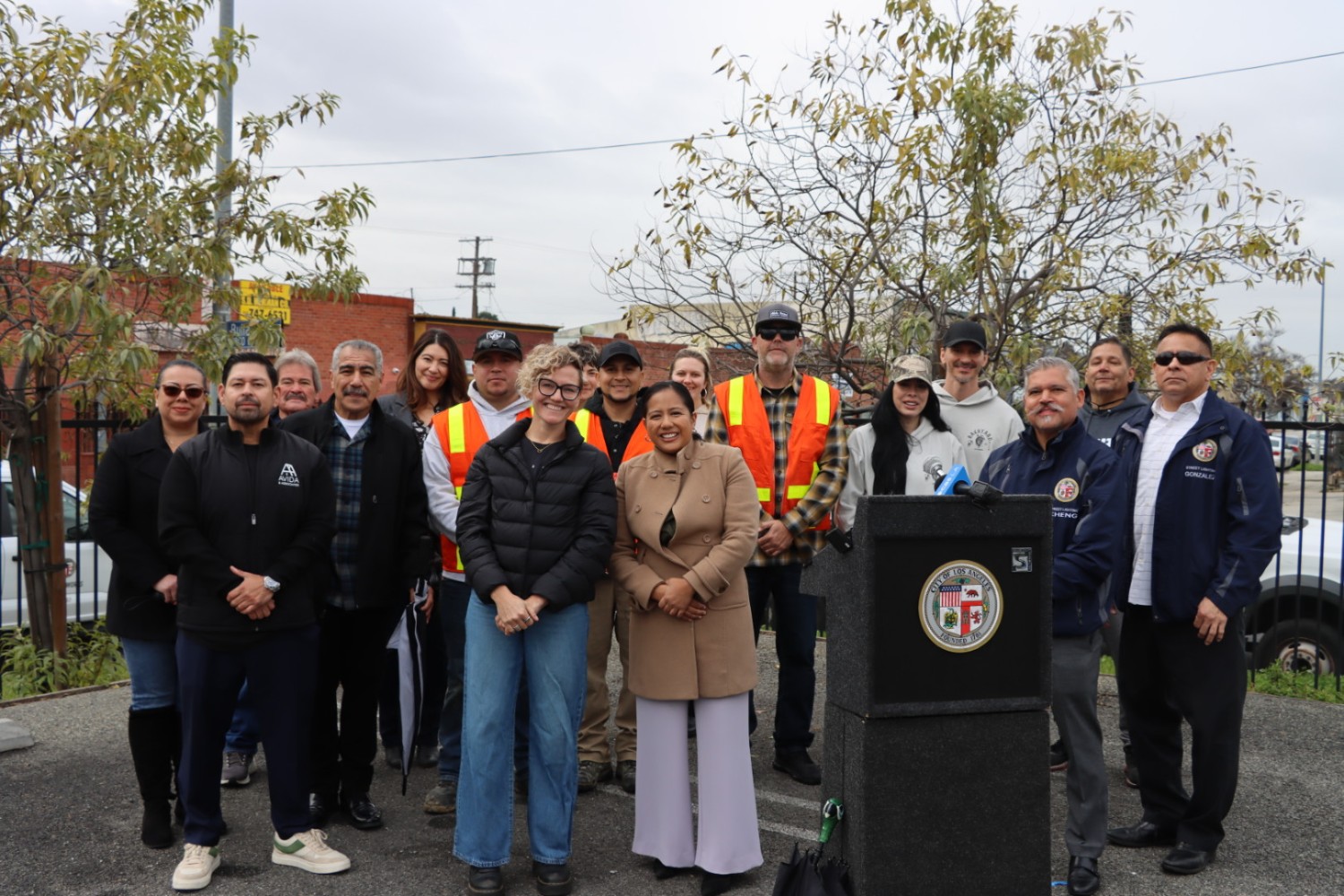
Councilmember Ysabel Jurado made streetlight repair one of her first priorities after taking office, seeing reliable lighting as a basic public safety issue for Council District 14 (CD14). Since November 2025, more than 400 streetlights across CD14 have been repaired, the result of $1.07 million in discretionary spending by Jurado’s office.
In Boyle Heights alone, more than 1,900 lights were reported as out last year, and Jurado said her office has brought that number down by nearly 500.
“The fact that we’re nearing the 500 mark is pretty remarkable,” Jurado said in an interview with The Occidental. “We’re trying to figure out how we can continue to keep attacking that goal.”
Mason Santa Maria, communications deputy for CD14, said the initiative reflects Jurado’s belief that darkness has real consequences for residents.
“She knows that when the streets are dark, people feel less safe,” Santa Maria said. “Kids walking home, seniors, workers, small businesses, they’re all affected by that.”
The initiative, run through a dedicated repair crew deployed across CD14, targets neighborhoods that Jurado’s office says have faced decades of city neglect. The Bureau of Street Lighting (BSL) receives less than 1 percent of the city’s budget, according to Santa Maria, leaving individual council offices to fill the gap or leave residents in the dark.
“BSL gets this tiny portion of the city budget that really doesn’t fit the needs of Angelenos,” Santa Maria said. “[To] get to the level that Angelenos deserve, you really need a team focused specifically on CD14.”
Darren Gold, president of the Historic Highland Park Neighborhood Council (HHPNC), said he has seen the effort’s results firsthand in Highland Park.
“There were blocks, full blocks that had no lights on them, and they’ve been repaired,” Gold said. “It feels like you can walk in certain places at night that maybe you wouldn’t have before.”
Gold said the HHPNC had been pushing for streetlight improvements for years before the initiative launched, sending letters to both CD14 and CD1 requesting that lighting be made a higher priority. Gold said constituent complaints about city services reflect a structural problem that extends beyond any single council office.
“While the council office is responsible for prioritizing and helping make those things happen, it’s a much bigger issue with the city budget and resources,” Gold said. “They don’t always have control over the city departments that actually are going to be doing the work, which is why council member Jurado took money out of her discretionary fund to have a crew she could control and direct.”
According to Santa Maria, property owners in the district currently pay a lighting fee of around $53 per year that has not increased in roughly 30 years. Santa Maria said Jurado’s office is supporting a ballot measure this summer that would raise the fee and expand BSL’s capacity citywide.
“[The fee] really hasn’t kept up with inflation, and it doesn’t fit the needs of what BSL needs to maintain and operate the system,” Santa Maria said.
Jurado said the stakes are significant if the measure fails, and the structural problem goes beyond streetlights.
“If [the budget increase] doesn’t pass, that means we are going to have to try to fight for the department to have more than less than 1 percent allocated to it, or continue to use discretionary funding to pay for the lighting,” Jurado said. “We are trying to refocus our budget to prevention and maintenance.”

Mayor Karen Bass announced Executive Directive 18, a new initiative that aims to repair and modernize street lights in LA, March 25. According to the Executive Directive 18 press release, BLS and the LA Dept. of Water and Power will join forces to install up to 60,000 street lights over the next two years — and cut down on the city’s backlog of 32,000 street light service requests.
Santa Maria said seven miles of wire were stolen from the Sixth Street Bridge, netting thieves roughly $11,000 while costing millions to repair and compounding the backlog. Jurado’s office has supported AB 476, a state assembly bill authored by Assemblymember Gonzalez that tightens oversight of scrap metal sales, with the goal of deterrence rather than prosecution, according to Santa Maria.
“It’s making it not viable to steal in the first place and being more proactive about prevention,” Santa Maria said. “We’ve had this very long underinvestment into our lighting infrastructure. It just made it not a modernized solution to protect against things like copper wire theft.”
Gold said the HHPNC has also pushed for solar streetlights as a longer-term fix, arguing that reducing dependence on copper wire would cut down on theft-related outages.
Gold and Evan Lieber (senior), an Eagle Rock Neighborhood Council (ERNC) member, both said sidewalks are the district’s next urgent infrastructure need. Lieber said the issue is especially serious for disabled residents.
“The unevenness of the sidewalks makes it hard, especially for disabled people, to get around,” Lieber said. “I’d say that’s probably the biggest issue.”
Jurado said her office is already looking ahead to improve the quality of sidewalks.
“We are looking into different sources of funding to launch a sidewalk strike team,” Jurado said. “I know it is of a particular concern for the city regarding ADA accessibility.”
Lieber said awareness of the streetlight initiative remains low among Occidental students, many of whom do not know that a repair program exists or how to engage with it, and encouraged residents to call 311 to report outages.
“Most people aren’t aware of this program, but it’s important,” Lieber said. “If they see a street light out, they should report it, and then it will hopefully get fixed.”
Gold said Northeast LA (NELA) has consistently been last to receive the infrastructure improvements that other parts of the city take for granted, and that the city needs a long-term capital plan.
“There’s a lot of making up to do in Northeast LA for many years of it not happening,” Gold said. “I think it’s really important that we’re looking at this right now.”
In a year marked by the Eaton Fire, a billion-dollar budget deficit and ICE raids that she said devastated local economies, Jurado said the initiative she wishes had moved faster is a district mural program, which she connected to the same public safety goals driving the streetlight repairs.
“Murals are another way that we keep our community safe,” Jurado said. “We keep the community clean and we keep it beautiful, which is very important for all of our constituents who deserve an attractive neighborhood.”
Jurado said her office is now moving toward formalizing the program, though no timeline has been announced.
“For the mural program, we’re inching towards a formalization, but we sent a letter of support for the murals on Fourth Street,” Jurado said. “A comprehensive program will follow.”
Lieber said the broader lesson of the initiative is simpler than the budget fights surrounding it.
“I think it is an important issue that maybe doesn’t get the light it deserves,” Lieber said.
Jurado said the gaps her office inherited were years in the making, and that her constituent’s complaints about the pace of city services are fair.
“It didn’t start with me, and it definitely started before me,” Jurado said. “There was a long history of disinvestment by the city.”
Contact Samhita Krishnan at krishnan@oxy.edu
